 Lynden Exterior
 Why Maple Falls Is a Harder Climate on Siding Than Most Homeowners Realize
Maple Falls sits up in the forested foothills that feed into the rest of Whatcom County, and that setting cuts both ways. The tree cover is part of what makes the area beautiful, but it also means homes here get less direct sun, more standing shade, and a longer stretch of damp weather than houses closer to open ground. Add in the marine-influenced air that moves through the valleys off the Salish Sea, and you get a climate that keeps siding wet longer than the label on most building products assumes.
Driving rain is the other half of the equation. Storms coming off the water don't just fall straight down here — wind pushes rain sideways into wall assemblies, working it into seams, corners, and butt joints that a fair-weather install might get away with ignoring. Over years, that combination of shade, moisture, and wind-driven rain is what separates siding that holds up for decades from siding that starts failing at year twelve.
Moss Season Runs Longer Than You'd Expect
In a shaded, damp property, moss and algae don't just show up in the fall and disappear by summer — they can hang on for most of the year on north-facing walls and anywhere siding stays wet under tree canopy. Moss itself doesn't destroy every siding material the same way. It holds moisture against the wall longer than bare siding would sit, and on materials that swell, delaminate, or absorb water at the edges, that constant dampness is what starts the clock on real damage.
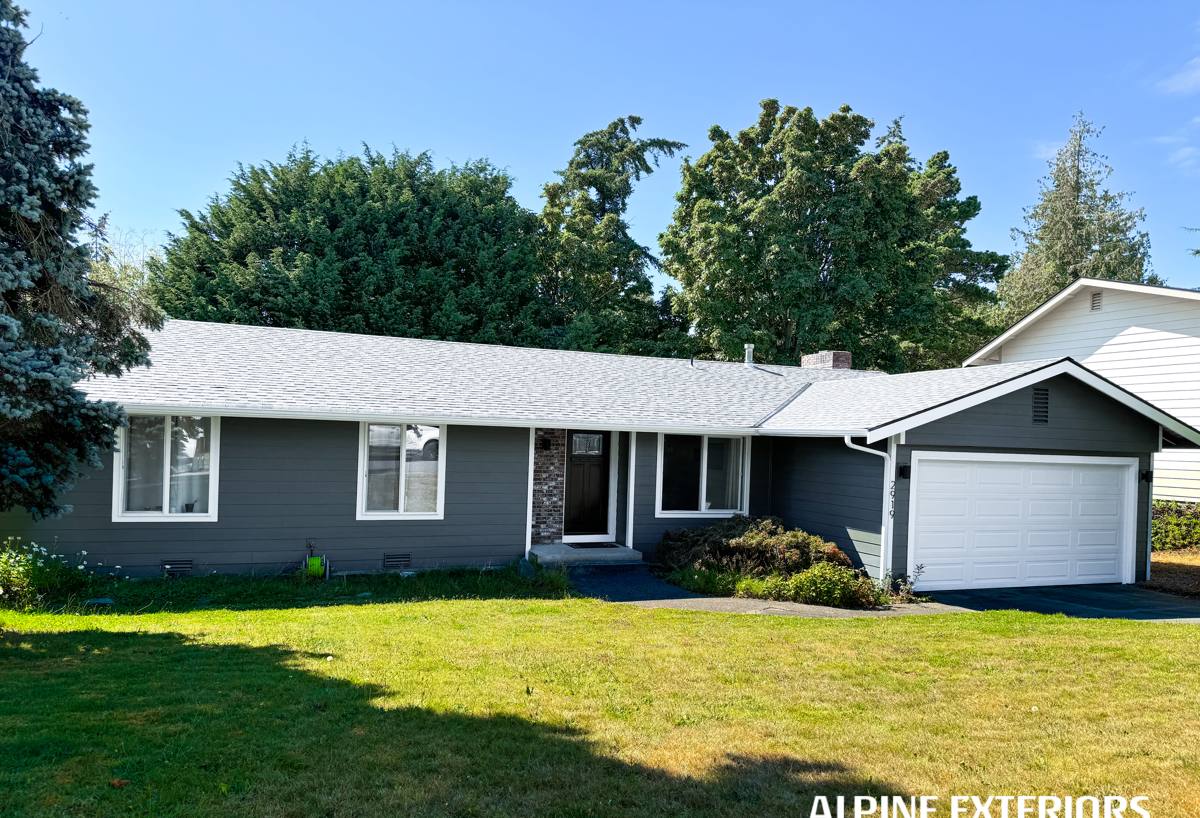
Signs Your Siding Has Reached the End of Its Useful Life
Most homeowners don't replace siding because they woke up one day and decided to — they replace it because a specific problem got hard to ignore. In a climate like this one, watch for:
- Soft or spongy spots when you press on the wall, especially near the bottom courses and around window and door trim
- Paint that keeps failing within a couple of years no matter how well it was applied
- Visible swelling, bubbling, or delamination at panel edges and seams
- Persistent moss, algae, or black streaking that comes back within months of cleaning
- Gaps opening up at corners, trim, or butt joints where caulk has cracked or pulled away
- A musty smell or visible staining on interior walls that share an exterior wall with problem siding
- Warping or bowing panels, particularly on shaded, north- or west-facing elevations
Any one of these on its own might be a repair. Several of them together, especially on a home more than 15-20 years old, usually means the siding system itself — not just the paint — is done.
Why We Only Install James Hardie Fiber Cement in This Climate
We get asked why we don't offer vinyl, LP SmartSide, or the cheaper fiber cement alternatives. The honest answer is that we've made a professional call, based on what this climate does to a wall over 20-plus years, and we don't think it's fair to install something on a Maple Falls home that we know is going to struggle here.
Vinyl is inexpensive and easy to install, but it's a thin plastic product that expands and contracts with temperature swings, can crack in cold snaps, and was never engineered to stand up to the kind of wind-driven rain this area sees — water gets behind it more easily than most homeowners expect. Engineered wood products like LP SmartSide perform reasonably well when the details are perfect, but they're wood-based, and wood-based siding is more sensitive to sustained moisture exposure than fiber cement — which matters a great deal in a location where walls can stay damp for days at a stretch under tree cover.
James Hardie fiber cement is non-combustible, doesn't support rot the way wood-based products can, and holds its shape and paint line in freeze-thaw and constant-damp conditions far better than vinyl or engineered wood. Hardie also builds its HZ5 product line specifically engineered for climate zones like ours, with moisture and freeze-thaw performance tuned for the Pacific Northwest rather than a one-size-fits-all national spec. The factory-applied ColorPlus finish resists fading and doesn't rely on a field-applied paint job holding up against years of rain and shade — which, in a moss-prone area, is one less maintenance headache for the homeowner. It's not the cheapest material on the market, but it's the one we're willing to warranty our workmanship behind.
What a Correct Siding Replacement Involves
Fiber cement siding is only as good as the assembly behind it. A rushed install can leave a Hardie-clad home just as vulnerable to moisture problems as a poorly installed vinyl one. The details that separate a correct job from a corner-cut one are almost all invisible once the siding is up.
Water-Resistive Barrier and Flashing
Every square foot of sheathing gets a continuous water-resistive barrier before any siding goes on, with proper overlaps so water sheds downward and out, not into the wall. Flashing at windows, doors, and any horizontal trim has to be installed and lapped correctly — this is the single most common place we find problems on older homes we're re-siding, and it's almost always the reason a wall was staying wet from the inside out rather than a failure of the siding material itself.
Fastening, Clearances, and Joints
James Hardie has specific fastening patterns, nail spacing, and clearance requirements — including keeping the bottom edge of siding a set distance above roofing, decks, and grade — that exist specifically to keep water from wicking into the plank ends where it does the most damage. Butt joints get treated as the moisture risk they are, not just cosmetic seams, and caulking follows Hardie's own specifications rather than a generic bead wherever it looks like it needs one.
| Detail | Done Right | Cut Corner |
|---|---|---|
| Water-resistive barrier | Continuous, properly lapped, sealed at penetrations | Gaps, reused old barrier, missed penetrations |
| Flashing at openings | Integrated with the barrier, directs water outward | Caulk used as a substitute for flashing |
| Bottom clearance | Set gap above grade, decks, and roofing per spec | Siding buried at grade or tight to hardscape |
| Fastening | Correct nail type, spacing, and depth | Over-driven nails, wrong spacing, wrong fastener |
| Joints and caulking | Manufacturer-spec sealant, backer rod where needed | Generic caulk, no backer rod, gaps left open |
Cost Factors for a Maple Falls Siding Replacement
Every home is different, but the same handful of factors drive most of the cost variation we see on jobs in this area.
| Factor | Why It Matters |
|---|---|
| Sheathing and wall condition | Rot or moisture damage found once old siding comes off adds repair scope |
| Home size and wall complexity | Dormers, gables, and cut-up elevations take more labor per square foot |
| Siding profile and trim package | Lap width, trim boards, and accent details affect material and labor |
| Access and site conditions | Steep lots, tree cover, and tight access slow staging and setup |
| Existing moisture or moss damage | Extra prep, treatment, or sheathing repair before new siding goes on |
We won't know which of these apply to your home until we walk it, which is why we don't quote sight-unseen. What we can tell you up front is that a correct tear-off, an intact water-resistive barrier, and proper flashing cost more than skipping those steps — and that's money that shows up as decades of dry walls, not as anything you can see on the surface the day the job wraps up.
Our Process, Start to Finish
- Walk-through and assessment — we look at your current siding, trim, and any moisture signs, and talk through what we're seeing before you commit to anything
- Written estimate — a clear scope of work, product and color selection from the Hardie lineup, and a real price, not a placeholder
- Tear-off and inspection — old siding comes off and we inspect the sheathing underneath before anything new goes up
- Repair as needed — any rot or damaged sheathing gets addressed before the water-resistive barrier goes on, not covered over
- Barrier, flashing, and siding install — installed to Hardie's fastening and clearance specifications, not shortcuts
- Final walk-through — we go over the finished job with you before we consider it done
Why Working With a Crew That Already Knows Maple Falls Matters
A siding crew that mostly works flatter, more open lots in town can still do a fine job, but the details that matter most in a shaded, damp, higher-elevation setting like Maple Falls are the ones you learn by doing the work here repeatedly — how much clearance to leave given the moss and shade pattern on a given elevation, where wind-driven rain tends to find gaps on homes tucked under tree cover, and which older builds in this area are more likely to have moisture already working on the sheathing before the first piece of old siding comes off. None of that shows up in a manufacturer's install manual. It comes from having stood on enough roofs and ladders in this specific stretch of Whatcom County to know what the climate actually does to a wall over time, and building the install to answer for it.
If your siding is showing its age, or you're just trying to figure out what a replacement would realistically involve for your home, we're glad to come take a look. The estimate is free, there's no pressure attached to it, and you'll walk away with a straight answer about what your siding needs — whether that's a full replacement or something less. You can request one using the form below.