 Lynden Exterior
 Two Fiber Cement Products, One Big Difference in Practice
If you've gotten a few siding quotes in Lynden or anywhere else in Whatcom County, you've probably noticed that most contractors are bidding fiber cement siding, but not all of them are bidding the same brand. Cemplank and James Hardie are both fiber cement products, made from the same basic recipe of cement, sand, and cellulose fiber. On paper they look similar. In the field, over years of installs and callbacks, they haven't performed the same, and that's the reason Lynden Exterior Co made a decision years ago to install James Hardie exclusively and turn down Cemplank jobs, even when it would have been an easier sale.
This page isn't about trashing a competitor's product. Cemplank is a legitimate fiber cement siding made by Plycem/Etex, and fiber cement as a category is a good choice for this climate. Our issue isn't with the concept — it's with specific, practical differences in the finish, the warranty, the color and product ecosystem, and the manufacturer support that matter a lot once siding is actually on a house facing Pacific Northwest weather.
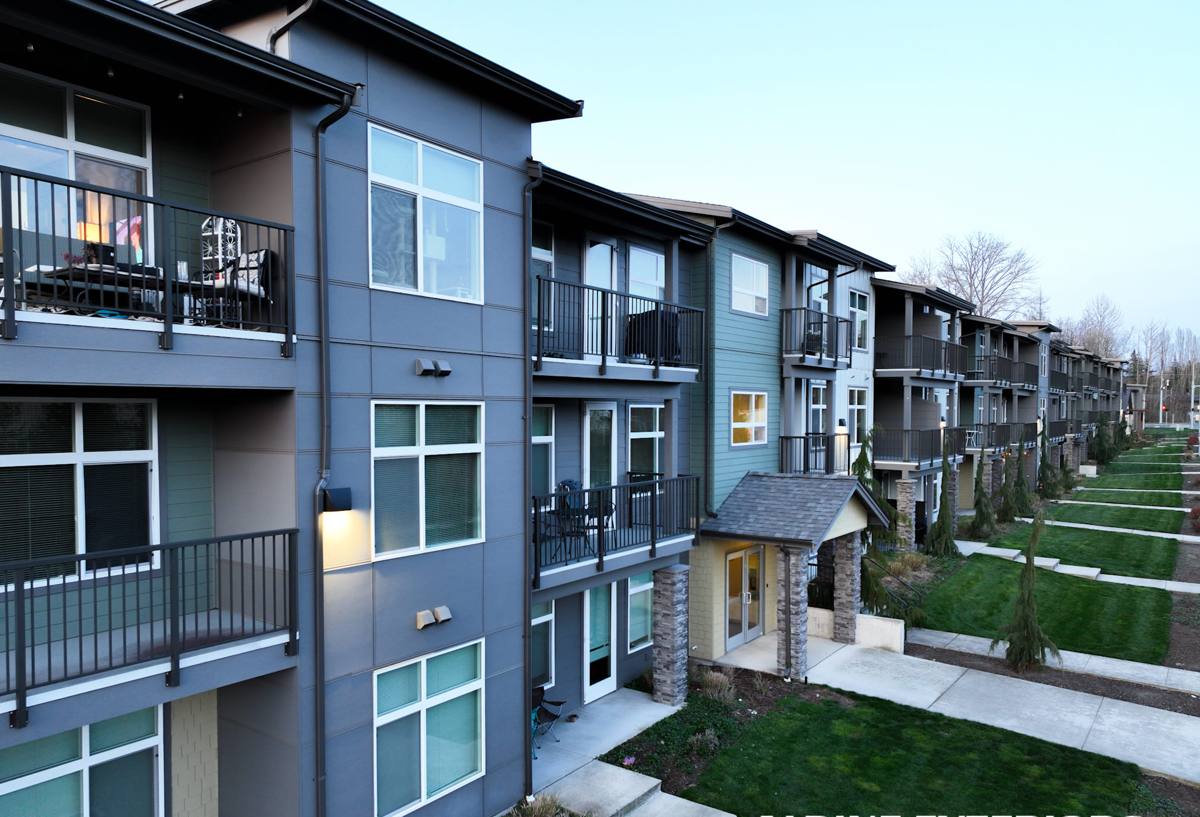
What Cemplank Gets Right
To be fair to it: Cemplank is real fiber cement, not a vinyl or engineered-wood substitute. It resists fire, resists rot better than wood siding, and holds paint reasonably well when installed and maintained correctly. It's often priced a step below Hardie, which makes it attractive on bigger jobs or tighter budgets. Some contractors like it because it's a little lighter to handle and cuts similarly to other fiber cement boards. For a homeowner comparing it only against vinyl or cedar, Cemplank is a step up in durability and fire resistance.
Where it starts to fall short, for us, is in the details that show up five, ten, and twenty years down the road — which is exactly the timeline that matters in a climate like ours.
Why Whatcom County Weather Exposes the Differences
Lynden sits inland from Bellingham Bay, but this is still a marine climate — salt-laden air moves up the Nooksack valley, driving rain comes in sideways off the Strait of Georgia weather systems most of the fall and winter, and the shaded, damp conditions here support a long moss and algae season on north-facing walls, fences, and rooflines. Siding here isn't just cladding — it's a moisture management system that has to shed water, resist mildew growth, and hold its finish through repeated wet-dry cycles for decades.
That's a demanding environment for any factory finish. It's also exactly the kind of environment where the difference between a good fiber cement product and a great one becomes visible — usually first in the paint film, then in the caulk lines, then in the substrate itself if moisture gets behind the boards.
What We Watch For
- Finish chalking or fading unevenly on south and west-facing exposures
- Caulk joints failing at butt seams before the siding itself shows wear
- Moss and algae taking hold faster on textured or lower-sheen finishes in shaded, damp wall sections
- Edge and end-cut swelling where factory sealant wasn't applied correctly during install
Factory Finish: The Real Differentiator
The single biggest practical difference between Cemplank and James Hardie is the factory-applied finish system. James Hardie's ColorPlus technology bakes on multiple coats of finish in a controlled factory environment, with a finish that's engineered specifically for fiber cement's expansion and moisture behavior, backed by a separate 15-year finish warranty on top of the product warranty. Cemplank offers primed and some prefinished options, but the finish ecosystem — the depth of factory-baked color options, the touch-up systems, and the length of finish-specific warranty coverage — isn't built out to the same degree.
In a climate that puts a factory finish through real stress every winter, that difference compounds. A finish that's holding up marginally worse in year one is often holding up noticeably worse by year twelve.
| Factor | Cemplank | James Hardie |
|---|---|---|
| Base material | Fiber cement | Fiber cement (engineered HZ5 for this climate zone) |
| Factory finish | Primed / limited prefinished options | ColorPlus baked-on finish, multiple coats |
| Finish warranty | Shorter or bundled with product warranty | Separate 15-year finish warranty |
| Product warranty | Typically shorter non-prorated period | 30-year limited warranty on siding |
| Color/trim ecosystem | Narrower matched trim and accessory line | Full matched trim, soffit, and fascia system |
| Manufacturer install support | Standard specs | Regional climate-specific install guides and trained-contractor network |
Warranty Structure Matters More Than the Number
Every siding brand advertises a warranty, but the structure behind the number is what actually protects a homeowner. James Hardie's warranty is transferable to a new owner if the home is sold, which matters for resale in a market where buyers ask about siding age and condition. It also separates product coverage from finish coverage, so a finish issue is judged against its own dedicated warranty rather than getting folded into a shorter combined term. Cemplank's coverage, by contrast, tends to run shorter overall and doesn't carry the same depth of finish-specific backing.
We install siding we're willing to stand behind for decades. A warranty structure that's harder to lean on if something does go wrong isn't something we want to hand a homeowner, especially on a house that's going to take the kind of weather this county sees every winter.
Climate-Engineered Product Lines
One thing that pushed us firmly toward Hardie is that the company engineers specific product formulations for different climate zones — HZ5 for regions with freeze-thaw cycles and moisture exposure like ours, versus HZ10 for hot, humid climates. That's not a marketing label; it changes the composition of the board to better resist the specific stresses of a region. Cemplank doesn't offer that same degree of climate-zone-specific engineering, which means the same board specification is doing the job in a dry southwestern install and a wet, mossy Whatcom County one.
Given how much of our work is repairing or replacing siding that failed because it wasn't matched to this climate in the first place, that's not a difference we're willing to shrug off.
Installation Sensitivity: The Product Is Only Half the Job
Fiber cement siding of any brand fails early most often because of installation mistakes, not the board itself — wrong nail placement, missing clearances at grade, unsealed cut ends, or improper flashing at windows and penetrations. Both Cemplank and Hardie require correct installation to perform. The difference is that Hardie backs its installer network with detailed, climate-specific installation manuals and a trained-contractor program, and its warranty coverage is tied to installation per those specs. That gives us — and the homeowner — a documented standard to install to and point back to if a question ever comes up.
We treat correct installation as non-negotiable regardless of brand, but having a manufacturer that engineers its specs and support around the Pacific Northwest's rain and moisture patterns makes it easier to get that installation right the first time.
What This Means for Your Siding Decision
If a contractor quotes you Cemplank, it's not a red flag by itself — it's a legitimate fiber cement product installed on plenty of homes without issue. But if you're comparing bids and one comes in noticeably lower on Cemplank, ask what's driving that: material cost, finish quality, warranty length, or corners on installation labor. Those are fair questions for any siding quote, on any brand.
For us, after years of installs and repairs across Lynden and the surrounding county, the finish durability, the climate-specific engineering, and the warranty structure tipped decisively toward James Hardie. That's why it's the only fiber cement siding we install, and the only one we're willing to warranty our labor against.
Questions Worth Asking Any Siding Contractor
- Is the siding you're quoting engineered for this climate zone, or a general-purpose formulation?
- Is the color a factory-baked finish, or field-primed and painted after install?
- Does the finish carry its own warranty, separate from the base product?
- Is the warranty transferable if you sell the home?
- Will the installer follow the manufacturer's written install specs for flashing, clearances, and fastening?
Get a Straight Answer for Your Home
Every house in this county deals with the same driving rain, salt air, and shaded, mossy stretches — but every roofline, exposure, and existing wall assembly is a little different. If you'd like an honest look at your siding, what condition it's in, and what a Hardie install would involve and cost, we're glad to come take a look. It's a free, no-pressure estimate, and we'll tell you straight what we'd actually do on your house.