 Lynden Exterior
 Cedar Has a Real Reputation — And It's Earned
Cedar siding didn't become a Pacific Northwest staple by accident. It's a genuinely good-looking, regionally native material with warm color, straight grain, and a natural resistance to insects and decay that comes from the wood's own oils. On a new install, a cedar-clad home in Lynden looks like it belongs here. We're not going to pretend otherwise, and we're not going to tell you cedar is a bad product. It isn't. What we will tell you is why, after years of installing and repairing siding across Whatcom County, we made the decision to stop installing it — and why we think that decision is the right one for homeowners who plan to stay in their house for more than a few years.
What Cedar Gets Right
To be fair to the material, cedar siding offers some things that manufactured products still struggle to match:
- Natural, varied grain pattern that no fiber cement or vinyl product fully replicates
- Renewable, biodegradable material with a smaller manufacturing footprint than some alternatives
- Naturally occurring tannins and oils that resist insects and some fungal decay when the wood is healthy and dry
- A warm, timeless look that fits Pacific Northwest architecture
If cedar siding is properly finished, properly ventilated, and maintained on a strict schedule by an owner who's committed to that upkeep, it can perform well for a long time. The problem is that "properly maintained on a strict schedule" is doing a lot of work in that sentence — and it's exactly where things fall apart for most homeowners.
The Maintenance Burden Nobody Mentions at the Sales Pitch
It's a Finish, Not a One-Time Job
Cedar siding is wood, and wood moves, absorbs moisture, and breaks down under UV exposure. The factory or job-site finish — whether it's stain, oil, or paint — is a sacrificial layer that the sun and weather are actively destroying from the day it goes up. In most climates that means refinishing every 3 to 5 years. In Whatcom County, with our long wet season and salt-laden air near the coast and the Strait, we typically see homeowners needing to recoat closer to the 3-year mark to keep the wood protected. Skip a cycle and you're not just losing curb appeal — you're exposing bare wood to moisture cycling, which is when real damage starts.
The Real Cost Is Cumulative
A single refinishing job on a full house isn't cheap, and it isn't a homeowner-weekend project if it's done right — proper prep means pressure washing, spot-sanding, caulking, and multiple coats. Multiply that by every 3 to 5 years over a 20 or 30-year ownership window, and the lifetime cost of cedar often exceeds what homeowners expect when they compare the up-front price against a lower-maintenance product.
Moisture Is the Real Enemy Here — And Whatcom County Gives It Plenty of Time to Work
Wood siding fails from moisture more often than anything else. Cedar resists rot better than most species, but "resists" isn't "immune," and resistance only holds up as long as the finish is intact and water isn't sitting against the wood or trapped behind it.
Lynden sits in a part of Whatcom County that gets driving rain off the Pacific through a long, wet fall and winter, plus a moss season that stretches for months on shaded north- and west-facing walls. Moss and algae hold moisture directly against the wood surface, and on a cedar wall that's overdue for cleaning or refinishing, that constant dampness is exactly the condition that leads to soft spots, cupping boards, and eventually rot — especially at butt joints, corners, and anywhere caulk has failed. Homes closer to the water pick up salt air on top of that, which accelerates finish breakdown and adds another maintenance variable most homeowners don't budget for.
None of this means cedar rots the moment it goes up. It means the margin for deferred maintenance is thin here, thinner than in drier climates, and thinner than most homeowners realize when they're comparing siding quotes.
Installation Sensitivity: Cedar Punishes Shortcuts
Cedar siding is far less forgiving of installation mistakes than people assume. A few examples we see repeatedly on repair calls:
- Back-priming: boards need finish on the back and end grain before install, not just the visible face — skip it, and moisture wicks in from behind where you can't see it
- Fastener choice: the wrong nail material stains and streaks cedar within a couple of years
- Clearance and flashing: cedar needs proper rain screen detailing and ground clearance; without it, splash-back and capillary moisture get into the bottom courses fast
- Grain and board selection: knots, sapwood, and inconsistent grain all behave differently under weather exposure, and inconsistent lumber quality shows up as inconsistent aging
A crew that installs cedar correctly is doing meticulous, detail-heavy work. A crew that treats it like any other lap siding is setting the homeowner up for problems five to ten years down the road — problems that look like normal weathering at first and turn out to be moisture damage underneath.
Why We Made the Call to Stop
We didn't stop installing cedar because it's a bad material. We stopped because we were tired of being the crew that got called back in year six or seven to explain why a wall was soft, why the finish was peeling unevenly, or why a corner board needed replacing — problems that trace back to normal wood behavior in a wet coastal climate, not to bad luck. We'd rather put a product on your home that we can stand behind for decades with a straightforward maintenance routine than one that requires a disciplined refinishing schedule to avoid moisture problems.
That's the honest version. Cedar isn't a scam or a bad product — it's a high-maintenance one, and Whatcom County's weather doesn't give high-maintenance siding much slack.
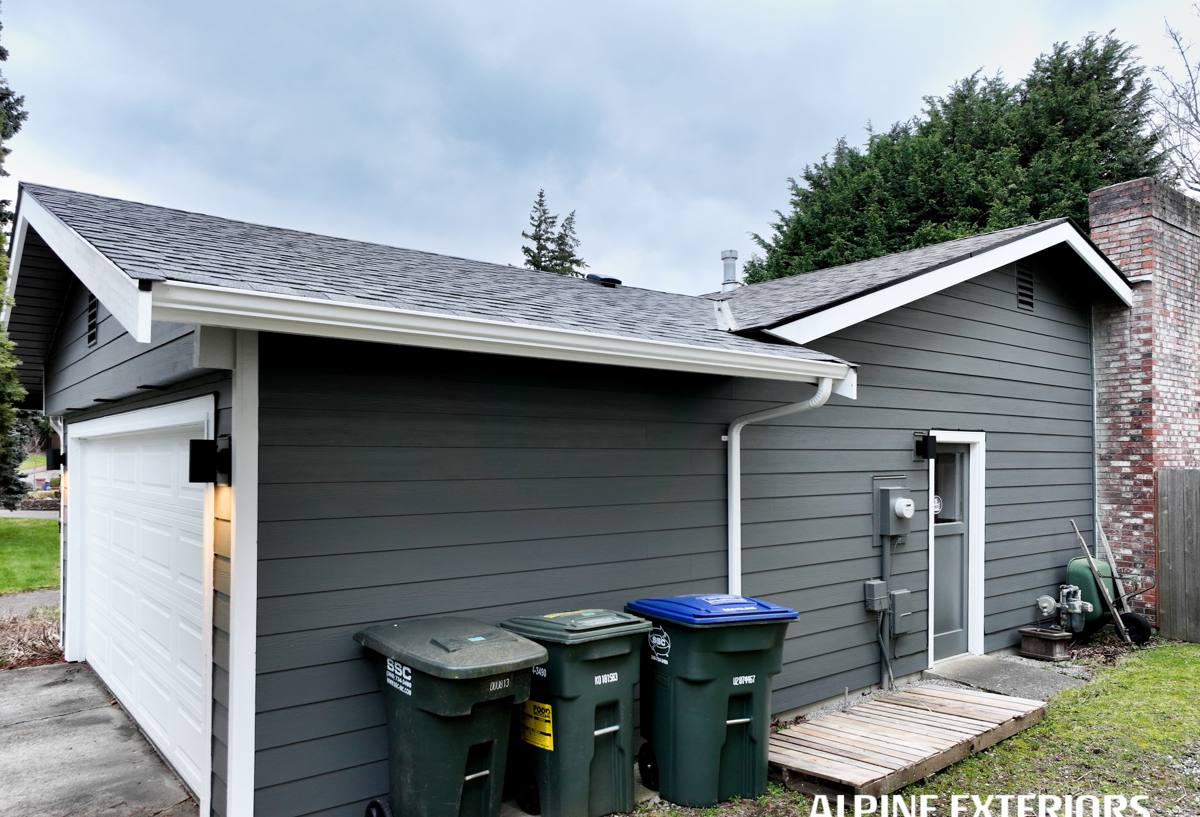
What We Install Instead: James Hardie Fiber Cement
We install James Hardie fiber cement siding exclusively, and the reasons map directly to cedar's weak points:
| Factor | Cedar Siding | James Hardie Fiber Cement |
|---|---|---|
| Refinishing cycle | Every 3-5 years, sooner near salt air | ColorPlus factory finish rated for decades, no full-house repaint cycle |
| Moisture behavior | Absorbs, swells, and can rot if finish fails | Fiber cement doesn't rot or swell from moisture exposure |
| Fire resistance | Combustible | Non-combustible material |
| Insect resistance | Naturally resistant but not immune | Not a food source for insects |
| Warranty | Typically none beyond the finish product used | Strong transferable manufacturer warranty |
| Regional engineering | Same product regardless of climate | HZ5 product line engineered for wet, freeze-prone climates like ours |
Hardie's HZ5 formulation is built specifically for the moisture and moss exposure common in the Pacific Northwest, and the ColorPlus finish is baked on in a factory-controlled process rather than applied on site — which means far more consistent, longer-lasting color and far less of the maintenance treadmill that comes with a wood product.
What to Weigh If You're Still Considering Cedar
If cedar is still on your list, ask yourself honestly:
- Are you willing to budget for refinishing every 3-5 years, indefinitely, for as long as you own the home?
- Is your property in a moss-prone area — shaded, near trees, or on a north or west exposure?
- Are you close enough to the water that salt air is a factor?
- Do you plan to sell within 10-15 years, and if so, will the next owner keep up the maintenance?
- Have you priced out the lifetime cost — install plus every refinishing cycle — not just the up-front bid?
If the honest answers give you pause, that's usually the same conclusion we came to.
Our Recommendation
We're not in the business of telling homeowners what they want to hear — we're in the business of siding that holds up in Lynden's weather without turning into a recurring maintenance project. That's why James Hardie fiber cement is the only siding we install, on every job, no exceptions. It gives you the durability and appearance homeowners want without the moisture vulnerability and refinishing treadmill that comes with cedar in a climate like ours.
If you're weighing cedar against fiber cement, or you've got an existing cedar-sided home you're trying to decide whether to maintain or replace, we're happy to take a look and give you a straight answer. Reach out for a free, no-pressure estimate — no sales pressure, just an honest read on your siding.