 Lynden Exterior
 Roof Repair Built for Birch Bay's Coastline, Not a Generic Climate
Birch Bay sits right where Whatcom County meets the water, and that location changes what a roof has to survive. A roof repair that holds up fine a few miles inland in Lynden can fail early out here because the inputs are different: salt-laden air moving off the water, wind-driven rain that gets pushed sideways into laps and flashing instead of just falling straight down, and long stretches of gray, damp weather that never quite let a roof dry out. We repair roofs across Whatcom County, and Birch Bay is one of the areas where we adjust our approach specifically because of the coastal exposure, not just the general Pacific Northwest climate.
This page is about roof repair, not full replacement or new construction. If your roof is fundamentally sound but has a leak, damaged section, or wear pattern that needs correcting, this is what that work looks like when it's done right for a Birch Bay home.
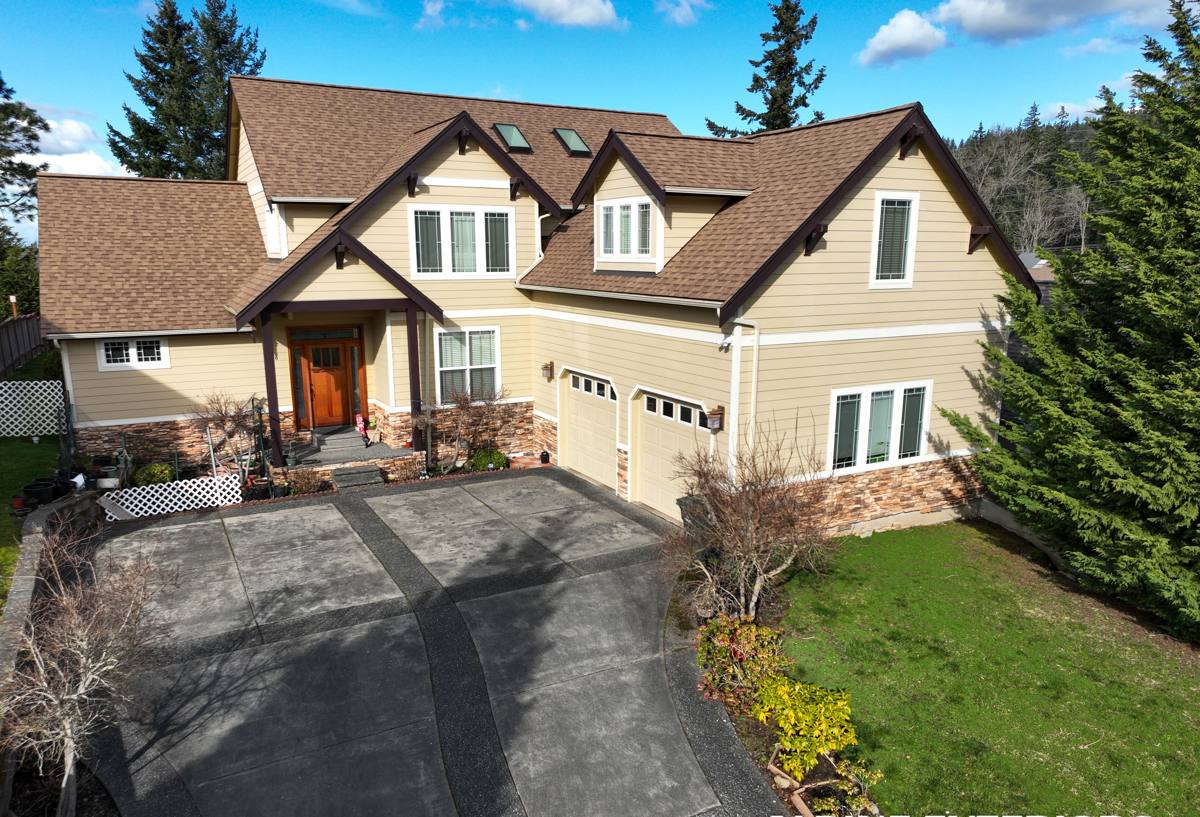
Why Salt Air, Wind-Driven Rain, and Moss Hit Birch Bay Roofs Harder
Salt Air and Metal Components
Airborne salt is corrosive to exposed metal. On a roof, that means flashing, fasteners, vents, and gutter hardware near the coast age faster than the same materials would a few miles inland. Corrosion often starts small — a fastener head rusting, a flashing seam losing its coating — and the failure shows up later as a leak that seems to come from nowhere, because the actual point of entry is a pinhole or a lifted seam that's been quietly failing for a season or two.
Driving Rain and Wind Exposure
Open water means wind has room to build speed before it reaches the roof. That wind doesn't just push rain onto the roof surface — it drives it sideways and upward, forcing water under shingle laps, into valleys, and around flashing edges that would stay dry in a calmer setting. Roofs designed and installed without that in mind tend to develop leaks first at penetrations (vents, chimneys, skylights) and at valleys, because those are the places where wind-driven water finds the shortest path to the deck.
Moss and Moisture
Whatcom County's wet season is long, and shaded or north-facing roof sections in Birch Bay — especially on lots with mature trees — can stay damp for weeks at a time. Moss and algae take hold in those conditions, and moss does real damage: it holds moisture against the roofing material, lifts shingle edges as it grows, and works its way into laps and fastener lines. A roof that looks "just cosmetically mossy" from the ground often has moisture intrusion starting underneath by the time it's visibly green.
Signs a Birch Bay Roof Needs Repair Now, Not Later
Most roof failures near the water don't start as dramatic leaks — they start as small signs that get ignored because they don't seem urgent. Here's what we tell Birch Bay homeowners to watch for:
- Water stains on interior ceilings or upper walls, especially after a windy rainstorm rather than a calm one
- Moss buildup in valleys, along the ridge, or on north-facing slopes
- Granule loss showing up in gutters (a sign shingles are wearing thin)
- Rust streaking below metal flashing, vents, or fasteners
- Lifted, curled, or missing shingles, particularly on the side of the roof that faces prevailing wind
- Soft spots or sagging when walked on or viewed from a ladder
- Daylight visible through the attic roof deck
- Flashing that's separated slightly from a chimney, skylight, or wall intersection
Any one of these on its own might be minor. Several together, or any sign paired with an active interior leak, means it's time for an inspection before the next storm.
What a Correct Roof Repair Actually Involves
A roof repair that lasts in a coastal environment isn't just patching the spot that's visibly leaking. Water rarely enters where it shows up — it travels along the deck or underlayment before dripping through somewhere lower or further inside. A correct repair means:
- Finding the real entry point, not just the stain. This often means checking the attic side of the deck and tracing water paths, not just looking at the roof surface from outside.
- Assessing the deck and underlayment around the damaged area for rot, soft spots, or saturated insulation before any new material goes on.
- Matching materials correctly — shingle type, weight, and color, and flashing metal that won't set up galvanic corrosion against what's already there.
- Rebuilding flashing and laps properly, not just sealing over old flashing with caulk, which is a short-term fix that fails again within a season or two near the water.
- Clearing moss and treating the cause, not just the symptom, if moss contributed to the damage.
Sealant and patching have a place in roof repair, but they're a component of a correct fix, not a substitute for one. A repair that's just caulk over a failing flashing joint is the kind of thing that looks fine at handoff and leaks again by the following winter.
Our Roof Repair Process in Birch Bay
We keep the process straightforward because homeowners dealing with a leak don't need extra steps between the problem and the fix.
1. Inspection and Diagnosis
We look at the roof surface, the flashing and penetrations, the valleys, and — where accessible — the attic side of the deck. We're diagnosing the actual cause, not just locating the visible symptom.
2. A Straight Answer on Repair vs. Replacement
If the damage is contained and the rest of the roof has useful life left, we say so and repair it. If the repair would just be a stopgap on a roof that's genuinely near the end of its service life, we tell you that too, with our reasoning, so you can decide with real information instead of a sales pitch either direction.
3. A Written Scope Before We Start
You know what's being repaired, with what materials, and roughly what it involves before work begins — no surprise add-ons discovered halfway through.
4. The Repair Itself
We remove and rebuild the affected area properly, including flashing and underlayment where needed, rather than layering a patch over the existing problem.
5. Cleanup and a Final Check
Debris and old material are cleared, and we walk the repair with you so you can see what was done and why.
Repair vs. Replacement: How We Help You Decide
Not every damaged roof needs to come off. But a repair on a roof that's already at the end of its usable life is money that doesn't hold. Here's generally how the decision breaks down:
| Factor | Leans Toward Repair | Leans Toward Replacement |
|---|---|---|
| Age of roofing material | Well within its expected service life | At or past the manufacturer's expected lifespan |
| Extent of damage | Localized — one section, valley, or penetration | Spread across multiple slopes or repeated failures in different spots |
| Deck condition | Solid, dry decking under the damaged area | Soft, rotted, or repeatedly wet decking |
| Granule loss / wear | Minimal, isolated to the repair area | Widespread thinning across the roof surface |
| History of repairs | First or second repair on this roof | Recurring leaks in different areas over recent years |
We'll walk you through where your roof actually falls on this before recommending either direction.
Materials and Fasteners We Use for Coastal Conditions
For repairs in Birch Bay, we default to corrosion-resistant fasteners — stainless steel or hot-dip galvanized rather than standard coated fasteners — because standard hardware simply corrodes faster this close to the water. Where flashing needs replacing, we pay attention to what metal is already on the roof so we're not pairing two metals that will corrode each other through galvanic reaction. For shingle repairs, we match to algae-resistant product lines where the existing roof allows it, since standard shingles in a shaded, damp setting are more prone to the moss and algae growth that shortens roof life here. None of this is about a specific brand being better or worse than another — it's about matching the material to the exposure the roof actually faces.
Why Hiring a Crew That Already Works in Birch Bay Matters
A roofer who mostly works drier, inland areas can do fine general work, but they may not automatically account for salt exposure on fasteners, the wind direction that actually drives rain into a particular roof's valleys, or how aggressively moss establishes on a shaded coastal lot. We work across Whatcom County, including Birch Bay regularly, so those adjustments aren't guesswork — they're just part of how we scope and price the job from the first inspection. That matters most on repair work specifically, because a repair that doesn't account for the local exposure tends to fail again in the same spot, which costs you twice.
Get a Straight Assessment of Your Birch Bay Roof
If you're dealing with a leak, visible moss, damaged shingles, or you just want a second opinion on something a home inspector flagged, we're glad to take a look. The estimate is free, there's no pressure attached to it, and if the honest answer is a small repair rather than a bigger job, that's what we'll tell you. Use the form below to request your no-obligation estimate.