 Lynden Exterior
 Fiber Cement Siding Built for Acme's Conditions
Acme sits in a corner of Whatcom County where the weather doesn't do anything halfway. Homes here take on a steady diet of driving rain off the water, damp air that lingers in the foothills, and a moss season that can stretch for months if siding isn't detailing water correctly. We install James Hardie fiber cement siding for homeowners in Acme because it's the one product system we've found that holds up to this specific combination of moisture, organic growth, and temperature swings without turning into a maintenance project every spring.
This page covers what fiber cement siding actually needs to do on an Acme home, what a correct installation involves, and how our process works from first look to final walk-through. If you're comparing siding options for a home in this area, the details below are the ones that matter most.
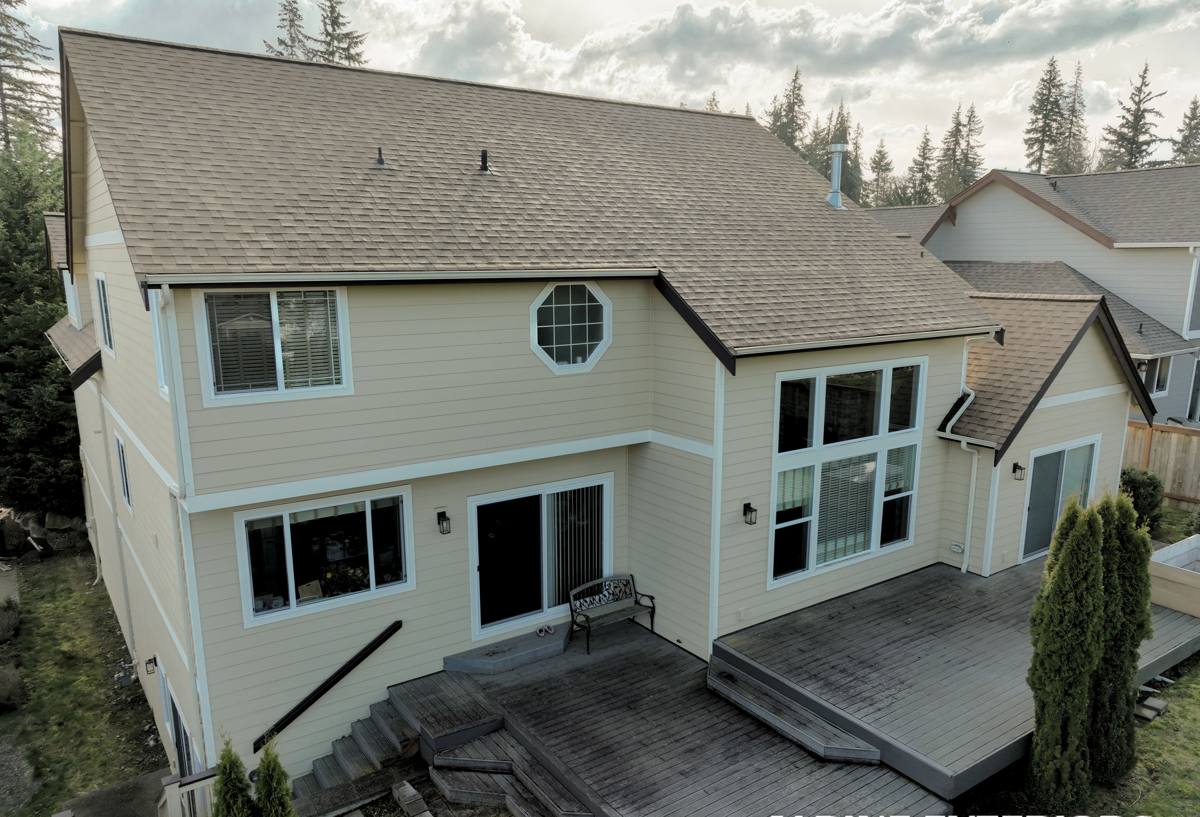
What Acme's Climate Actually Does to Siding
Whatcom County's marine-influenced climate means Acme homes deal with more than just "a lot of rain." A few specific stressors show up again and again:
- Driving rain: Wind-driven storms push water sideways into wall assemblies, not just straight down. Siding with poor water management channels moisture behind the cladding instead of shedding it.
- Salt-influenced air: Proximity to Puget Sound and the broader marine air mass means airborne salt and moisture accelerate corrosion of fasteners and degrade some coatings faster than inland climates would.
- Extended moss and algae season: Shade, dampness, and mild temperatures give moss and algae a long window to establish on north-facing walls, under eaves, and anywhere airflow is limited.
- Freeze-thaw cycling: Not extreme here, but real — enough to stress any siding material that absorbs water and doesn't dry out between storms.
None of these are dramatic on their own. The problem is cumulative — siding that's marginal in one of these categories usually fails in a few of them at once, and by the time it's visible, the sheathing behind it has often already taken damage.
Why This Matters for Material Choice
Wood-based products swell, absorb moisture, and give moss a foothold. Vinyl flexes and gaps over time, creating entry points for wind-driven rain. Fiber cement, done correctly, doesn't absorb water the way wood does, holds a factory finish that resists the kind of buildup that feeds moss and algae, and stays dimensionally stable through the county's freeze-thaw swings.
Why We Install James Hardie Only
We don't install LP SmartSide, vinyl, Cemplank, Allura, primed spruce, or cedar. That's not a marketing position — it's a standard we set because of what we've seen play out on homes in this climate over time. Hardie's fiber cement is non-combustible, holds its factory-applied ColorPlus finish far longer than field-painted alternatives, and the HZ5 product line is engineered specifically for climates with sustained moisture exposure like ours.
Other products aren't necessarily bad at what they're built for — cedar looks good, vinyl is cheap, engineered wood is easy to install. But each of them asks the homeowner to take on a maintenance burden or a moisture risk that we're not willing to install and then stand behind. Hardie is the one system where we can commit to the workmanship warranty with confidence, because the material itself doesn't work against us.
What a Correct Fiber Cement Installation Involves
Fiber cement siding is only as good as the assembly behind it. A huge share of the siding failures we get called out to inspect in this area trace back to installation shortcuts, not the material itself. On an Acme project, the sequence we follow includes:
- Inspecting and repairing sheathing — any water damage or rot from the old siding gets addressed before anything new goes up.
- Installing a weather-resistant barrier — correctly lapped and sealed so water sheds down and out, not into the wall cavity.
- Flashing every penetration — windows, doors, hose bibs, vents, and anywhere else the wall is interrupted.
- Maintaining proper clearances — siding held up off decks, patios, and grade so it isn't sitting in standing water or constant splash-back.
- Correct fastening — using the fastener type and pattern Hardie specifies, not whatever's fastest for the crew.
- Factory-finished panels installed to keep field cuts sealed — exposed cut edges are a common spot for moisture intrusion if they're not treated.
Skipping any one of these doesn't show up on day one. It shows up in year three or four, usually as a soft spot, a stain, or moss that won't stop coming back in the same spot.
Our Process for an Acme Project
1. On-Site Assessment
We walk the exterior, check the current siding and any signs of moisture behind it, and look at drainage, grading, and roof-to-wall transitions that affect how water moves around the home.
2. Scope and Product Selection
We talk through Hardie plank profiles, panel options, and color choices, and we're direct about which HZ line fits the exposure on each side of the house — a south wall catching driving rain and a shaded north wall dealing with moss pressure don't always need identical treatment.
3. Removal and Sheathing Check
Old siding comes off, and we don't cover up anything underneath. If there's rot or water damage, we show it to you and repair it before moving forward.
4. Installation to Manufacturer Spec
Barrier, flashing, clearances, and fastening are done to Hardie's published installation requirements — this is what keeps the product warranty and our workmanship warranty both valid.
5. Final Walk-Through
We go around the house with you, check trim and caulking lines, and make sure everything's tight before we call it done.
Comparing Siding Options for Acme Homes
| Factor | Fiber Cement (James Hardie) | Vinyl | Cedar / Wood-Based |
|---|---|---|---|
| Moisture resistance | Strong — engineered for wet climates | Moderate — gaps can let water behind panels | Weak — absorbs water, prone to rot |
| Moss/algae resistance | Strong factory finish resists buildup | Moderate | Weak — organic surface, moss takes hold easily |
| Fire resistance | Non-combustible | Combustible | Combustible |
| Finish longevity | Factory ColorPlus finish, long service life | Color molded in, can fade and chalk | Requires repainting/staining on a cycle |
| Typical maintenance | Low — occasional wash and caulk check | Low but prone to cracking/warping over time | High — regular sealing, staining, moss treatment |
Cost Factors to Expect
Every home is different, but the variables that move the price on an Acme project are consistent:
- Square footage and the complexity of the home's shape (corners, dormers, gables add labor)
- Condition of the existing sheathing — hidden rot repair adds cost but shouldn't be skipped
- Panel style chosen — lap siding, panel systems, and trim details all price differently
- Number of stories and access (scaffolding vs. ladders)
- Existing siding removal and disposal
We give a written, itemized estimate after the on-site assessment so you know what you're paying for and why — not a ballpark figure pulled from a square-footage formula.
Why Local Experience in Acme Matters
A crew that's worked in Acme and the surrounding Lynden area already knows which sides of a house tend to take the worst of the driving rain, where moss pressure builds fastest, and how the local moisture patterns interact with different roof and gutter setups. That's not something you can fully compensate for with a generic installation checklist — it changes where extra flashing attention goes, how clearances get handled near grade, and which details get double-checked before the crew leaves.
Hiring locally also means warranty and service calls are simple. If something needs a look five years down the road, we're not driving in from out of the area — we're already working in Whatcom County.
Signs Your Current Siding May Be Failing
- Soft or spongy spots when you press on the siding, especially near the bottom courses
- Persistent moss or algae staining that comes back within weeks of cleaning
- Visible gaps, warping, or buckling panels
- Peeling or bubbling paint, especially on wood-based siding
- Water stains or discoloration on interior walls near exterior corners
If you're seeing any of these on your Acme home, it's worth having someone look at the wall assembly, not just the visible siding — the damage is often further along than it appears from the outside.
If you're weighing siding options for a home in Acme, we're happy to take a look and give you a straightforward, no-pressure estimate — fill out the form below and we'll set up a time to walk the property.