 Lynden Exterior
 Why Ferndale's Climate Is Hard on Siding
Ferndale sits close enough to Bellingham Bay and the Strait of Georgia that salt-laden air is a real factor in how exterior materials age here, not a theoretical one. Add Whatcom County's wet season — long stretches of driving rain pushed in off the water, followed by damp, low-sun winters where surfaces barely get a chance to dry — and you have a climate that actively works against siding that isn't built for it. Moss and algae take hold anywhere moisture sits and sunlight is scarce, which describes most north-facing walls and shaded elevations around Ferndale for a good chunk of the year.
Homes closer to the water deal with airborne salt that settles on siding, trim, and fasteners. Over years, that salt exposure accelerates corrosion on unprotected metal and breaks down finishes that weren't formulated to resist it. Combine that with rain that doesn't just fall but drives sideways in a stiff westerly, and you need a siding system where the material itself, the finish, and the installation details all hold up — not just one of the three.
Why Fiber Cement Is the Right Call for Ferndale Homes
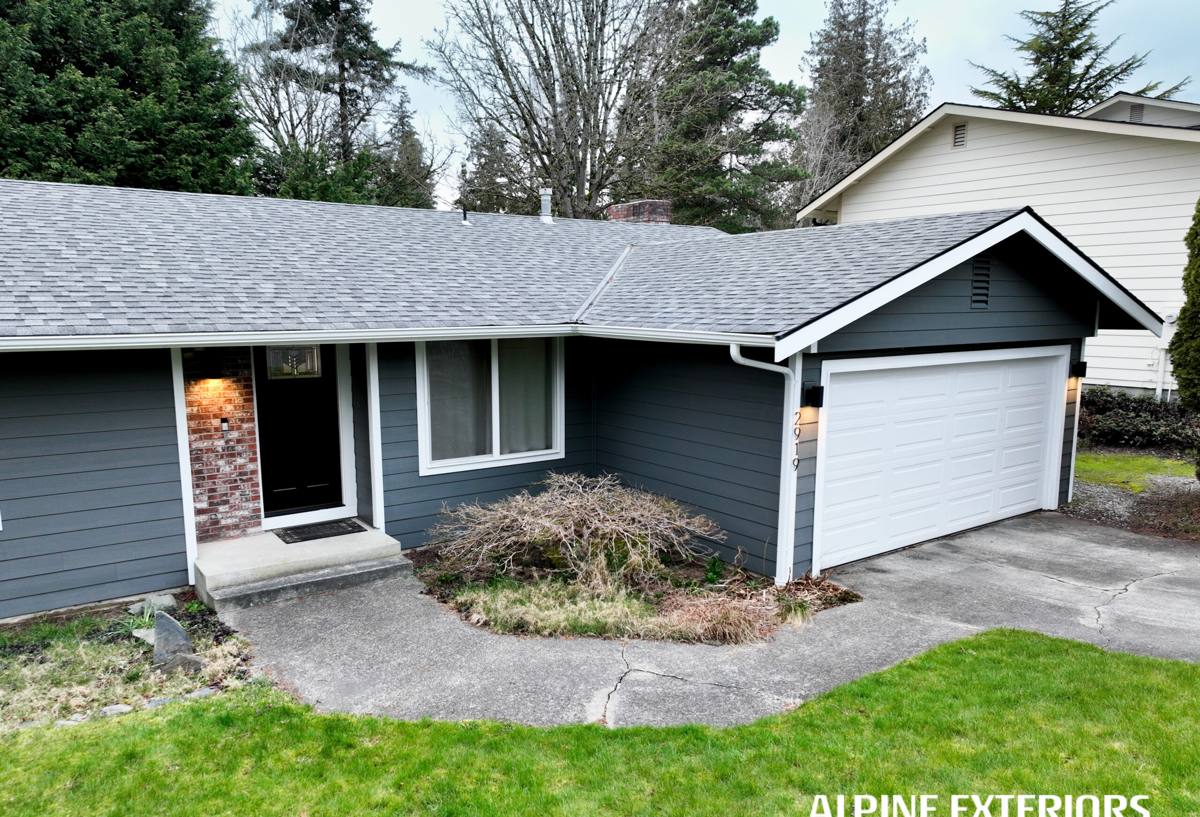
We install James Hardie fiber cement siding exclusively, and Ferndale is exactly the kind of environment that decision was made for. Fiber cement is a mix of cement, sand, and cellulose fiber pressed and cured into a dense, stable board. It doesn't absorb water the way wood-based products do, it won't rot, and it's non-combustible — which matters more every year as wildfire smoke and dry spells become part of Pacific Northwest summers.
James Hardie manufactures its siding in climate-specific formulations, including an HZ5 line engineered for regions with freeze-thaw cycles and sustained moisture exposure — a good match for Whatcom County's weather pattern. The factory-applied ColorPlus finish is baked on under controlled conditions, which gives it better UV and moisture resistance than field-applied paint, and it holds color longer against the kind of gray, overcast stretches that fade lesser finishes unevenly.
What This Means Day to Day
For a homeowner, the practical difference shows up in what you're not doing: not re-caulking swollen seams every couple of years, not scraping and repainting a south wall that's peeling while the north wall still looks fine, not finding soft, spongy board edges after a wet winter. Fiber cement holds its shape and finish under the conditions Ferndale actually produces.
What a Correct Fiber Cement Installation Involves
Fiber cement's reputation depends entirely on installation quality. The material itself is durable, but James Hardie's warranty and real-world performance both assume the job was done to spec — and in a wet, salt-exposed climate, shortcuts show up faster than they would somewhere drier.
- Correct fastener spacing and type — stainless or hot-dip galvanized fasteners sized to Hardie's specifications, not whatever was on the truck
- Proper clearance from grade, roof lines, decks, and hardscaping so board edges aren't sitting in standing water or splash-back
- A drainable water-resistive barrier behind the siding, with correctly lapped and taped seams so any moisture that gets past the cladding has somewhere to go
- Rainscreen furring where the wall assembly calls for it, creating an air gap that lets siding dry out after wind-driven rain instead of staying damp against the sheathing
- Factory-cut and factory-primed edges used wherever possible, with any field cuts sealed per Hardie's guidelines
- Correct joint treatment and sealant selection — the wrong caulk in a high-moisture climate fails early and traps water behind it
- Proper flashing at windows, doors, and any wall penetration, since most siding failures actually start as flashing failures
Skip any one of these and you can end up with a product that's rated for decades performing far worse — trapped moisture, early paint failure, or fastener corrosion that streaks the finish. This is the core reason we don't treat installation as a commodity task; it's the difference between fiber cement living up to its reputation and it not.
Our Process on a Ferndale Job
We start with a walk-around assessment of the existing siding and the wall assembly underneath it — checking for hidden moisture damage, soft sheathing, and problem areas around windows, decks, and roof transitions before any material gets ordered. In an area with this much rain exposure, what's happening behind the old siding often matters more than what's visible on the surface.
From there: removal of the old cladding, repair of any damaged sheathing or framing we find, installation of a drainable weather-resistive barrier, and a rainscreen gap where the assembly and budget call for it. Hardie boards go up to manufacturer spec — fastener pattern, clearances, and joint treatment — with flashing detailed at every window, door, and penetration before trim and final caulking. We clean up as we go and leave the site graded and swept at the end of each day, not just the last one.
Fiber Cement vs. Other Siding Options for a Climate Like This
| Material | Moisture / Salt Air Behavior | Maintenance Burden Here | Typical Lifespan |
|---|---|---|---|
| James Hardie Fiber Cement | Won't rot; factory finish resists UV and moisture fade | Occasional wash; repaint only if ever needed, decades out | Multi-decade with proper install |
| Cedar / Primed Wood | Absorbs moisture; prone to swelling, cupping, rot at joints | Frequent repainting and caulk maintenance | Shorter, highly install- and upkeep-dependent |
| Vinyl | Doesn't rot, but can warp/fade and gets brittle in cold snaps; seams are a moisture path | Low, but limited repair options once damaged | Variable; appearance degrades over time |
| LP SmartSide (engineered wood) | Better than raw wood but still wood-based; edge and cut-end sealing is critical in wet climates | Moderate; edge sealing and caulk need monitoring | Shorter than fiber cement; installation-sensitive |
We don't install vinyl, LP SmartSide, cedar, or primed wood siding. Vinyl can perform reasonably well in the right application, but its seams and thermal movement aren't a great match for the wind-driven rain Ferndale sees, and repairs are limited once a panel is damaged. Wood-based products, including engineered wood, depend heavily on every cut edge and seam staying sealed — a single missed detail in a climate this wet becomes a moisture entry point. Fiber cement gives us a material that doesn't carry those same failure points, which is why it's the only siding we put on homes.
What Drives Cost on a Ferndale Project
| Factor | Why It Matters |
|---|---|
| Home size and wall complexity | More corners, gables, and trim detail mean more cuts, more flashing, more labor |
| Condition of existing sheathing | Rot or moisture damage found during tear-off adds repair scope before new siding goes up |
| Siding profile and finish | Lap width, texture, and ColorPlus color selection affect material pricing |
| Rainscreen / drainage upgrades | Adding an air gap behind the siding improves long-term drying but adds material and labor |
| Trim and accessory scope | Fascia, soffit, corner boards, and window trim are often replaced alongside the field siding |
| Access and site conditions | Multi-story sections, tight lot lines, or landscaping can affect staging and labor time |
We won't quote a number without seeing the house, but these are the factors that actually move a bid up or down — worth asking about directly when you're comparing estimates.
Living With Fiber Cement in a Moss and Salt-Air Climate
Fiber cement is low-maintenance, not maintenance-free. A few habits go a long way toward getting the full lifespan out of the system in this climate:
- Rinse siding periodically, especially shaded or north-facing walls where moss and algae are most likely to establish
- Keep gutters clear so overflow isn't running down the wall face during heavy rain events
- Trim back vegetation and landscaping that keeps a wall section shaded and damp longer than the rest of the house
- Check caulking at trim and penetrations every couple of years and touch up before gaps open, not after
- Have any impact damage — a ladder bump, a stray baseball — repaired promptly rather than left, since a damaged spot is where moisture finds a way in
None of this is heavy upkeep compared to what wood or vinyl demand in the same conditions — it's mostly about not ignoring small things until they become bigger ones.
Why a Crew That Already Works Ferndale Matters
Siding installation quality is largely about judgment calls made on site: how much clearance to leave at a specific grade condition, how to flash an unusual roof-to-wall transition, where a rainscreen gap earns its cost and where it doesn't. A crew that's already worked houses in and around Ferndale has seen how this specific stretch of Whatcom County weather actually behaves against a wall — which elevations take the worst of the wind-driven rain, where moss shows up first, what the salt exposure does over time a few miles inland versus right along the water. That's the kind of pattern recognition that comes from doing the work here repeatedly, not from a general specification sheet.
It also means straightforward accountability. We're not a crew passing through the area for one job — we're the same local company you'd call back for a warranty question or a trim repair five years down the line.
Get a Free, No-Pressure Estimate
If your Ferndale home's siding is showing signs of wear from moss, moisture, or salt exposure — or you're planning ahead before it becomes a problem — we're happy to take a look and walk you through what we'd recommend and why. There's no obligation and no pressure, just a straight assessment from a crew that installs James Hardie fiber cement siding and nothing else. Use the form below to request your free estimate.