 Lynden Exterior
 Building Decks for Homes Around Wiser Lake
Wiser Lake sits in a part of Whatcom County where the ground stays damp most of the year, tree cover holds shade over large parts of most yards, and a deck spends a lot of its life either wet or recovering from being wet. That changes how a deck should be built here compared to a dry-climate build. It's not about a different look — it's about the framing, fasteners, and material choices underneath that look, and whether they're specified for this ground and this weather or just for a catalog average.
We build custom decks throughout the Lynden area, and the properties around Wiser Lake come with their own set of conditions: soil that holds water longer than you'd expect, shaded northern exposures that never fully dry between rains, and the marine-influenced air that moves through this part of Whatcom County carrying moisture (and a little salt) well inland from the Salish Sea. None of that makes a deck impossible to build well. It just means the build has to account for it instead of ignoring it.
What This Climate Actually Does to a Deck
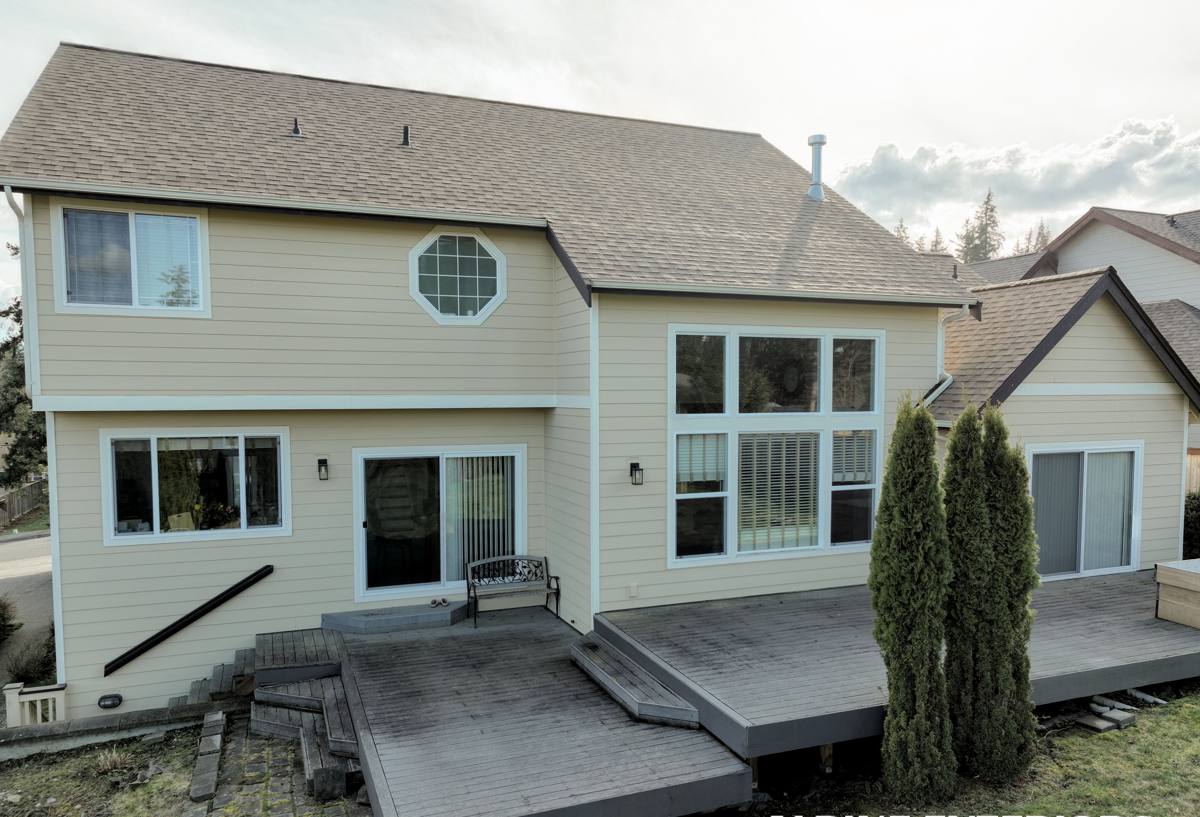
A deck around Wiser Lake faces three climate pressures that a dry-side deck rarely deals with at the same intensity: standing moisture, driving rain that gets pushed sideways under railings and against ledger boards, and a moss season that can run six months or longer in shaded spots. Each of these attacks a different part of the structure.
Moisture Near the Water
Proximity to the lake means higher ambient humidity and slower evaporation after rain. Decking that's rated fine for a drier part of the county can still cup, swell, or hold moisture in its fastener holes here longer than the manufacturer's spec sheet assumes. The framing underneath — joists, beams, ledger connection — is where this actually costs homeowners money, because framing rot is expensive to fix and often invisible until a board starts to feel soft underfoot.
Moss and Shade
Wiser Lake's tree cover means a lot of decks get partial or full shade for large parts of the day. Moss doesn't care what decking material you chose — it will colonize any surface that stays damp and shaded long enough, wood or composite. The difference is how much a material fights back: some surfaces shed moss with a seasonal wash, others need scrubbing or replacement of individual boards once moss has worked into the grain.
Choosing the Right Decking Material for a Lake Property
There's no single "best" decking material — there's a best match for a specific yard's sun exposure, budget, and how much maintenance the owner actually wants to do. For Wiser Lake properties, we weigh materials against moisture exposure and shade more heavily than we would for a sunny, open lot elsewhere in Lynden.
| Material | How it handles this climate | Maintenance | Typical lifespan |
|---|---|---|---|
| Pressure-treated fir/hem-fir | Affordable, but absorbs moisture readily in shaded, damp spots; needs a real sealing schedule to perform here | Annual cleaning, re-sealing every 1-2 years | 10-15 years with upkeep |
| Cedar | Naturally rot-resistant and handles this climate better than fir, but still needs finish maintenance to hold color and shed moisture | Cleaning plus finish renewal every 2-3 years | 15-20 years with upkeep |
| Composite (e.g., Trex, TimberTech, Fiberon) | Doesn't absorb water or rot, but can still grow surface moss in deep shade — needs periodic washing | Occasional wash, no sealing or staining | 25-30+ year warranty ranges, material-dependent |
| PVC decking | Fully moisture-immune surface, best option for the shadiest, dampest spots near the water | Occasional wash | Long manufacturer warranties, material-dependent |
Cost ranges vary a lot by size, framing complexity, and railing choice, so we'd rather walk a specific yard and give a real number than quote a generic per-square-foot figure that doesn't hold up once ledger, footing, or grading work gets added in.
Footings, Framing, and the Ground Around Wiser Lake
Frost Depth and Footing Requirements
Whatcom County's building code sets minimum footing depths to get below frost line and onto stable bearing soil. That's a code minimum everywhere in the county, but it matters more in practice on lake-adjacent lots where the soil profile often includes clay or fill that behaves differently once it's saturated. Footings poured to the letter of the code on soil that's been properly evaluated hold up; footings poured shallow, or without accounting for how wet that specific yard gets, are where deck settling and railing wobble usually trace back to.
Dealing with Clay and High Water Tables
Some Wiser Lake-area lots have heavier clay content or sit closer to the water table than lots further from the lake. That affects how footing holes drain during and after the pour, and it's worth checking before concrete goes in the ground rather than after a deck starts to shift. A crew that's dug footings around this lake before knows which streets tend to hit water in the hole and plan for it — that's not something you learn from a soil map, you learn it by having done the work here.
Flashing, Fasteners, and the Details That Actually Prevent Rot
Most deck failures we're called out to inspect aren't decking problems — they're flashing and fastener problems. In a climate that keeps wood and framing damp for long stretches of the year, these details carry more weight than they would somewhere drier.
- Ledger board flashed with proper metal flashing and a moisture barrier where the deck meets the house — this is the single most common failure point we find on older decks in this area
- Structural fasteners and hardware rated for ground contact/wet exposure — hot-dip galvanized or stainless steel, not standard-coated screws that corrode and weaken over a damp winter
- Joist tape or flashing tape on top of framing lumber to keep water from wicking into deck screws
- Proper board spacing gaps so water sheds through instead of pooling on the surface
- Post bases that hold posts above grade and off standing water, not buried or set flush in concrete
Skipping any one of these is invisible on the day the deck is finished. It shows up two, five, or eight winters later, which is exactly why they're worth getting right the first time rather than treating them as optional upgrades.
Permits and Code Considerations for a Lake-Adjacent Build
Deck permitting near Wiser Lake runs through Whatcom County's standard building permit process, and elevated decks, guardrails, and stairs all have specific code requirements around height, load, and railing spacing. Lake-adjacent lots can also carry additional considerations tied to setbacks or critical areas depending on how close the build sits to the shoreline — that's something we check against the specific parcel rather than assume, since it varies lot to lot. We handle the permit submission as part of the job so homeowners aren't the ones tracking down what applies to their property.
Our Process for a Wiser Lake Deck Project
- Site walk: we look at sun exposure, tree cover, soil, drainage, and how the deck will tie into the house before recommending a material or layout
- Design and material selection: we lay out sizing, railing style, and decking material against the yard's actual conditions and the homeowner's maintenance preference
- Permit handling: we submit the plans and pull the permit through the county
- Footings and framing: footings poured to code depth for the soil we find, framing built with wet-exposure-rated hardware and flashing at every connection
- Decking and railing installation: boards and railing installed to the manufacturer's spacing and fastening specs, not shortcuts that void a warranty
- Final walkthrough: we go over the finished deck and what upkeep, if any, it needs going forward
Keeping a Lake-Area Deck in Good Shape
Whatever material a deck is built from, a little seasonal attention goes a long way in this climate. This is the same list we'd hand a homeowner after finishing a project:
- Clear leaves and debris from between boards and off the surface before fall rains set in
- Wash shaded or moss-prone areas at least once a year — earlier if moss is visible
- Check that gaps between boards haven't closed up with debris or swelling
- Inspect ledger flashing and railing posts for movement once a year
- Re-seal or re-stain wood decking on the schedule the finish product calls for — don't wait until it's visibly gray
- Keep gutters and downspouts near the deck clear so runoff isn't draining directly onto or under it
Why a Crew That Already Works Wiser Lake Matters
A deck built to a generic spec can still fail in a specific place. The soil behavior, shade patterns, and moisture load around Wiser Lake aren't things you'd know from a plan set alone — they're things you learn from having dug footings, flashed ledgers, and fixed other contractors' shortcuts on this ground before. We're a Lynden-based crew, and the lake-area homes we've worked on inform the calls we make on footing depth, fastener grade, and material recommendations on the next one. That's the difference between a deck that's built to pass inspection and one that's built to hold up through this county's wet seasons for the long haul.
If you're planning a new deck or replacing one that's showing its age around Wiser Lake, we're happy to walk the site and put together a straightforward estimate — no pressure, no generic quote pulled from a spreadsheet. Use the form below to get started.