 Lynden Exterior
 Why Custer Siding Takes More Punishment Than Most
Custer sits close enough to the water that salt-laden air is a daily fact of life, not an occasional weather event. Add Whatcom County's long stretch of wind-driven rain and a moss season that can run from fall through spring, and you've got a combination that wears through the wrong siding material faster than most homeowners expect. It's not one dramatic storm that causes the damage — it's the slow, steady cycle of salt film, moisture, and shade that never fully lets a wall dry out.
We've seen what this does to siding that wasn't built for it: chalky paint within a few years, swollen seams, soft trim boards, and green-black streaking on the north and west-facing walls that never get direct sun. A siding job in Custer has to be judged against that reality, not against a generic installation checklist.
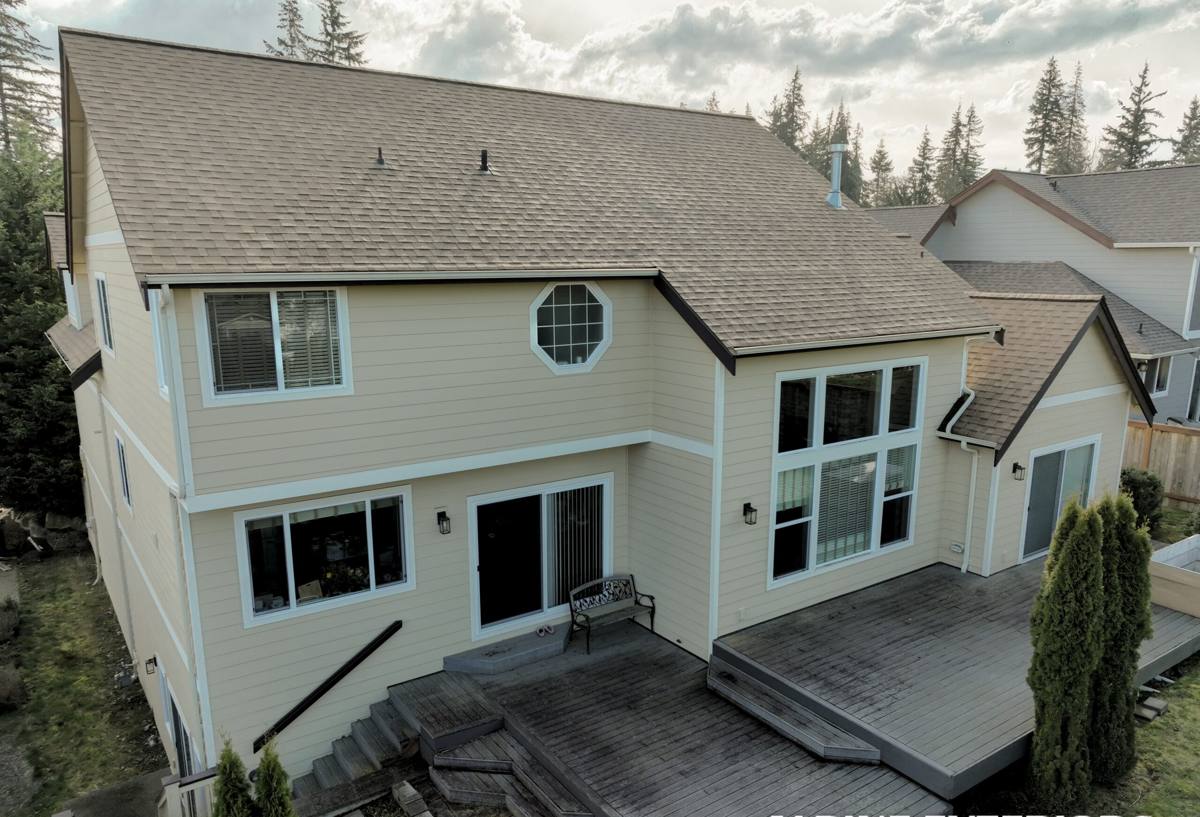
What Siding on a Custer Home Actually Needs to Do
Stand Up to Salt Air
Airborne salt accelerates corrosion on fasteners and speeds up the breakdown of lower-grade paint films. Over time it dulls color and, on materials that aren't dimensionally stable, can work into seams and joints and start softening the substrate underneath.
Shed Driving Rain, Not Just Vertical Rain
Wind off the water pushes rain sideways into a wall, not straight down onto a roof. That means lap siding, flashing, and caulk joints all have to perform under horizontal pressure, not just gravity. A siding system that's only been tested against ordinary rainfall is being asked to do a job it wasn't designed for.
Resist Moss and Sustained Moisture
Shaded walls in this part of Whatcom County stay damp longer than homeowners realize, and moss doesn't need much more than shade and moisture to take hold. Siding that absorbs water or holds it against the wall gives moss and mildew exactly the environment they need.
Why We Install Only James Hardie Fiber Cement
We made a deliberate decision to install James Hardie fiber cement siding exclusively — not vinyl, not LP SmartSide, not cedar, and not other fiber cement brands. That's a professional standard we hold ourselves to because of how each of those materials performs, over years, in exactly the conditions Custer sees.
Climate-Engineered HZ Formulation
James Hardie engineers its HZ product lines for specific climate zones, including the wet, moderate-temperature conditions of the Pacific Northwest. The fiber cement formulation is built to resist moisture intrusion and hold its shape rather than swell, cup, or delaminate the way wood-based and some composite sidings can when they stay damp for extended periods.
ColorPlus Factory Finish
Rather than relying on field-applied paint, Hardie's ColorPlus finish is baked on in a controlled factory setting, which gives it better adhesion and more consistent coverage than a job-site paint job can achieve. That matters directly for salt air exposure — a factory finish holds its color and integrity longer against the kind of chalking and fading that salt accelerates.
A Warranty That Actually Transfers
Hardie backs its siding with a long-term limited warranty that's transferable to a new owner if the home sells, which protects the investment rather than just the person who paid for the original install. That's a meaningful difference from products where warranty coverage is thin, non-transferable, or contingent on maintenance most homeowners never track.
What a Correct Installation Actually Involves
Fiber cement siding is only as good as the installation behind it. Most siding failures we're called out to inspect in Whatcom County didn't fail because of the material — they failed because of shortcuts in the installation. The table below covers where correct practice and common shortcuts diverge.
| Detail | Correct Practice | Common Shortcut |
|---|---|---|
| Ground and roof clearance | Minimum clearance maintained per Hardie's installation specs to keep siding away from standing moisture | Siding installed tight to grade, decks, or roofing, trapping moisture against the bottom edge |
| Flashing | Properly lapped flashing at windows, doors, and horizontal trim to direct water outward | Reliance on caulk alone instead of physical flashing |
| Fastening | Correct fastener type, spacing, and depth per manufacturer specs | Over-driven or under-driven nails that crack the board or leave it loose |
| Joints and seams | Joints backed and sealed with the correct sealant rated for the exposure | Butt joints left unbacked or sealed with general-purpose caulk |
| Cut edges | Field-cut edges sealed to protect the exposed core from moisture | Cut edges left unsealed, allowing water to wick in over time |
Why Flashing and Clearance Matter Most Here
In a marine climate, flashing and clearance details do more work than almost anything else on the wall. Water that gets behind siding in Custer doesn't get a chance to dry out quickly between rain events, so any gap in the flashing or any spot where siding sits too close to grade becomes a long-term problem rather than a minor one.
Fastening and Sealant Choices
We use fasteners and sealants rated for the exposure the wall will actually see, not just whatever is fastest to install. A sealant that isn't built for constant damp-dry cycling will crack and open a path for water well before the siding itself shows any wear.
Our Process for a Custer Siding Project
- Site walk and assessment — We look at wall exposure, existing moisture damage, trim condition, and how the home is oriented relative to prevailing wind and rain.
- Material and detail selection — We help you choose the right Hardie profile, plank width, and color for the home and confirm trim, flashing, and fastening details up front.
- Tear-off and prep — Old siding comes off, the wall sheathing gets inspected for hidden moisture damage, and any repairs happen before new siding goes on — never over a compromised wall.
- Installation — Siding, flashing, and trim go in to manufacturer spec, with attention to clearances and joint sealing throughout, not just on the visible courses.
- Final walkthrough — We review the finished job with you, cover basic care, and make sure every detail — corners, penetrations, trim — was finished correctly.
Cost Factors for Fiber Cement Siding in Custer
Every home is different, but the factors that actually move the price on a fiber cement project are consistent. We won't quote a number without seeing the home, but this is what drives the estimate up or down.
| Factor | Why It Affects Cost |
|---|---|
| Home size and wall complexity | More square footage and more corners, dormers, or gables mean more cutting, flashing, and labor time |
| Existing siding removal | Tear-off and disposal of old material adds time, especially with layered or damaged siding |
| Hidden moisture damage | Rot or sheathing damage found during tear-off has to be repaired before new siding goes on |
| Trim and detail level | Additional trim boards, window casing, and architectural detail add material and labor |
| Siding profile and color | Plank width, texture, and ColorPlus color selection affect material cost |
Living With Fiber Cement Siding in a Marine Climate
Fiber cement siding is low-maintenance compared to wood or vinyl, but "low-maintenance" doesn't mean "no maintenance" — especially this close to the water. A little routine attention keeps the siding performing the way it's designed to for decades.
- Rinse salt film off the siding periodically, especially on walls facing the water or open wind
- Inspect caulking at joints, windows, and trim yearly and re-seal anything that's cracked or pulled away
- Trim back vegetation and keep gutters clear so water isn't running down or pooling against the wall
- Check shaded, north-facing walls for early moss or algae growth and clean it before it spreads
- Watch for any soft spots at the bottom edge of the siding near grade, decks, or downspouts
Signs Your Current Siding May Already Be Struggling
Homeowners in Custer often notice one or two of these before they realize how far the underlying problem has progressed: chalky or fading paint that rubs off on your hand, soft or spongy spots when you press on the siding, visible gaps or warping at seams, and persistent green-black staining that comes back shortly after cleaning. Any of those is worth having looked at before it turns into a sheathing repair.
Why Hiring a Crew That Already Works Custer Matters
Siding crews that only occasionally work this far into Whatcom County tend to install to a generic standard — one that may hold up fine in a drier climate but leaves gaps here. Crews who work Custer and the surrounding area regularly know which walls take the worst of the wind-driven rain, where moss shows up first, and which flashing and clearance details actually matter versus which ones are just code minimums. That local pattern recognition is part of what keeps a siding job performing years down the road instead of just looking good on install day.
If you're weighing your siding options for a home in Custer, we're happy to take a look and talk through what we'd recommend — no pressure, no obligation. Fill out the form below for a free estimate.