 Lynden Exterior
 Why Birch Bay Siding Wears Differently Than Homes Further Inland
Birch Bay sits right on the water, and that changes what siding has to deal with year-round. Homes a few miles inland in Lynden or elsewhere in Whatcom County catch plenty of rain, but they don't get the steady dose of salt-laden air coming off the bay. That salt air settles on exterior surfaces, works into seams and fastener heads, and accelerates corrosion and finish breakdown in ways that inland homes simply don't experience at the same rate.
Add in driving rain that comes in sideways during winter storms, and you've got moisture getting pushed into laps, seams, and trim joints that would stay dry in a calmer climate. Then there's moss. Whatcom County's long wet season gives moss and algae months to establish themselves on any siding surface that stays shaded or damp, and once established, moss holds moisture against the material instead of letting it shed.
None of this means Birch Bay homes are doomed to constant repair. It means the siding, the installation details, and the repair work all have to account for a harsher set of conditions than a generic "Pacific Northwest" repair job would assume.
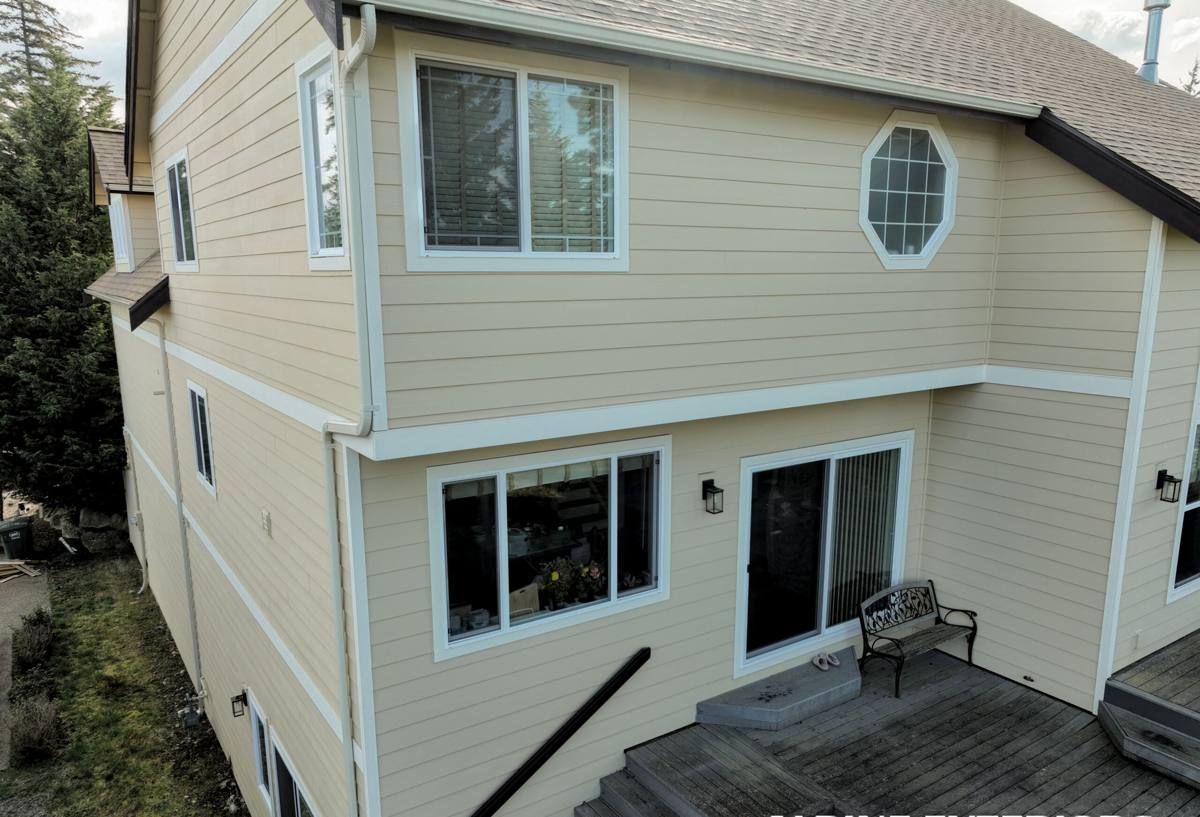
Signs a Birch Bay Home Needs Siding Repair
Because damage here often starts at seams, fastener points, and low-lying areas near grade or landscaping, it's easy to miss until it's gone further than it should have. Here's what we tell Birch Bay homeowners to check for:
- Soft or spongy spots when you press on siding, especially near the bottom courses or below windows
- Visible gaps or separation at butt joints and corner boards
- Persistent moss or dark streaking that keeps returning after cleaning
- Peeling, bubbling, or chalky paint film, particularly on sun-exposed and salt-exposed walls
- Rust staining running down from fastener heads or trim
- Warping, cupping, or visible waviness in panels
- Interior signs — musty smell, discoloration on interior walls near exterior corners, or trim that feels damp to the touch
Any one of these on its own might be minor. Several together, or any sign paired with softness you can feel by hand, usually means moisture has already gotten past the surface.
Why Small Problems Don't Stay Small Here
In a drier climate, a small gap at a seam might sit for years without consequence. In Birch Bay's combination of driving rain and near-constant coastal humidity, that same gap is an entry point almost every wet week of the year. Once water gets behind siding, it's working on sheathing, framing, and insulation that were never designed to get wet — and by the time it shows up as a visible problem outside, there's often more damage behind the wall than the exterior suggests.
What a Correct Siding Repair Actually Involves
A proper repair isn't just pulling a bad board and nailing up a new one. It starts with figuring out why that section failed in the first place — a flashing detail that was never sealed correctly, a caulk joint that dried out, a drainage path that got blocked by landscaping or grade changes over the years. Replacing the visible damage without fixing the cause just buys a few more years before the same spot fails again.
Steps We Follow on a Repair
- Inspect beyond the visible damage — check sheathing and framing behind the failed section for rot or moisture
- Identify the moisture source: flashing, caulk failure, grade, gutter overflow, or installation gap
- Remove and replace any compromised sheathing or framing, not just the siding
- Correct the underlying detail so the same failure doesn't repeat
- Install matching material, cut and fastened to manufacturer spec
- Seal and finish so the repair blends in rather than standing out as a patch
Skipping straight to step five — just swapping the board — is the most common shortcut in siding repair, and it's why some homeowners end up calling a contractor back for the same wall a couple of years later.
Repair vs. Replace: How We Make That Call
Not every damaged section needs a full re-side, and not every repair is worth doing if the rest of the siding is near the end of its life anyway. We look at a few factors before recommending one path over the other.
| Factor | Favors Repair | Favors Full Replacement |
|---|---|---|
| Extent of damage | Isolated to one or two wall sections | Recurring damage across multiple elevations |
| Age of existing siding | Under 10-15 years, in otherwise sound condition | Near or past expected service life |
| Underlying cause | One-time or localized (impact damage, single flashing failure) | Systemic (original installation defects, chronic moisture path) |
| Material match | Existing product still available or closely matchable | Discontinued profile, color, or product no longer made |
| Sheathing condition | Framing and sheathing behind the damage are sound | Rot or moisture damage found in structural layers |
Birch Bay's exposure tips this calculation a bit compared to inland homes. If we open up a wall section and find that moisture damage has traveled well beyond the visible problem, that's usually a sign the rest of the elevation is on the same timeline — just a step or two behind.
Why We Repair With James Hardie — Not a Mixed Patch
We install James Hardie fiber cement siding exclusively, and that carries into how we handle repairs. When a Birch Bay home already has Hardie siding, repairs are usually straightforward: Hardie's HZ5 product line is engineered for wet, high-exposure climates like this one, so matching material, fastening pattern, and finish is a like-for-like fix rather than a compromise.
When a home has vinyl, wood, or another fiber cement product and needs repair, we'll still do honest, correct repair work on the existing material where that's the right call. But when a section is far enough gone that a real fix means new siding rather than a patch, we recommend Hardie rather than matching the original product — because in this exposure, we've found that a non-combustible fiber cement product with a factory-applied ColorPlus finish holds up to salt air and driving rain with far less maintenance than the alternatives, and we're not willing to install materials we don't stand behind long-term.
What This Means for Color and Finish Matching
Hardie's ColorPlus finish is baked on in a controlled factory process, which gives it more consistent color retention over time than field-applied paint — including on the moss-prone, salt-exposed sides of a Birch Bay home. When we're repairing an existing Hardie installation, we source matching ColorPlus product where possible so the repaired section weathers alongside the rest of the wall instead of aging at a visibly different rate.
Our Process for Birch Bay Repair Calls
Because we work this stretch of coastline regularly, we're familiar with how homes here are typically built, where moisture tends to collect given local wind and rain patterns, and what past siding work in the area tends to look like when we open it up. That local pattern recognition speeds up diagnosis — we're not guessing at what a Birch Bay home's exposure has been doing to its siding.
- On-site inspection of the damaged area and a broader check of the rest of the exterior
- Straight talk on whether it's a repair or a sign of something bigger, with our reasoning explained
- A written estimate before any work starts — no surprise scope changes
- Repair work scheduled around Whatcom County's weather windows, since siding work needs a reasonably dry stretch to do correctly
- A finished repair that matches the surrounding siding, not a visible patch job
What Happens If Repairs Get Put Off
We understand the instinct to wait, especially if the damage looks cosmetic. But in Birch Bay's climate, the gap between "cosmetic" and "structural" closes faster than in drier parts of the county. Moss left in place keeps a wall damp for months at a stretch. A gapped seam facing the prevailing wind and rain direction is taking on water almost every storm. Rust at a fastener head means that fastener's grip is weakening while you wait.
Delaying a repair rarely makes the job smaller — it usually means the eventual fix involves more sheathing replacement, more framing repair, and a bigger bill than addressing it when it was first noticed.
Why Local Experience in Birch Bay Matters
Siding repair isn't one-size-fits-all across a county with as much microclimate variation as Whatcom County has. A crew that mostly works drier, more sheltered neighborhoods can still do competent general repair work, but they may not immediately recognize the specific failure patterns that show up on a coastal Birch Bay wall — the fastener corrosion, the moss concentration on north- and west-facing elevations, the way driving rain finds its way into details that would hold up fine a few miles inland.
Working this area regularly means we're not learning Birch Bay's exposure on your house. We already know what to check first, and that saves time during diagnosis and reduces the chance of missing a related problem while fixing the obvious one.
After the Repair: Keeping Moss and Moisture From Coming Back
A correct repair addresses the cause, but ongoing conditions in Birch Bay mean a bit of routine attention pays off. Keeping gutters clear so water isn't overflowing onto siding, trimming back vegetation that's shading and dampening a wall, and rinsing off moss buildup before it establishes itself all extend the life of both the repaired section and the surrounding siding. None of this requires special products or a lot of time — it's mostly about not letting moisture and organic growth sit against the siding for months on end.
If you're seeing soft spots, moss that won't quit, gaps at the seams, or any of the other warning signs on your Birch Bay home, we're happy to take a look and give you a straight answer on what it needs. Reach out for a free, no-pressure estimate using the form below.