 Lynden Exterior
 Roof Replacement for Sumas Homes
Sumas sits tucked against the Canadian border in the Nooksack River valley, a low, often shaded corner of Whatcom County where roofs work harder than they do just a few miles away. The same marine weather that moves across the rest of the county — driving rain off the Salish Sea, long stretches of overcast humidity, and salt-tinged air carried inland on winter storms — settles into this valley and lingers. Add tree cover and slower-drying mornings, and you get a textbook environment for moss, moisture intrusion, and roofs that wear out from the inside before they look bad from the curb.
We're based just down the road in Lynden, and Sumas is part of our regular service area, not a stretch. That matters more than it sounds like it should. Roofing here isn't the same job as roofing in a dry climate — the details that keep water out for twenty-plus years are different, and getting them wrong is expensive to fix later.
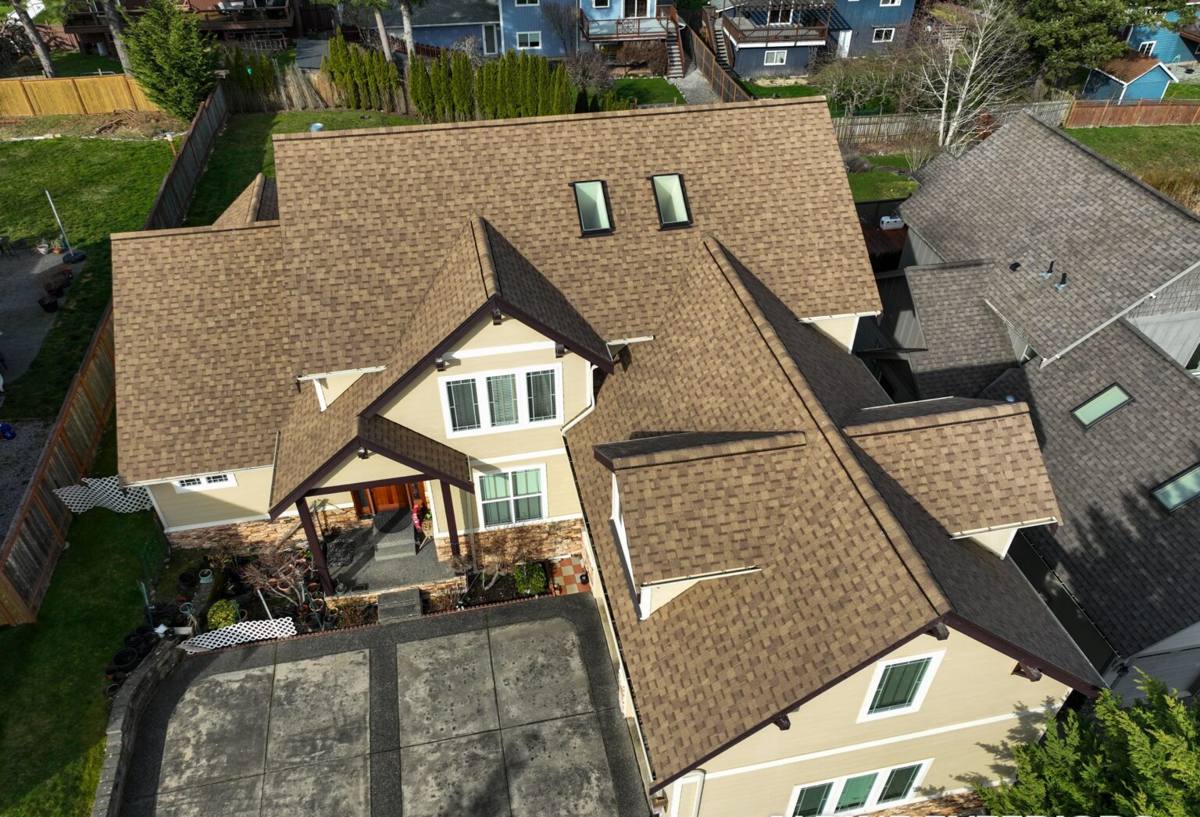
What This Climate Actually Does to a Roof
Before talking about replacement, it's worth being specific about what's actually failing and why, because it shapes every decision that follows.
Moss and organic growth
Sumas gets a long moss season — roughly fall through spring, longer on north-facing slopes and anything shaded by trees. Moss isn't just cosmetic. It holds moisture against the roofing material, lifts shingle edges as it grows, and works its root structure under tabs and into fastener lines. A roof that looks merely dirty from the ground can have moss doing real damage underneath.
Driving rain and wind-driven water
Storms here don't always come straight down. Wind pushes rain sideways and up under laps, ridges, and flashing that would stay dry in a calmer climate. This is why underlayment quality and flashing detail matter more here than in most parts of the country — a roof that's "basically fine" in a mild rain can still leak in a sideways one.
Marine and salt-influenced air
Whatcom County sits along the Salish Sea, and that marine air moves inland with weather systems, carrying a mild salt content that accelerates corrosion on exposed metal — fasteners, flashing, vent stacks, and gutter hardware. It's not as aggressive here as on the immediate coastline, but over fifteen or twenty years it adds up, especially on lower-grade hardware.
Temperature swings and freeze-thaw
Whatcom County winters bring enough freeze-thaw cycling to stress aging shingles and any roof deck that's already taking on moisture. Materials that have lost flexibility from age or moss damage crack rather than flex when temperatures drop overnight.
Signs a Sumas Roof Needs Replacement, Not Another Repair
Not every problem roof needs a full tear-off. But there's a point where patching becomes a way of paying for the same roof twice. Here's how we tell the difference on a typical inspection:
- Granule loss heavy enough that you can see bare asphalt mat on multiple shingles, not just a few
- Moss established at the shingle layer (not just on the surface) across more than isolated patches
- Soft or spongy decking felt underfoot during inspection — a sign water has already reached the wood
- Daylight or staining visible in the attic, especially around valleys, chimneys, or vent penetrations
- Shingles curling, cupping, or cracking across large sections rather than a few storm-damaged spots
- The roof is past 20–25 years old (typical composition shingle lifespan in this climate) and repairs are becoming frequent
- Flashing that's rusted, separated, or was never properly stepped at walls and roof-to-roof transitions
If you're only seeing one or two of these, a repair is often the honest answer and we'll say so. Replacement makes sense when the underlying deck, underlayment, or flashing system is compromised broadly enough that repair would just be delaying — and paying twice for — the same failure.
What a Correct Roof Replacement Involves
A roof replacement is only as good as what's underneath the shingles. Here's what we consider non-negotiable on every job:
Full tear-off and deck inspection
We remove the existing roofing down to the deck rather than layering over it. This lets us actually see the plywood or plank decking and replace any sections that have soft spots, delamination, or rot — something you can't do from a layover.
Ice and water shield at vulnerable points
Given the amount of driving rain and occasional freeze-thaw here, self-adhering ice and water barrier goes at eaves, valleys, and around all penetrations — the spots where wind-driven rain and ice damming cause the most damage.
Synthetic underlayment across the field
A quality synthetic underlayment sheds water more reliably than old-style felt if the primary roofing is ever compromised, and it holds up better through a long, wet install season.
Balanced ventilation
Intake at the eaves and exhaust at the ridge, sized to actually move air through the attic. Poor ventilation traps moisture, which shortens shingle life and feeds the moss and mildew this climate already encourages.
Proper flashing at every transition
Step flashing at walls, counter-flashing at chimneys, and correctly lapped flashing at valleys and roof-to-roof intersections. Flashing failures — not worn-out field shingles — are behind most of the leaks we get called out for on roofs under fifteen years old.
Material Options for a Sumas Home
Composition shingle is still the most common and most cost-effective choice for this climate, but it's worth understanding the trade-offs against the alternatives homeowners ask about.
| Material | Typical Lifespan Here | How It Handles Moss/Rain | Trade-offs |
|---|---|---|---|
| Architectural composition shingle | 25–30 years | Good with proper ventilation; needs periodic moss treatment | Best value; wide color/style range; the standard choice locally |
| 3-tab composition shingle | 15–20 years | Same moss exposure as architectural, shorter lifespan | Lower upfront cost, but shorter service life in this climate |
| Standing seam metal | 40–50+ years | Sheds moss and moisture better than any shingle | Higher upfront cost; needs a crew experienced with metal detailing |
| Cedar shake | 20–30 years with upkeep | More moisture-sensitive; needs regular maintenance in this climate | Higher maintenance burden here than in drier regions |
We install and stand behind architectural composition shingle and standing seam metal on most Sumas homes. Cedar shake can look excellent, but we're upfront that a damp, moss-prone valley like this one is a harder environment for it to age well without consistent upkeep — that's a maintenance reality, not a knock on the material itself.
How Our Process Works
- On-site inspection. We walk the roof and attic, not just look from the ground, and tell you honestly whether you need replacement or repair.
- Written estimate. Material options, scope, and pricing laid out clearly, with the reasoning behind each recommendation.
- Scheduling around the weather. We work with the realistic window Whatcom County gives us and won't tear off more roof in a day than we can dry in before rain arrives.
- Tear-off and deck repair. Full removal, deck inspection, and replacement of any compromised sheathing before anything new goes down.
- Underlayment, flashing, and ventilation installed to spec. The parts that don't show but determine whether the roof actually performs for its full lifespan.
- Final walkthrough. We go over the finished roof with you, including cleanup, before we call the job done.
Cost Factors Homeowners Should Understand
Every roof is different, so we won't quote a number without seeing yours, but these are the variables that actually move the price:
- Roof size and number of facets, valleys, and penetrations — more cuts and flashing detail means more labor
- Pitch and access — steeper roofs and limited ground access both add time and safety requirements
- Deck condition — hidden rot found at tear-off adds material and labor that can't be quoted sight unseen
- Material choice — architectural shingle, metal, and cedar carry different material and labor costs
- Layers to remove — a roof with an existing layover takes longer to tear off than a single-layer roof
- Ventilation upgrades — bringing an older roof's intake/exhaust up to a proper balance
Be cautious of any bid that's dramatically lower than the others without explanation — it's usually missing one of these line items, not offering a discount.
Why It Matters That We Already Work in Sumas
A crew that only occasionally works this part of the county will treat Sumas like any other job. A crew that works here regularly already knows which details this climate punishes if you skip them — where moss tends to establish first on a given roof orientation, how much ice and water shield is actually enough at the eaves, and why cutting corners on ventilation shows up as a callback two winters later, not immediately.
That local familiarity also means straightforward scheduling and follow-up. If a question comes up after the job — a question about a vent boot, a gutter tie-in, anything — we're not driving in from out of the area to answer it.
A Few Questions Worth Asking Any Roofing Contractor
- Do you do a full tear-off, or will you install over the existing layer?
- What underlayment and ice-and-water shield do you use, and where specifically does it go?
- How will you handle ventilation — is intake and exhaust actually being balanced, or just patched?
- What's your plan if you find deck damage once the old roofing is off?
- What warranty covers the materials, and separately, what warranty covers your labor?
- Can you walk me through how you'll manage the job if weather moves in mid-tear-off?
If a contractor can't give straight answers to these, that's worth noticing before you sign anything.
If your Sumas roof is showing its age — moss taking hold, granules in the gutters, or a leak you're tired of chasing — we're happy to take a look and give you a straight, no-pressure estimate. Use the form below to get started.