 Lynden Exterior
 Metal Roofing Built for Bellingham's Weather
Bellingham sits close enough to the water that salt-laden air is a real factor in how a roof ages, and far enough into the Pacific Northwest rain belt that a roof here can see well over 100 wet days a year. Add in the shaded, moisture-holding conditions that let moss take hold on north-facing slopes and under mature tree cover, and you have a climate that is genuinely tough on roofing material. We install and service metal roofs for homeowners in Bellingham and throughout Whatcom County, and we size the system to that specific mix of conditions rather than treating it as a generic Pacific Northwest install.
Metal roofing has become popular here for good reason. It sheds water fast, it doesn't give moss the organic surface it needs to establish a real foothold, and a properly finished panel system resists the kind of coastal corrosion that shortens the life of lower-grade materials. But "metal roof" covers a wide range of products and installation quality, and in a marine climate like this one, the details of how it's installed matter as much as the material itself.
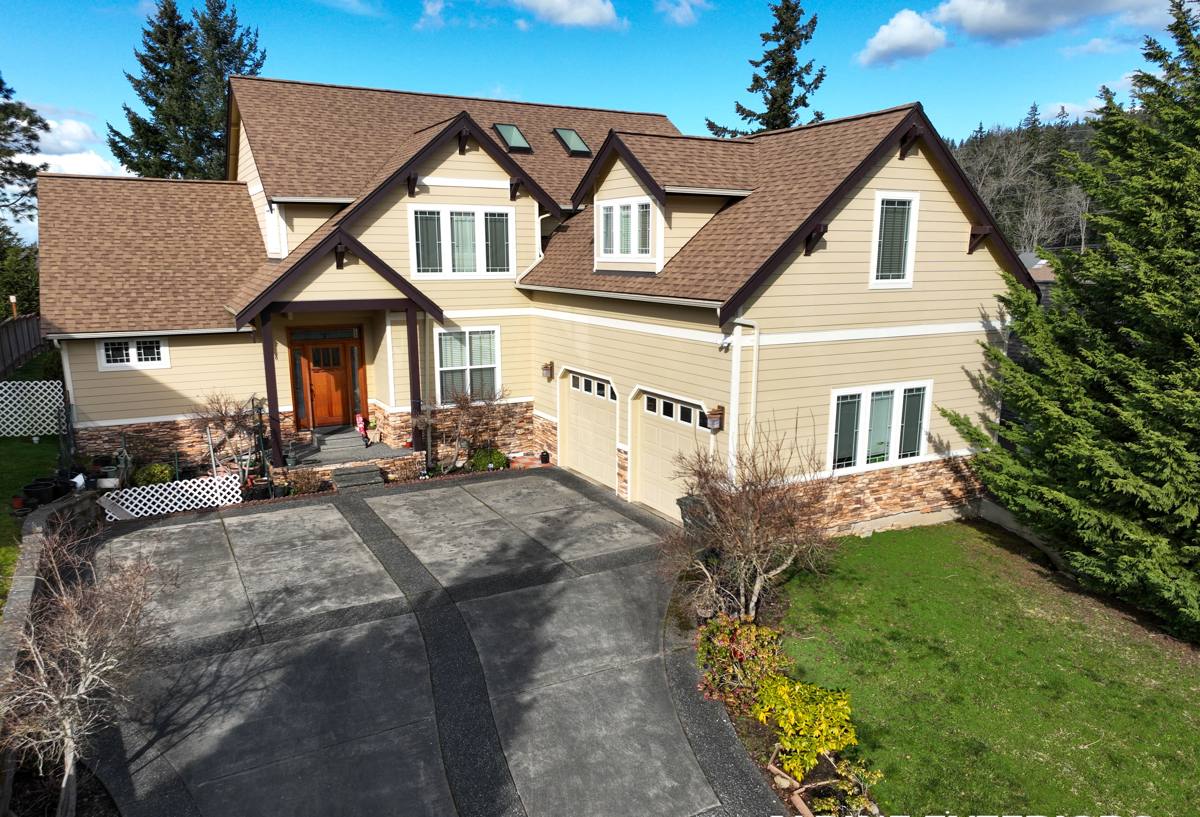
What Bellingham's Climate Actually Does to a Roof
Salt Air and Corrosion
Bellingham isn't a beachfront town, but it's close enough to Bellingham Bay and the Strait of Georgia that airborne salt reaches homes on higher ground and near the waterfront in measurable amounts. Salt exposure accelerates corrosion at cut edges, fastener heads, and any spot where a coating has been scratched or thinned during installation. This is why fastener choice and finish quality matter more here than they would on a roof fifty miles inland.
Driving Rain
Wind-driven rain doesn't just fall straight down — it pushes sideways under ridge caps, around penetrations, and into any lap or seam that wasn't detailed correctly. A metal roof's advantage is a continuous, low-permeability surface, but that advantage only holds if the underlayment, flashing, and seam work are done to handle water moving sideways and uphill under pressure, not just water running downhill.
Moss and Shade
Bellingham's tree cover and long overcast stretches keep roof surfaces damp longer than they would stay in a drier climate. Moss needs that sustained moisture and a rough surface to grip. Smooth metal panels give moss far less to hold onto than shingles do, but debris buildup in valleys, behind chimneys, and along low-slope transitions can still create the damp, shaded pockets moss prefers — which is why panel layout and drainage detailing are part of preventing it, not just the material choice.
What a Correct Metal Roof Installation Involves
A metal roof is only as good as the assembly underneath it. The panels are the visible layer, but four other components determine whether the system actually performs in this climate.
- Underlayment: A synthetic or self-adhered underlayment rated for high-moisture climates, installed with proper laps oriented to shed wind-driven rain rather than trap it.
- Fastening system: Corrosion-resistant fasteners matched to the panel metal — mixing incompatible metals accelerates corrosion through galvanic reaction, which is a common failure point on poorly sourced repairs.
- Flashing and trim: Custom-formed flashing at valleys, eaves, rakes, and every penetration (vents, chimneys, skylights). This is where most leaks originate on any roof type, and it's the part that separates a clean install from a rushed one.
- Ventilation: Balanced intake and exhaust airflow so moisture from inside the home doesn't condense against the underside of the metal, which can cause hidden deck rot even when the roof surface looks fine.
Panel type matters too. Standing seam systems use raised, mechanically or hand-crimped seams with no exposed fasteners on the field of the roof, which removes the most common long-term leak point. Exposed-fastener panels cost less up front but rely on gasketed screws that compress over time and need periodic checking — a maintenance item worth knowing about before you choose that route in a wet climate.
Comparing Metal Roofing Options
| System | Typical Lifespan | Best Suited For | Key Trade-Off |
|---|---|---|---|
| Standing seam steel | 40–60+ years | Full replacements, homes near the water | Higher upfront cost, no exposed fasteners to maintain |
| Exposed-fastener panel | 25–40 years | Budget-conscious replacements, outbuildings, shops | Fastener gaskets need periodic inspection and eventual replacement |
| Stone-coated steel | 40–50 years | Homeowners wanting a shingle or shake profile with metal durability | More seams and fasteners than standing seam; installation detail is critical |
| Aluminum panel | 40–60 years | Coastal-proximity homes concerned about corrosion | Softer material, more careful handling required during install |
We generally steer homeowners in higher-exposure areas of Bellingham toward standing seam steel or aluminum, simply because fewer exposed fasteners means fewer future maintenance points in a climate that's hard on hardware. That's a judgment based on long-term maintenance burden, not a knock on exposed-fastener systems — they're a legitimate, cost-effective choice for the right application.
How Our Process Works
1. On-Site Inspection
We walk the roof, check the deck condition, evaluate existing ventilation, and look at how water currently moves off the structure — valleys, eaves, and any spots showing past moss or moisture staining. This is also where we identify whether a full tear-off is needed or whether the existing deck is sound enough to build on.
2. System Selection
Based on the inspection, sun and shade exposure, and your budget, we walk through panel and finish options with you in plain terms — what each one costs to install, what it needs from you in upkeep, and how it will hold up given the specific exposure of your roof.
3. Tear-Off and Deck Prep
Old roofing material comes off, the deck is inspected for rot or soft spots (common around old penetrations and in valleys on older Bellingham homes), and any damaged sheathing is replaced before anything new goes down.
4. Underlayment and Flashing
We install underlayment rated for our rainfall volumes, then custom-form and install flashing at every valley, wall transition, and penetration before a single panel goes up. This step is what actually stops leaks — panels are the finish layer, not the waterproofing layer.
5. Panel Installation
Panels are installed to manufacturer spec with attention to expansion allowance (metal moves with temperature swings) and correct fastener spacing and torque, so gaskets seal properly without over-compression.
6. Final Walkthrough
We check seams, trim, and penetrations, clear the site of debris and fasteners, and walk the finished roof with you so you know what to look for over the years ahead.
Maintenance in a Whatcom County Climate
Metal roofing is low-maintenance compared to shingles, but "low-maintenance" doesn't mean "no-maintenance" here. A few habits go a long way toward getting the full lifespan out of the system:
- Clear debris from valleys and low-slope areas each fall, before the wet season builds up organic material that can hold moisture against the surface.
- Check gutters and downspouts for proper flow — driving rain in this area puts real volume through the drainage system, and a clogged gutter can back water up under eave flashing.
- Have exposed-fastener systems checked periodically for gasket wear, especially on south- and west-facing slopes that see the most thermal cycling.
- Keep overhanging branches trimmed back where practical, both to reduce debris load and to cut down on the shaded, damp microclimate moss favors.
- After any major windstorm, a quick visual check for lifted trim or displaced flashing is worth the five minutes it takes.
What Drives Cost
| Factor | Why It Matters |
|---|---|
| Roof complexity | Valleys, dormers, and multiple planes require more custom flashing work and labor time |
| Panel and finish choice | Standing seam and premium finishes cost more per square than exposed-fastener panel |
| Deck condition | Rot or soft sheathing found during tear-off adds repair scope before installation can proceed |
| Tear-off vs. overlay | Removing old material adds labor but is often the right call for long-term performance |
| Access and pitch | Steep or hard-to-access roofs take longer and require additional safety setup |
Exact numbers depend on your roof's size and condition, and we'll give you a specific, itemized figure after seeing it in person rather than a broad estimate that doesn't hold up once we're actually on the roof.
Signs It's Time to Look at Your Roof
- Visible moss growth, especially in valleys or on shaded north-facing slopes
- Granule buildup in gutters (a sign of an aging asphalt roof nearing replacement age)
- Rust streaking or corrosion at existing metal flashing or fasteners
- Daylight visible through the attic at eaves, ridges, or penetrations
- Interior ceiling stains that appear or worsen after wind-driven rain events
- Curling, cracked, or missing shingles on an existing roof
Any one of these on its own isn't necessarily an emergency, but they're worth a professional look before the next wet season, since small issues in this climate tend to compound quickly once water finds a way in.
Why a Bellingham-Familiar Crew Matters
A metal roof installed correctly in a dry inland climate can still underperform here if the crew doesn't build in the margin this weather demands — extra attention to lap direction against driving rain, corrosion-appropriate fasteners, and ventilation sized for consistently damp conditions. We work in Bellingham and across Whatcom County regularly, which means we're accounting for wind exposure patterns, typical roof pitches in the area, and the moisture load local homes actually see, not applying a one-size-fits-all approach borrowed from a different climate. We're also familiar with local permitting requirements and typical inspection expectations, which keeps the project moving without surprises partway through.
If you're weighing a metal roof for your Bellingham home — whether it's a full replacement, a repair, or just an honest evaluation of what your current roof needs — we're happy to take a look and walk you through your options. Reach out for a free, no-pressure estimate using the form below.