 Lynden Exterior
 Blaine's Siding Problem Isn't Like Lynden's
Blaine sits right on the water — Semiahmoo Bay and Drayton Harbor are close enough that salt-laden air is part of daily life, not an occasional weather event. That's a different exposure profile than what we see on inland jobs in Lynden or Everson. A house a few blocks from the water takes on airborne salt, near-constant humidity, and wind-driven rain off the Strait of Georgia in a way that accelerates every weak point in a siding system: fasteners, caulk joints, paint film, and anything with exposed end-grain.
Add in Whatcom County's long, gray moss season — roughly October through April when north- and west-facing walls barely dry out between storms — and you've got a climate that's genuinely tougher on exterior cladding than most of the rest of the county. Siding that performs fine in a drier or more sheltered part of Lynden can fail years early in Blaine if it isn't matched to these conditions and installed with that exposure in mind.
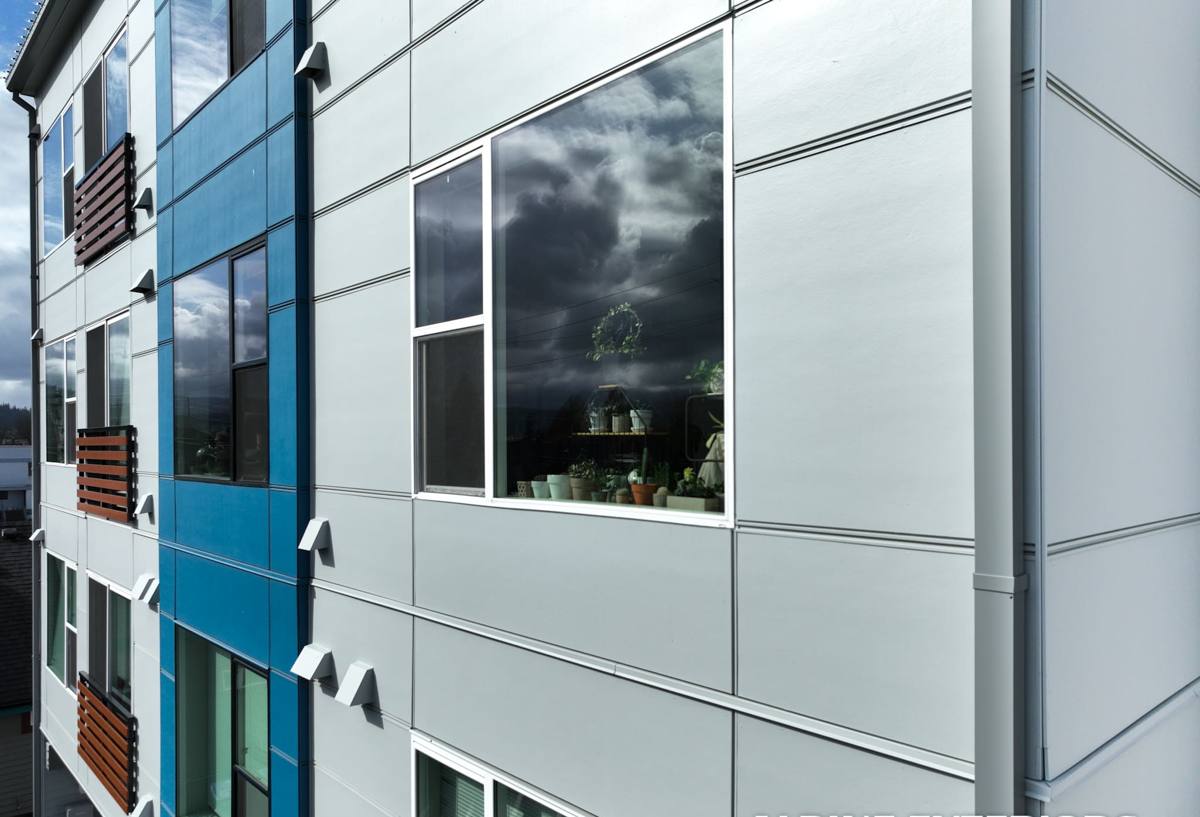
What Salt Air and Moisture Actually Do to Siding
Corrosion Where You Can't See It
The most common failure we find on coastal Whatcom County homes isn't the siding panel itself — it's the fasteners and flashing behind it. Standard steel nails and staples corrode faster near salt water, and once a fastener starts rusting, it can bleed through paint, lose holding power, or create a small gap where water gets behind the cladding. This is a slow, hidden problem that usually isn't visible until siding starts to loosen or streak.
Moss, Algae, and Trapped Moisture
Blaine's tree cover and marine humidity mean shaded and north-facing walls stay damp for long stretches, especially in winter. That supports moss and algae growth on any siding surface that holds moisture at the surface or in surface texture. Over time, organic growth traps additional moisture against the wall, which is bad news for any material that isn't dimensionally stable or that relies on a field-applied paint film to keep water out.
Driving Rain and Wall Assembly Stress
Wind off the water pushes rain sideways, not straight down. That means laps, butt joints, trim intersections, and penetrations (hose bibs, vents, light fixtures) take on more direct water pressure than they would on a sheltered inland lot. A siding system that depends on perfect field caulking to stay watertight is a liability here — the assembly needs to shed water even when a joint isn't perfectly sealed.
Why We Only Install James Hardie Fiber Cement
We install James Hardie fiber cement exclusively — not vinyl, not LP SmartSide or other engineered wood products, not other fiber cement brands. That's a deliberate standard, not a sales preference, and it matters more in a place like Blaine than almost anywhere else in the county.
Non-Combustible and Dimensionally Stable
Fiber cement is made from cement, sand, and cellulose fiber. It doesn't expand and contract with humidity the way wood-based products do, and it doesn't soften or swell at cut edges and joints the way engineered wood can if moisture gets in. In a climate where walls stay damp for months at a time, that stability is the difference between siding that holds its line for decades and siding that starts to show waviness, joint gaps, or edge swelling within the first several years.
ColorPlus Factory Finish
James Hardie's ColorPlus finish is baked on at the factory under controlled conditions, not brushed or sprayed on site. That gives a harder, more UV- and moisture-resistant top coat than field-applied paint, which matters directly here: a factory finish holds up better against the constant damp-dry cycling that drives mold, algae, and coating failure on coastal homes.
Engineered for the Region
Hardie makes climate-specific product lines (HZ5 for the Pacific Northwest and similar cold/wet climates), engineered with moisture and freeze-thaw performance in mind rather than a one-size-fits-all formulation. That's part of why we standardized on Hardie over other fiber cement brands — the product is actually engineered for the exposure Blaine homes see, not just similar on paper.
How Siding Materials Compare in Blaine's Climate
| Factor | Vinyl | Engineered Wood (LP-type) | James Hardie Fiber Cement |
|---|---|---|---|
| Moisture/humidity tolerance | Won't rot, but warps and gaps in heat/cold swings | Vulnerable if seals or paint fail; edge swelling risk | Dimensionally stable wet or dry |
| Salt air / corrosion exposure | Panel itself is inert, but fasteners and trim still at risk | Same fastener risk, plus wood substrate degradation | Panel inert; corrosion-resistant fastener specs used |
| Moss/algae resistance | Textured surface can hold growth | Wood grain texture holds moisture and growth | Smooth factory finish sheds growth more easily |
| Finish durability | Color baked into panel but can chalk/fade | Field or factory paint, needs recoating over time | Factory ColorPlus finish, longer recoat interval |
| Fire performance | Combustible, can melt/deform near heat | Combustible | Non-combustible |
None of this means vinyl or engineered wood are junk products in general — they have their place. But given what Blaine's air and rain do to a wall over a 20- or 30-year horizon, we made a professional call to standardize on the material that holds up best to that specific exposure, and stand behind that installation with one product system rather than juggling several.
What a Correct Installation Looks Like Here
Fastener and Flashing Specification
In a salt-air environment, we spec corrosion-resistant fasteners and flashing details rather than treating that as an afterthought. This is the single most common corner cut we see on coastal siding failures — the panel material is fine, but the hardware holding it up wasn't chosen for the exposure.
Proper Clearances and Drainage
Hardie's warranty and installation manual specify minimum clearances from grade, roofing, and decks, plus a drainage plane behind the panel. In a climate where walls stay wet longer, skipping or shrinking these clearances is exactly what lets moisture sit against the wall assembly instead of draining and drying.
Caulking and Joint Treatment
Butt joints, trim intersections, and penetrations get treated as the weak points they are — sealed and flashed to shed wind-driven rain rather than relying on caulk alone as the only line of defense.
Field-Cut Edge Sealing
Any factory edge that gets field-cut needs to be sealed per Hardie's specifications before installation. Skipping this is a common shortcut that shows up years later as a moisture entry point right at the cut, especially on a job exposed to the amount of driving rain Blaine sees.
Signs Your Current Siding Is Losing the Fight
- Persistent moss or dark streaking on north- or west-facing walls that comes back within a season of cleaning
- Rust streaks running down from nail heads, trim screws, or flashing edges
- Visible waviness, bowing, or gaps opening at panel joints
- Soft or spongy spots when you press on siding near the bottom courses or around penetrations
- Paint or finish that's chalking, peeling, or has faded unevenly compared to sheltered walls
- Caulk joints that have shrunk, cracked, or pulled away from trim
If more than one or two of these show up during a walk around the exterior, it's worth having someone look closer before the underlying sheathing or framing gets involved.
Our Process for a Blaine Project
We start with a walk-around assessment that pays specific attention to the sides of the house facing the water and prevailing wind, since those take the worst of the salt and driving rain. From there:
- Inspect existing siding, trim, flashing, and any moisture-damaged sheathing before quoting the scope
- Confirm the right Hardie product line and profile for the home's exposure and existing architecture
- Spec corrosion-resistant fasteners and flashing appropriate to a coastal Whatcom County job
- Install to Hardie's published clearance, fastening, and joint-treatment specifications
- Walk the finished job with the homeowner, including a look at drainage details and touch-up needs
Because we work coastal Whatcom County jobs regularly, this isn't a generic install adapted on the fly — the fastener spec, flashing details, and clearance decisions are ones we're already making by default for this exposure.
Maintenance and Warranty in a Salt-Air Environment
Fiber cement is low-maintenance, not no-maintenance, and that's especially true this close to the water. An occasional rinse to keep salt residue and organic buildup from accumulating, a periodic look at caulk joints, and prompt attention to any impact damage will get the most out of the system. James Hardie backs its siding with a strong transferable product warranty, and correct installation is what keeps that warranty intact — which is another reason installation detail matters as much as the product choice itself.
If you're weighing a siding replacement or repair on a Blaine home and want a straight answer on what your walls actually need, we're happy to walk the exterior with you and give a free, no-pressure estimate — no obligation, just an honest look at what's going on and what it would take to fix it right.