 Lynden Exterior
 Why Custer Homes Wear Out Siding Faster Than You'd Expect
Custer sits in northern Whatcom County, close enough to the Salish Sea that salt-laden air reaches homes on a regular basis, especially during winter storms that push wind straight off the water. Combine that with the driving, sideways rain typical of Pacific Northwest winters and a moss season that can run eight months or longer in shaded, north-facing areas, and you have a climate that is genuinely harder on exterior siding than most of the country ever deals with.
Salt air accelerates corrosion of fasteners and trim metal. Wind-driven rain finds every gap in a siding system that wasn't installed with proper flashing and drainage. And moss and algae hold moisture against the surface of the siding for weeks at a time, which is exactly the condition that rots wood-based products and degrades poorly-sealed panel edges. None of this is unique to Custer, but it's more constant here than in drier inland parts of Whatcom County, and it shows up in how fast siding on local homes starts to fail if it wasn't built for the job in the first place.
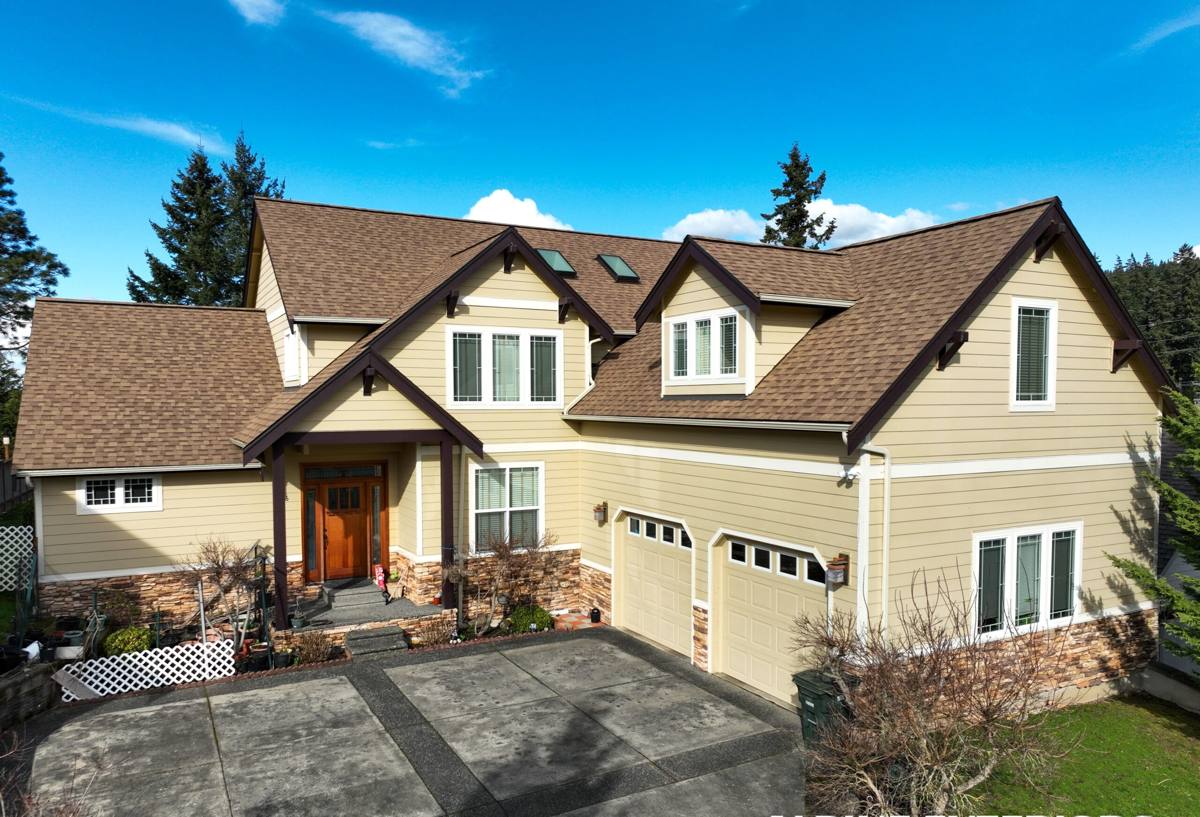
Signs a Custer Home Needs Siding Replacement, Not Another Patch
We get a lot of calls for "just fix this one spot," and sometimes that's genuinely all that's needed. But certain signs mean the underlying material or installation has failed and patching will just buy a year or two before the same problem resurfaces somewhere else on the wall.
- Soft or spongy spots when you press on siding, especially near the bottom courses or under windows
- Persistent black or green staining that comes back within weeks of being cleaned
- Paint that's bubbling, peeling, or chalking in patches rather than evenly across the wall
- Visible gaps, warping, or buckling panels, particularly on the sides of the house that catch prevailing wind and rain
- Rust streaks running down from nail heads or trim fasteners
- Interior signs — musty smells, damp drywall, or peeling interior paint on an exterior wall
- Siding that's more than 20-25 years old and made of untreated wood, hardboard, or older-generation composite products
If you're seeing two or more of these at once, it's usually a sign the moisture barrier behind the siding has been compromised, not just the visible surface.
Why We Only Install James Hardie Fiber Cement
We've made a deliberate call as a company to install one siding system: James Hardie fiber cement, engineered specifically for the Pacific Northwest through Hardie's HZ5 product line. That's not a marketing preference, it's a response to what we consistently see happen to other materials in exactly this kind of climate.
How the common alternatives hold up here
Vinyl siding is affordable and low-maintenance in the sense that it doesn't need repainting, but it expands and contracts significantly with temperature swings, which opens seams over time, and it's not rated to stop wind-driven rain the way a properly flashed fiber cement system is. In a direct impact from hail or debris, it also cracks rather than dents.
Engineered wood products (like LP SmartSide) use a wood-strand core with a resin coating. That coating is only as good as its weakest point, and once moisture gets past a cut edge, seam, or fastener hole, the wood-strand core absorbs water and swells. In a climate with Custer's moss season and rain exposure, that's a real risk over the life of the siding, not a hypothetical one.
Cedar and primed spruce look excellent when new, but they're organic materials in a climate built to break down organic materials. They demand a repainting and caulking cycle every few years to stay ahead of moisture, and skipping even one cycle can let rot get started somewhere you won't see until it's advanced.
| Material | Behavior in salt air / driving rain | Repainting cycle | Non-combustible |
|---|---|---|---|
| James Hardie fiber cement | Engineered for moisture and coastal exposure; factory ColorPlus finish resists fading | 15+ years (ColorPlus), longer than field-painted products | Yes |
| Vinyl | Seams can open with thermal movement; not a rain-screen system | None, but cracks and fades over time | No |
| Engineered wood (LP SmartSide) | Vulnerable at cut edges and fastener penetrations | 5-8 years | No |
| Cedar / primed spruce | Absorbs moisture, prone to rot without upkeep | 3-5 years | No |
James Hardie fiber cement is cement, sand, and cellulose fiber — it doesn't feed rot, doesn't swell when it gets wet, and it's noncombustible, which matters given wildfire smoke seasons have become a more regular part of Pacific Northwest summers even here on the wet side of the state. The ColorPlus factory finish is baked on under controlled conditions, which holds color and resists moisture intrusion far better than a coat of paint applied on site. Backed by a strong transferable warranty when installed to Hardie's specifications, it's the one system we're comfortable standing behind on every home we side.
What a Correct Siding Replacement Job Actually Involves
The material is only half the equation. Most siding failures we see on older Custer homes weren't caused by bad siding, they were caused by a rushed or incomplete installation underneath it. A correct job means:
Tear-off and inspection
Full removal of the old siding down to the sheathing, followed by an honest look at what's underneath. This is where hidden rot, damaged sheathing, or old improper flashing gets found and dealt with, not covered over.
Weather-resistive barrier and flashing
A continuous, properly lapped weather barrier goes on before any siding, with flashing at every window, door, and penetration so water is directed out and down rather than into the wall cavity. This is the step that determines whether wind-driven rain off the Salish Sea stays outside the house or ends up in your framing.
Correct fastening and clearances
James Hardie panels have specific nailing patterns, fastener types, and minimum clearances from grade, roofing, and decks that have to be followed exactly for the warranty to hold and for the system to perform. Rust-resistant fasteners matter here specifically because of the salt air exposure — the wrong fastener corrodes and stains the siding face within a few years.
Trim, caulking, and paint touch-up
Corner boards, trim, and any factory-cut edges get sealed and finished so there's no exposed raw material for moisture to enter. This last step is where a lot of lower-bid jobs cut corners, and it's usually the first place problems show up.
How Our Process Works, Start to Finish
- Free on-site assessment — we look at the current siding, check for hidden moisture or rot, and give you a straight answer on whether replacement or repair actually makes sense.
- Written estimate — a clear scope and price, no vague allowances, so you know what you're paying for before any work starts.
- Tear-off and sheathing check — old siding comes off, sheathing gets inspected and repaired as needed before anything new goes on.
- Weather barrier and flashing install — the part of the job that actually keeps water out, done to manufacturer spec.
- James Hardie installation — panels, trim, and fasteners installed to Hardie's published specifications for our climate zone.
- Final walkthrough — we go over the finished work with you before calling the job done.
What Drives Cost on a Custer Siding Replacement
| Factor | Why it matters |
|---|---|
| Home size and wall complexity | More corners, dormers, and trim detail mean more labor and cut waste |
| Condition of existing sheathing | Rot repair found during tear-off adds cost but has to be fixed, not covered over |
| Siding profile and color | Lap width, shingle-style panels, and specialty ColorPlus finishes vary in material cost |
| Access and site conditions | Slopes, tight setbacks, and landscaping affect staging and scaffolding time |
| Trim and accessory scope | Full trim replacement alongside siding costs more up front but avoids mismatched, unprotected wood trim later |
We'd rather walk your specific home and give you real numbers than throw out a broad range that doesn't mean much until someone's actually looked at your walls.
Why a Crew That Already Works in Custer Matters
Siding installation isn't just about following a manufacturer's manual, it's about knowing how a specific product performs under the specific conditions it'll face. A crew that already works across Custer and the greater Lynden area has seen firsthand which walls take the worst of the wind and rain, which older homes tend to have hidden moisture issues behind their original siding, and how to sequence a tear-off around this area's weather rather than fighting it. That local pattern recognition is the difference between a crew that installs siding correctly on paper and one that installs it correctly for this specific climate.
It also means faster response if something needs a warranty check or follow-up down the road — you're not waiting on a crew that has to drive in from another region or another state.
Maintenance After Installation
James Hardie fiber cement is genuinely low-maintenance, but "low" isn't "none." A simple annual routine keeps it performing for decades:
- Rinse the exterior with a garden hose once or twice a year to clear salt residue and organic buildup before it sets in
- Keep gutters clear so overflow doesn't run down the siding face repeatedly in one spot
- Trim back vegetation and landscaping that holds moisture or shade against the wall, which is exactly what feeds moss
- Check caulking at trim joints and penetrations every couple of years and touch up as needed
That's a fraction of the upkeep wood or engineered wood siding demands, and it's part of why the long-term cost of Hardie tends to come out ahead even though the up-front installation is a genuine investment.
If your Custer home's siding is showing any of the wear signs above, or you're just planning ahead before it becomes a problem, we're happy to take a look. Reach out for a free, no-pressure estimate using the form below and we'll give you a straight assessment of where things stand.