 Lynden Exterior
 Board & Batten Siding Built for Ferndale's Marine Climate
Ferndale sits close enough to Bellingham Bay and the Strait of Georgia that homes here deal with a version of coastal weather most inland Whatcom County towns don't see as often: salt-laden air, wind-driven rain that hits walls at an angle instead of just falling straight down, and long stretches of gray, damp months that keep siding wet for days at a time. Board & batten siding — with its bold vertical lines and deep shadow reveals — is one of the more popular exterior styles we're asked about in Ferndale, and it can hold up beautifully here. But only when it's built and installed with this specific climate in mind, not treated as a one-size-fits-all product.
The vertical boards and raised battens that give this siding its look also create more seams, more fastener penetrations, and more edges than a standard lap profile. Every one of those details is a place water can try to get in. Done right, board & batten is a durable, low-drama siding choice for a Ferndale home. Done wrong — or installed with a material that wasn't engineered for this kind of exposure — it becomes a slow-motion moisture problem hiding behind an attractive face.
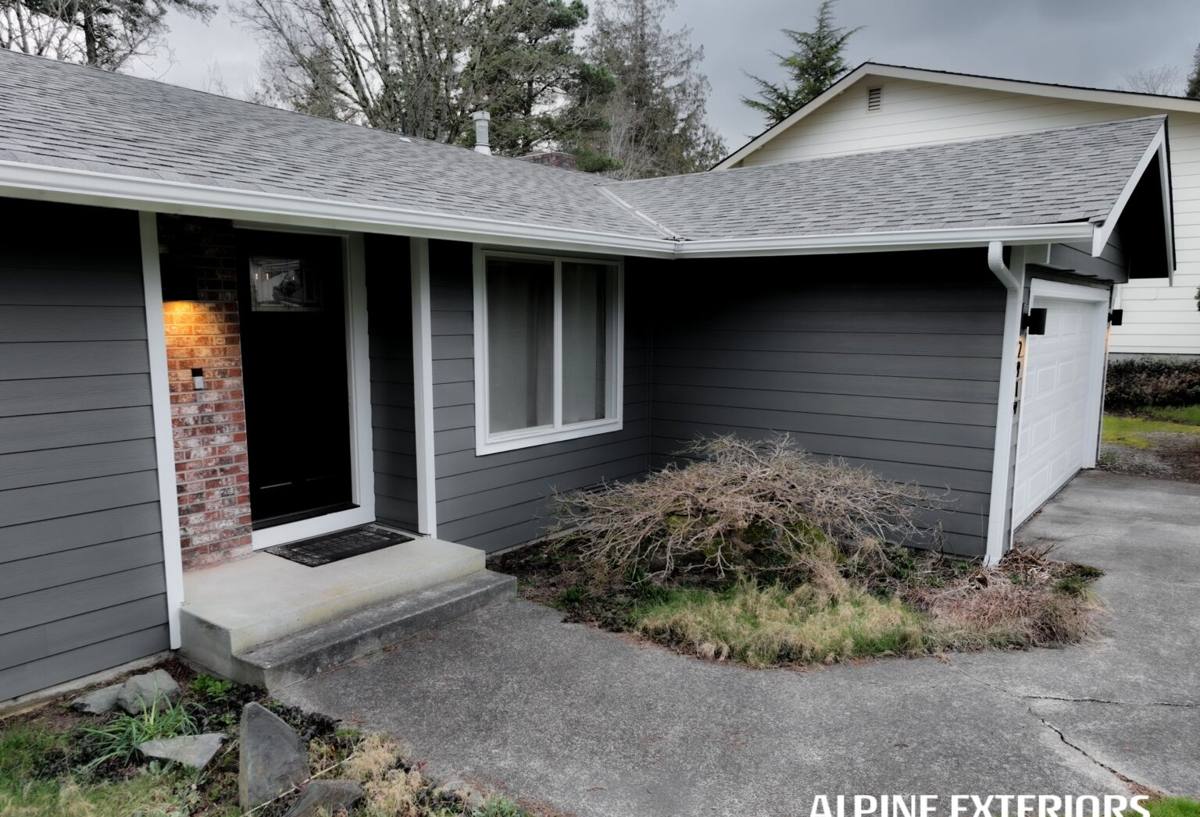
What Salt Air and Driving Rain Actually Do to Siding
Salt Air
Airborne salt is corrosive to fasteners, trim flashing, and any metal components on a wall system, and it accelerates the breakdown of paints and finishes that weren't formulated to resist it. Over years, homes closer to open water tend to show chalking, fading, and finish failure faster than the same product would show further inland.
Driving Rain
Wind off the water doesn't just add rainfall — it pushes water sideways into vertical seams, under battens, and around window and door trim. A board & batten wall depends on its drainage plane and flashing details doing their job every single time it rains, because the face of the siding is never the only thing keeping water out.
Moss Season
Shaded lots, tree cover, and long wet winters mean moss and algae growth is a fact of life on north- and west-facing walls in this part of Whatcom County. Moss holds moisture against the siding surface far longer than open air would, which matters a lot for how a material ages and how often it needs attention.
What Correct Board & Batten Installation Actually Involves
Board & batten looks simple from the street, but the assembly behind it is more involved than a standard lap job. The details that separate a siding system that lasts from one that fails early are almost all invisible once the project is finished.
- A drainage gap (rainscreen) behind the siding so any moisture that gets past the face has somewhere to go besides the wall sheathing
- Weather-resistive barrier installed and lapped correctly, shingle-style, so water sheds down and out rather than behind the barrier
- Flashing at every horizontal transition — window heads, door heads, roof-to-wall intersections, and any trim board that runs horizontally
- Batten spacing and fastening that follows the manufacturer's engineering, not just what looks even
- Proper clearance from grade, decks, patios, and roof lines so splash-back and standing water don't sit against the bottom edge
- Sealed, backed joints wherever boards meet, rather than relying on caulk alone to do the work
Skipping any one of these doesn't usually cause a visible problem right away. It shows up two, five, or ten years later as soft trim, stained sheathing, or paint that won't stop failing in the same spot — by which point the fix is far more expensive than doing it correctly the first time would have been.
Why We Only Install James Hardie for Board & Batten Projects
Board & batten siding is available in several materials — vinyl, engineered wood like LP SmartSide, and fiber cement among them. We made the decision to install James Hardie fiber cement exclusively, and board & batten profiles are actually where that decision matters most, because the vertical seams and exposed battens put extra stress on whatever material is behind them.
| Factor | James Hardie Fiber Cement | Engineered Wood (e.g. LP SmartSide) | Vinyl |
|---|---|---|---|
| Moisture behavior | Non-combustible, engineered to resist moisture-related swelling | Wood-based core can swell or delaminate if moisture reaches cut edges or gaps | Won't rot, but panels expand/contract and can warp or crack in temperature swings |
| Salt air / coastal exposure | Climate-specific HZ formulations built for wet, coastal regions | Requires diligent sealing of every cut edge to hold up long-term | Doesn't corrode, but color fades faster in UV and salt exposure |
| Finish | Factory-applied ColorPlus finish, baked on for consistency and UV resistance | Typically field- or factory-painted; touch-up matching can be difficult | Color is through-body but limited in depth and tends to chalk over time |
| Fire rating | Non-combustible material | Combustible, wood-based | Combustible, can deform under heat |
| Long-term look | Holds crisp shadow lines with minimal warping over decades | Can show swelling, edge softening at seams over time | Can look and feel less substantial; visible flex on wide boards |
Engineered wood and vinyl both have legitimate uses and plenty of homes carry them without issue. Our reasoning is narrower than "one product is bad" — it's that board & batten specifically has more seams and more exposed edges than lap siding, and in a wet, salt-influenced climate like Ferndale's, we've decided that's exactly where we don't want to compromise on moisture resistance, fire performance, or finish durability. Hardie's engineered fiber cement and factory finish are built to take that exposure without the maintenance burden that comes with resealing edges or repainting on a shortened cycle.
Our Process for Ferndale Board & Batten Projects
1. On-Site Assessment
We look at wall exposure, existing moisture damage, roofline transitions, and how much direct weather and shade each elevation gets — north and west walls in Ferndale often need extra attention because of the combination of driving rain and slower drying time.
2. Tear-Off and Sheathing Check
Old siding comes off and the sheathing underneath gets inspected before anything new goes up. Hidden rot or soft spots get addressed at this stage, not covered over.
3. Weather Barrier and Drainage Plane
A properly lapped weather-resistive barrier and rainscreen gap go in before a single board is hung, giving the wall a real second line of defense.
4. Flashing and Trim
Every window, door, and horizontal transition gets flashed before the siding closes around it — this is the step that determines whether the wall stays dry for the next thirty years or not.
5. Board & Batten Installation
Panels and battens go up to Hardie's fastening and spacing specifications, with joints backed and sealed correctly rather than caulked and hoped for.
6. Final Walkthrough
We walk the finished job with the homeowner, check reveals and lines, and confirm everything meets both the manufacturer's install requirements and our own standard.
Living With Board & Batten Siding in Ferndale
Even a well-installed system benefits from some basic upkeep, especially given local moss and salt exposure.
- Rinse pollen, salt residue, and grime off with a garden hose and soft brush once or twice a year
- Keep gutters clear so overflow doesn't run down the wall face repeatedly in one spot
- Trim back vegetation and tree limbs that keep a wall shaded and slow to dry
- Treat moss on shaded elevations early rather than letting it build up against the siding
- Have caulking and trim joints checked periodically, since these are the first place wear shows
This is markedly less maintenance than an engineered wood product needs, where cut edges and joints require ongoing sealant attention to keep moisture from finding its way into the core material.
What Board & Batten Siding Costs to Consider
| Cost Factor | Why It Matters in Ferndale |
|---|---|
| Wall exposure and elevation count | North/west walls facing prevailing weather often need extra flashing and drainage detail |
| Existing sheathing condition | Hidden moisture damage from prior siding adds repair scope before new siding can go on |
| Trim and batten complexity | More corners, window trim, and batten runs mean more labor and material |
| Color and finish selection | ColorPlus factory finishes vary in cost by line and color depth |
| Access and site conditions | Sloped lots, tight setbacks, and landscaping affect scaffolding and staging time |
We give firm numbers only after seeing the actual walls — anyone quoting a board & batten job over the phone without inspecting the sheathing and elevations is guessing.
What to Ask Before Hiring a Board & Batten Contractor
- Will you install a rainscreen/drainage gap behind the siding, or fasten directly to the barrier?
- How do you flash window and door heads, and roof-to-wall transitions?
- What's your fastener and batten spacing based on — the manufacturer's spec sheet or general practice?
- Do you inspect and repair sheathing before installing new siding, or install over existing damage?
- Can you show me the specific product line and finish warranty for the siding you're proposing?
Why a Crew That Already Works Ferndale Matters
A contractor who works this area regularly already knows which elevations tend to hold moss, how much wind-driven rain a given exposure sees over a winter, and where cut corners on a previous job tend to show up first. That familiarity shows up in the details — flashing choices, drainage planning, fastener selection — long before it shows up as a problem. It's the difference between a crew applying a generic install and one building specifically for the weather your home actually faces.
If you're weighing board & batten siding for a home in Ferndale, we're glad to walk the property, look at your current siding and trim condition, and give you a straight, no-pressure estimate — no invented urgency, just an honest look at what your walls need. Use the form below to get started.