 Lynden Exterior
 Blaine's Climate Is Rougher on a Deck Than It Looks
Blaine sits right up against Semiahmoo Bay and the Strait of Georgia, which means homes here deal with something most of Whatcom County doesn't get in the same combination: salt-laden air off the water, driving rain that comes in sideways during winter storms, and a moss season that can stretch from October well into spring. Any one of those on its own is manageable. Together, they're exactly the conditions that expose a poorly built deck within a few years instead of a few decades.
Salt air accelerates corrosion on anything metal — fasteners, joist hangers, railing brackets, even the screws holding down deck boards. Driving rain doesn't just fall on a deck, it gets pushed underneath railings and into end grain and seams that a calmer climate would never test. And moss doesn't just grow on the surface; it holds moisture against the decking material and the framing below it for months at a time, which is where rot and mold actually start. A deck built for a dry inland climate is not the same deck a Blaine home needs.
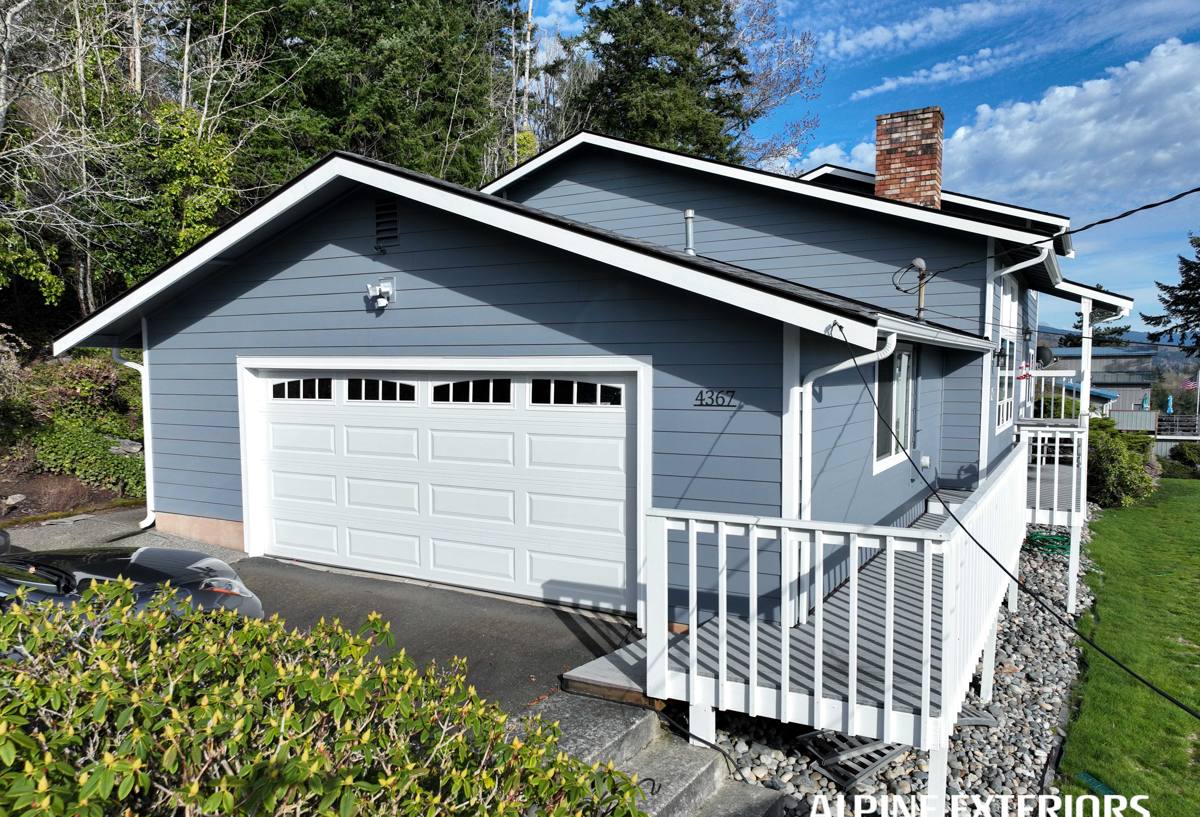
Why Composite Makes Sense for This Specific Environment
Composite decking was built to solve moisture problems, which is precisely Blaine's biggest liability. Unlike wood, composite boards don't have open end grain that wicks up water, and they don't provide the organic surface that moss and algae prefer to root into. That doesn't mean composite is maintenance-free — nothing outdoors on the water is — but it removes the two failure points that hurt wood decks fastest in this area: rot from trapped moisture and surface degradation from constant damp.
The other advantage is dimensional stability. Composite boards expand and contract with temperature and moisture, but far less than wood does, and far more predictably. That matters in a climate where a deck can go from soaked to sun-baked and back again multiple times in a week during shoulder seasons. Boards that move less mean fewer popped fasteners, less board-to-board gapping over time, and a railing system that stays tight instead of working itself loose.
What Composite Doesn't Solve on Its Own
Composite decking is a material choice, not a substitute for correct building practice. A composite deck built on unprotected joists, with poor drainage underneath, or with hardware that isn't rated for a coastal environment will still develop problems — they'll just show up in the substructure instead of the boards themselves. That's the part of the job that actually determines how long a Blaine deck lasts.
Choosing the Right Composite for a Salt-Air Setting
Not all composite decking is built the same way, and the differences matter more here than they would forty miles inland. The biggest distinction is between capped and uncapped composite.
| Composite Type | How It Handles Moisture | Salt-Air Suitability | Maintenance Load |
|---|---|---|---|
| Uncapped composite | Wood fiber is exposed at the surface; absorbs some moisture over time | Workable, but more prone to surface staining and mold in a wet climate | Higher — needs regular cleaning to prevent surface mold |
| Capped composite (cap-stock) | Polymer shell fully encloses the wood-fiber core | Strong fit — resists moisture intrusion and salt staining at the surface | Lower — occasional washing, no sealing or staining |
| Solid PVC decking | No wood fiber at all; fully synthetic | Excellent moisture resistance; heavier, higher upfront cost | Lowest — cleaning only |
For most Blaine homes, fully capped composite hits the right balance of upfront cost, appearance, and long-term performance against salt air and rain. We'll walk through where uncapped boards or solid PVC make more sense depending on your deck's exposure — a deck facing open water year-round has different needs than one tucked behind the house.
What a Correct Composite Deck Installation Actually Involves
The composite boards get the attention because they're what you see, but the framing underneath is what determines whether this deck is still solid in fifteen years. In a climate like Blaine's, we treat the substructure as the priority, not an afterthought.
- Joist tape on every joist — a waterproof membrane over the top of each joist so fasteners seal against it and rain can't sit on exposed wood
- Corrosion-resistant fasteners and hardware — stainless or coated hardware rated for coastal exposure, not standard galvanized that's fine inland but degrades faster near salt air
- Proper board spacing and fastening pattern — following the manufacturer's specified gapping so boards can expand and contract without buckling or pulling loose
- Ventilation underneath the deck — enough airflow below the frame that moisture doesn't pool and sit, which is a major driver of moss and mold on the underside of low decks
- Correct slope and drainage — a slight pitch away from the house so water sheds instead of collecting near the ledger board or foundation
- Ledger board flashing — proper flashing where the deck attaches to the house, since this is the single most common point of hidden water damage on any deck
Skipping any one of these doesn't usually cause a visible problem right away. It shows up two, five, or ten years later as soft framing, a sagging section, or a railing post that's gone loose — by which point the fix is far more invasive than it would have been to do it right the first time.
Railings, Fascia, and Hardware in a Salt-Air Setting
Railings and fascia boards take more weather than the deck surface itself, since they're vertical and catch driving rain directly. We spec hardware and railing brackets rated for coastal or marine-adjacent use on Blaine projects, and we pay close attention to how railing posts are anchored — a post that isn't properly through-bolted and flashed is one of the more common places we see early failure on decks near the water.
Our Process, Start to Finish
We keep the process straightforward because a deck project shouldn't feel like a mystery to the homeowner paying for it.
- On-site assessment — we look at your home's exposure, existing structure (if replacing a deck), grade and drainage, and how much direct weather the deck will take
- Material walkthrough — we go over composite options suited to your budget and exposure, including color and board profile choices
- Written estimate — a clear scope of work and price, with no surprise add-ons buried in fine print
- Framing and structural work — built or reinforced to current code, with joist protection and coastal-rated hardware throughout
- Composite installation — boards, fascia, and railing installed to manufacturer spec for spacing, fastening, and ventilation
- Final walkthrough — we go over the finished deck with you, including what maintenance it actually needs (and what it doesn't)
Living With a Composite Deck in a Moss-Prone Climate
Composite decking is genuinely low-maintenance compared to wood, but "low-maintenance" isn't the same as "no maintenance," especially with Whatcom County's extended moss season. A little seasonal attention goes a long way toward keeping a deck looking and performing the way it should.
- Sweep off leaves, needles, and debris regularly through fall — trapped organic material is what gives moss and algae something to grow into
- Wash the deck surface a couple of times a year with a soft-bristle brush and mild soap-and-water solution — avoid pressure washers on composite, which can damage the cap surface
- Check gaps between boards each fall and clear out any built-up debris so water keeps draining properly
- Keep gutters and downspouts near the deck clear so runoff isn't dumping extra water directly onto or near the deck surface
- Inspect railing posts and fasteners annually for any looseness, especially after a hard winter storm season
Cost Factors Worth Understanding
Every deck is different, and we'd rather walk your specific project with you than quote a number that doesn't apply. That said, a few factors consistently move the price of a composite deck up or down, and it helps to know them going in.
| Factor | Why It Matters |
|---|---|
| Composite tier (uncapped vs. fully capped vs. PVC) | Material cost per board varies significantly, and higher-tier boards reduce long-term maintenance |
| Existing structure condition | Replacing boards on sound framing costs far less than rebuilding rotted substructure underneath |
| Deck height and railing requirements | Taller decks and code-required railings add both material and labor |
| Exposure to direct weather | Decks facing open water or prevailing storm direction may warrant upgraded hardware or drainage detailing |
| Size and shape complexity | Multiple levels, angles, or built-in features (benches, stairs) add labor time |
We'll break down where your project falls on each of these during the estimate, so the number you get reflects your actual deck rather than a generic average.
Why It Matters That We Already Work in Blaine
A deck built by a crew that's never dealt with Whatcom County's coastal conditions tends to get built like it's going in Spokane — same hardware, same drainage assumptions, same maintenance expectations. That's how you end up with a deck that looks fine for the first couple of winters and then starts showing problems that were baked in from day one.
Working regularly in Blaine and the surrounding Lynden area means we already know how the wind comes off the water, how far salt spray typically carries onto a property, and which details matter most for a deck that's going to sit through a full Pacific Northwest wet season every single year. That's not a marketing point — it's the difference between a deck that needs attention in year three and one that's still solid in year twenty.
If you're planning a new composite deck or replacing an aging one, we're happy to walk the property, look at your exposure and existing structure, and give you a straightforward, no-pressure estimate. There's a form below — reach out and we'll get a time on the calendar.