 Lynden Exterior
 Blaine's Coastal Climate Puts Real Stress on Exterior Siding
Blaine sits at the far northwest edge of Whatcom County, close enough to open saltwater that homes here take on a different kind of weather load than siding sees further inland around Lynden. It's not just rain totals — it's the combination of salt-laden air, wind-driven moisture, and a long, damp shoulder season that keeps siding wet for weeks at a stretch. Cheap or improperly installed siding gets found out fast in this environment. The good ones just quietly hold up, year after year.
Salt Air and Corrosion
Airborne salt doesn't just affect boats and railings. It settles on exterior surfaces, works into fasteners and trim, and accelerates corrosion on anything not rated or protected for it. Over time, that means premature rust bleed on fastener heads, degraded caulk joints, and faster breakdown of finishes that weren't built to shed salt residue in the first place.
Driving Rain and Wind-Driven Moisture
Blaine catches wind off the water more consistently than sheltered inland towns, and wind-driven rain behaves differently than a straight-down shower — it gets pushed sideways and upward into laps, seams, and penetrations that a calmer climate would never test. Siding, flashing, and water-resistive barrier details that are "close enough" in a mild rain event can fail outright when rain is being driven horizontally against a wall for hours.
The Long Moss and Mildew Season
Between the rain, the humidity, and the shade many Whatcom County lots carry from mature trees, siding here can stay damp far longer after a storm than siding in a drier climate. That extended dampness is exactly what moss, algae, and mildew need to take hold on surfaces that can't shed water and dry out quickly.
Why James Hardie Fiber Cement Is the Right Answer Here
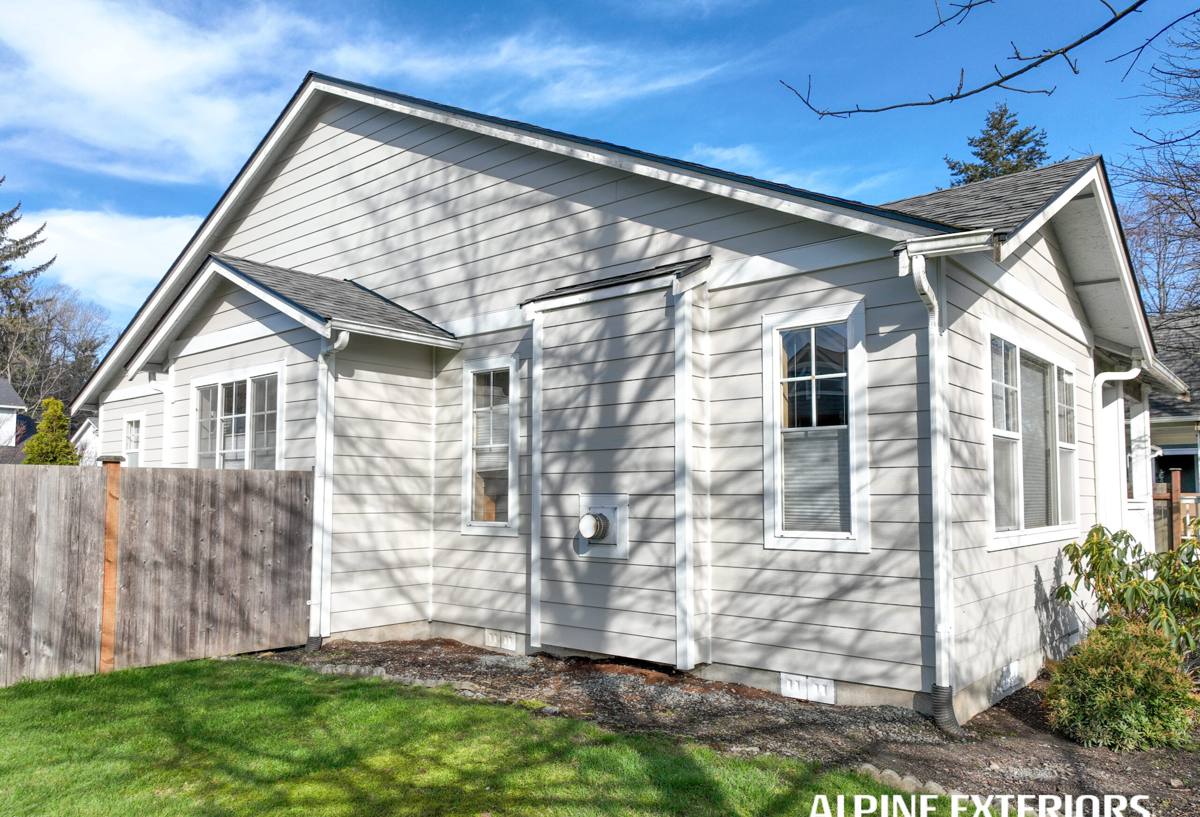
We install James Hardie fiber cement siding exclusively, and Blaine's climate is a big part of why. Fiber cement is non-combustible and dimensionally stable — it doesn't expand, contract, warp, or rot the way wood-based products can when they're cycling between wet and dry for months on end. Hardie's HZ5 product line is specifically engineered for climates like ours, with formulations built to resist moisture damage in areas that see sustained rain and humidity rather than short, dry summers.
The factory-applied ColorPlus finish matters just as much as the substrate. It's baked on under controlled conditions, not brushed on in the field, so it resists fading and holds up to UV and moisture exposure far longer than a typical field-applied coat. For a coastal-adjacent home, that translates into less repainting, fewer failed caulk lines, and a finish that keeps shedding water the way it's supposed to instead of chalking and cracking after a few damp winters.
Why We Don't Install Vinyl, LP SmartSide, or Other Alternatives
We get asked about vinyl and engineered wood siding often enough that it's worth being straight about it. Vinyl is inexpensive and easy to install, but it's a petroleum-based product that expands and contracts with temperature swings, can crack or become brittle over time, and simply can't match fiber cement's rigidity or fire performance. Engineered wood products like LP SmartSide perform reasonably well when installed and maintained exactly to spec, but they're wood-based at the core — meaning any breach in the coating or a caulk joint that fails gives moisture a path into a substrate that can swell or deteriorate, which is a real liability in a climate that stays wet as long as ours does.
Both are legitimate products elsewhere. We simply made a decision, as a company, that the trade-offs weren't worth carrying on a Whatcom County home when a better-performing option exists. That's why every job we take on uses James Hardie, and why we're comfortable explaining exactly what that means and why in plain terms.
What a Correct James Hardie Installation Involves
Fiber cement siding is only as good as the assembly behind it. Hardie is explicit about installation requirements for a reason — most siding failures we get called to inspect trace back to shortcuts in the details, not the product itself.
Weather-Resistive Barrier and Flashing
Every wall gets a continuous weather-resistive barrier installed correctly shingle-style, with proper flashing at windows, doors, and any penetration. In a driving-rain climate, this layer is what actually keeps water out of the wall assembly if it gets past the siding face — the siding is the first line of defense, not the only one.
Clearances and Fastening
Hardie specifies minimum clearances from grade, roof lines, decks, and other siding terminations, along with specific fastener types, spacing, and penetration depth. Skipping these clearances is one of the most common ways moisture gets trapped against the bottom edge of a wall and starts breaking things down from behind — exactly the failure mode a salt-air, high-rain area can't afford.
Caulking and Joint Treatment
Butt joints, trim intersections, and penetrations need the right sealant, applied correctly, or they become the weak point in an otherwise solid installation. We treat joint detailing as a core part of the job, not a finishing afterthought.
Choosing a Product Line and Profile for a Blaine Home
James Hardie makes several distinct product lines, and the right choice depends on your home's style, exposure, and how much detail work you want in the finished look.
| Product | Best For | Look |
|---|---|---|
| HardiePlank Lap Siding | Most home styles, the most common choice locally | Traditional horizontal lap |
| HardiePanel Vertical Siding | Modern designs, accent walls, gable ends | Clean vertical panels |
| HardieShingle Siding | Craftsman and cottage-style homes | Staggered or straight-edge shingle look |
| Board & Batten (HardiePanel-based) | Farmhouse and contemporary exteriors | Vertical boards with raised battens |
Color matters too. Darker ColorPlus finishes hold up well but absorb more heat and can show mineral deposits from salt air a bit more visibly than mid-tone colors, which is worth weighing on a home with direct water exposure. We'll walk through the color and profile options with you against your home's actual sun and wind exposure rather than picking off a swatch in isolation.
Our Process, Start to Finish
- Free on-site estimate. We look at your home's exposure, existing siding condition, and any moisture or trim issues before quoting anything.
- Written scope and product selection. You'll know exactly which Hardie products, colors, and trim details are included before work starts.
- Tear-off and substrate check. We remove the old siding and inspect sheathing for any hidden moisture damage before closing the wall back up.
- Weather-resistive barrier and flashing installation. This layer goes in correctly before a single piece of siding is hung.
- Hardie installation to manufacturer spec. Clearances, fastening, and joint treatment are done to Hardie's published requirements, not shortcuts.
- Final walkthrough. We go over the finished job with you directly before calling it done.
Maintenance: What Blaine Homeowners Actually Need to Do
One of the advantages of a correctly installed Hardie system is how little ongoing maintenance it demands compared to wood or vinyl — but "little" isn't "none," especially in a climate that stays damp as long as ours does.
- Rinse siding annually to clear salt residue and organic buildup before it has a chance to feed moss or algae.
- Inspect caulk joints at trim, windows, and doors yearly and have any cracked or separated caulk replaced promptly.
- Keep gutters clear so water isn't overflowing and running down the siding face during heavy storms.
- Trim back vegetation and tree cover that keeps siding shaded and damp longer than necessary.
- Watch for chalking, fading, or fastener staining, which usually signal it's time for a professional look rather than a DIY touch-up.
Why Hiring a Crew That Already Works in Blaine Matters
Installation quality is the single biggest factor in how long fiber cement siding actually performs, and that quality shows up in details that are easy to miss if a crew isn't used to this specific climate — clearance heights near grade on waterfront-adjacent lots, flashing sequencing around window and door openings that take on more wind-driven rain, and fastening patterns that account for higher wind exposure than a sheltered inland site. A crew that regularly works Whatcom County's coastal-adjacent homes has already made the adjustments that generic, one-size-fits-all installation practices miss.
We also stand behind our work directly, and James Hardie's product warranty is only as good as the installation underneath it — improper installation can affect warranty coverage, so getting it right the first time protects both the siding and the paperwork behind it.
Ready to Talk About Your Home's Siding?
If your Blaine home's siding is showing its age, or you're planning ahead before the next wet season sets in, we're happy to take a look and walk you through exactly what a correct James Hardie installation would involve for your specific home — no pressure, no obligation. Use the form below to request a free estimate.