 Lynden Exterior
 Siding Replacement in Aldergrove, BC: What the Border Climate Demands
Aldergrove sits right at the edge of the Fraser Valley, a short drive from Lynden and the Whatcom County line. Homes on both sides of that border share the same weather pattern, and it is not a gentle one for exterior building materials. Salt-tinged marine air drifts in off the coast, driving rain comes through sideways for weeks at a stretch in the fall and winter, and the valley holds onto damp, low-light days long enough for moss and algae to get established on shaded walls and north-facing exposures. Siding here does not fail because of one storm. It fails from years of repeated wetting and drying, freeze-thaw cycles at the edges of winter, and constant low-grade moisture exposure that most siding products were never engineered to shed indefinitely.
That combination is exactly why we treat a siding replacement in Aldergrove differently than we would in a drier inland climate. The product choice, the water management details behind the cladding, and the sequencing of the work all get adjusted for a wall assembly that is going to spend most of the year damp on the outside.
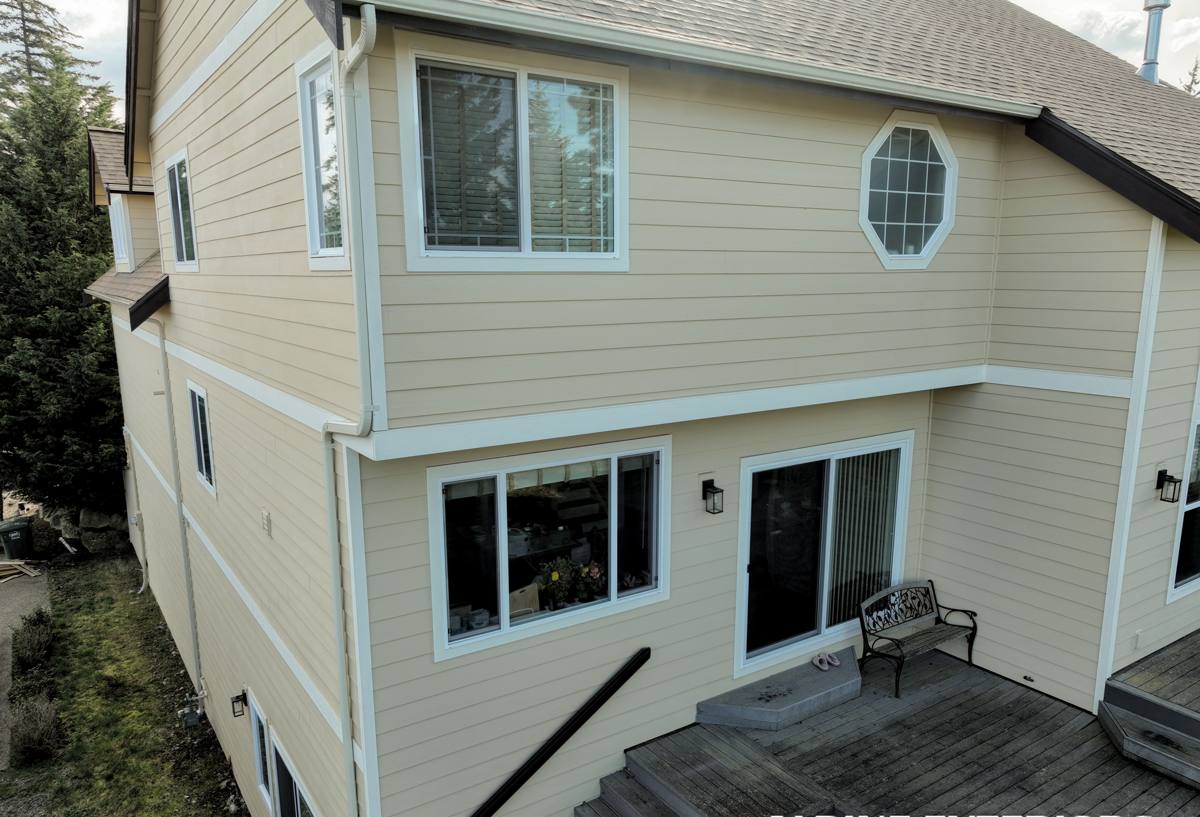
Signs Your Current Siding Has Reached Its Limit
Most homeowners call us after noticing one obvious problem, but a proper inspection usually turns up two or three more. Before recommending a full replacement, we look for a pattern of failure rather than a single symptom, because patching one spot on siding that is failing everywhere else just delays the real decision.
- Soft, spongy, or crumbling spots when you press on the siding, especially near the bottom courses and around window trim
- Persistent moss, algae, or black streaking that comes back within a season of cleaning
- Paint that is peeling, bubbling, or failing faster than a normal repaint cycle would explain
- Visible cupping, warping, or gaps opening up between boards or panels
- Interior signs that trace back to the wall — musty smells, staining near baseboards, or bubbled interior paint on an exterior wall
- Siding that is more than 20-25 years old and was never rated for this kind of sustained moisture load
If you're seeing two or more of these, it's worth a real inspection rather than another round of caulk and touch-up paint. Caulk buys time; it does not fix a wall assembly that is already taking on water.
What a Correct Siding Replacement Actually Involves
It starts underneath the siding, not with it
The siding itself is the last thing installed, not the first thing that matters. A correct replacement starts with a full tear-off so we can actually see the sheathing underneath — something you cannot properly evaluate from a ladder with the old siding still up. In this climate, we routinely find soft sheathing, rusted fasteners, or compromised house wrap behind siding that looked fine from the driveway.
The water-resistive barrier and flashing details
Once the wall is open, we repair or replace any damaged sheathing, install a new water-resistive barrier, and pay close attention to flashing at every penetration: windows, doors, hose bibs, light fixtures, and anywhere two roof planes or wall planes meet. In a region that gets this much driving rain, flashing details are usually the difference between a wall that sheds water and one that slowly absorbs it. We also make sure there's a drainage plane behind the new siding so any moisture that does get past the cladding has somewhere to go instead of sitting against the sheathing.
Installing to manufacturer spec, not just to code
Fastener spacing, gapping at butt joints, clearance off the roofline and ground, and proper caulking at the right joints (and not at joints that are supposed to be left open) all affect how the finished wall performs over the next 30-plus years. We install to the manufacturer's published specifications, because that's what keeps the product warranty intact and what actually determines whether the siding holds up in this climate.
Why We Only Install James Hardie Fiber Cement
We get asked regularly about vinyl, LP SmartSide, and cedar, and it's a fair question — all three have a place in the market. We simply don't install them, and it comes down to how each one behaves under years of the exact conditions Aldergrove and Lynden homes deal with.
| Material | What it does well | Where it struggles in this climate |
|---|---|---|
| Vinyl siding | Low upfront cost, no repainting | Can warp or crack in temperature swings; seams and panels can loosen, letting wind-driven rain track behind the cladding |
| LP SmartSide (engineered wood) | Lighter weight, easier to cut and install | Wood-based core is vulnerable to sustained moisture exposure at joints and cut edges if sealing isn't maintained perfectly |
| Cedar / primed spruce | Natural look, traditional appeal | Requires ongoing refinishing; end grain and butt joints are moisture entry points; moss and mildew take hold quickly in shaded, damp exposures |
| James Hardie fiber cement | Non-combustible, factory-cured finish, engineered for regional moisture exposure | Heavier material and more specific installation requirements — which is why installer experience matters |
None of these other products are junk. Vinyl is a reasonable budget option in a lot of climates, engineered wood has real advantages for certain builds, and cedar has genuine character. But we've made a professional call to stand behind one system that we can install to spec and back with confidence, and for the moisture load this area sees year after year, that system is James Hardie fiber cement.
James Hardie Product Lines Matched to This Climate
James Hardie engineers its siding in climate-specific formulations, marketed as HZ5 and HZ10 lines, built around the actual moisture and temperature exposure of the region they're installed in. That matters here — a wall in Aldergrove or Lynden is dealing with a very different moisture profile than one in a dry inland climate, and the product should be engineered accordingly rather than treated as a one-size-fits-all board.
The fiber cement core itself is non-combustible, which matters for wildfire-adjacent exposure in drier summer months, and it does not support the kind of moisture absorption that leads to swelling, rot, or insect damage the way wood-based products can. On top of that, most homeowners in this area choose the factory-applied ColorPlus finish rather than field-applied paint. Because it's baked on and cured under controlled conditions rather than brushed on outdoors, it holds color and resists the fading, chalking, and early peel-back that field paint jobs are prone to under years of UV exposure and rain.
Common profile choices for this area
- HardiePlank lap siding — the most common choice, available in several exposure widths and textures
- HardieShingle — for homes wanting a shingle-style look without the maintenance burden of real cedar shakes
- HardiePanel — vertical panel applications, often paired with lap siding as an accent
- HardieTrim — matching trim boards so the whole envelope is fiber cement, not a mix of materials aging at different rates
Our Process for Aldergrove and Cross-Border Properties
Working this close to the border means we're used to coordinating around property specifics on both sides of the line — Whatcom County homes and properties just across in the Aldergrove and greater Langley area. The process itself doesn't change, but knowing the area means fewer surprises once the walls are open.
- On-site inspection — we look at the current siding, sheathing condition where accessible, trim, flashing, and any problem areas you've already noticed
- Written estimate — scope, product line and profile selection, color, and a clear cost breakdown before any work starts
- Tear-off and wall assessment — full removal of old siding so the sheathing and water-resistive barrier can actually be inspected and repaired where needed
- Weather barrier and flashing installation — the part of the job that determines how the wall performs in wind-driven rain, done to manufacturer and code detail
- Hardie installation — fastening, gapping, and clearances installed to spec so the product warranty stays valid
- Final walkthrough — caulking check, trim detail review, and a walk of the full exterior with you before we call it done
Cost Factors for a Siding Replacement in This Area
Every home is different, so we won't quote a number without seeing the property, but these are the variables that actually move the price on a project like this.
| Factor | Why it affects cost |
|---|---|
| Sheathing condition | Rot or damage found during tear-off adds repair work before new siding can go on |
| Home size and wall complexity | Dormers, gables, and multiple stories add labor, staging, and cutting time |
| Siding profile and accessories | Shingle-style and trim-heavy designs take longer to install than straight lap siding runs |
| Access and site conditions | Tight lots, fencing, or difficult ladder/scaffold access add time |
| Existing material removal | Multiple layers of old siding or hidden damage increase tear-off labor |
We break all of this down in the written estimate so you know exactly what's driving the number, not just a lump sum.
Living With Hardie Siding After Installation
One of the practical advantages of a correctly installed Hardie system in this climate is how little upkeep it demands compared to wood or repainted siding. It won't need refinishing on the schedule that cedar or field-painted wood does. That said, no siding is maintenance-free in a wet, moss-prone valley.
- Rinse the exterior periodically, especially shaded and north-facing walls where moss and algae tend to build up
- Keep gutters clear so overflow doesn't run down the wall face and accelerate staining
- Trim back vegetation and tree cover that keeps siding shaded and damp longer than the rest of the house
- Check caulking at trim joints every couple of years and have it touched up if it's cracking or pulling away
- Address any impact damage promptly rather than letting a cracked panel sit through a wet winter
Handled this way, a correctly installed Hardie system is built to hold up through the kind of weather Aldergrove and Lynden see every year, without the recurring refinishing cycle that comes with wood siding.
Get a Straight Answer About Your Siding
If your siding is showing its age, soft in spots, or just tired of fighting the moss and rain every year, we're happy to take a look and give you an honest read on whether repair still makes sense or whether it's time to replace it properly. There's no pressure and no obligation — just a straightforward inspection and a written estimate you can take your time with. Use the form below to request your free estimate.