 Lynden Exterior
 Siding Built for the Border Country Between Lynden and Aldergrove
Aldergrove sits just across the international line from Lynden, and the two communities share almost identical weather, soil, and building conditions. If you own a home in Aldergrove, your siding is fighting the same battle as siding fifteen minutes south in Whatcom County: damp Pacific air, long wet winters, and a growing season for moss and algae that never really stops. Siding installation here isn't a generic job you can hand to whoever is cheapest that week. It has to be planned around this specific stretch of the Fraser Valley and Whatcom lowlands, where the Salish Sea's influence keeps everything a little damper, a little saltier, and a little slower to dry than most of the country ever deals with.
This page is about one job, done right, in one area: replacing or installing exterior siding on an Aldergrove-area home. We'll walk through what the local climate actually does to a wall system over time, what a correct installation involves from the sheathing out, and why a crew that already works this stretch of the border brings something a stranger with a truck full of vinyl samples can't.
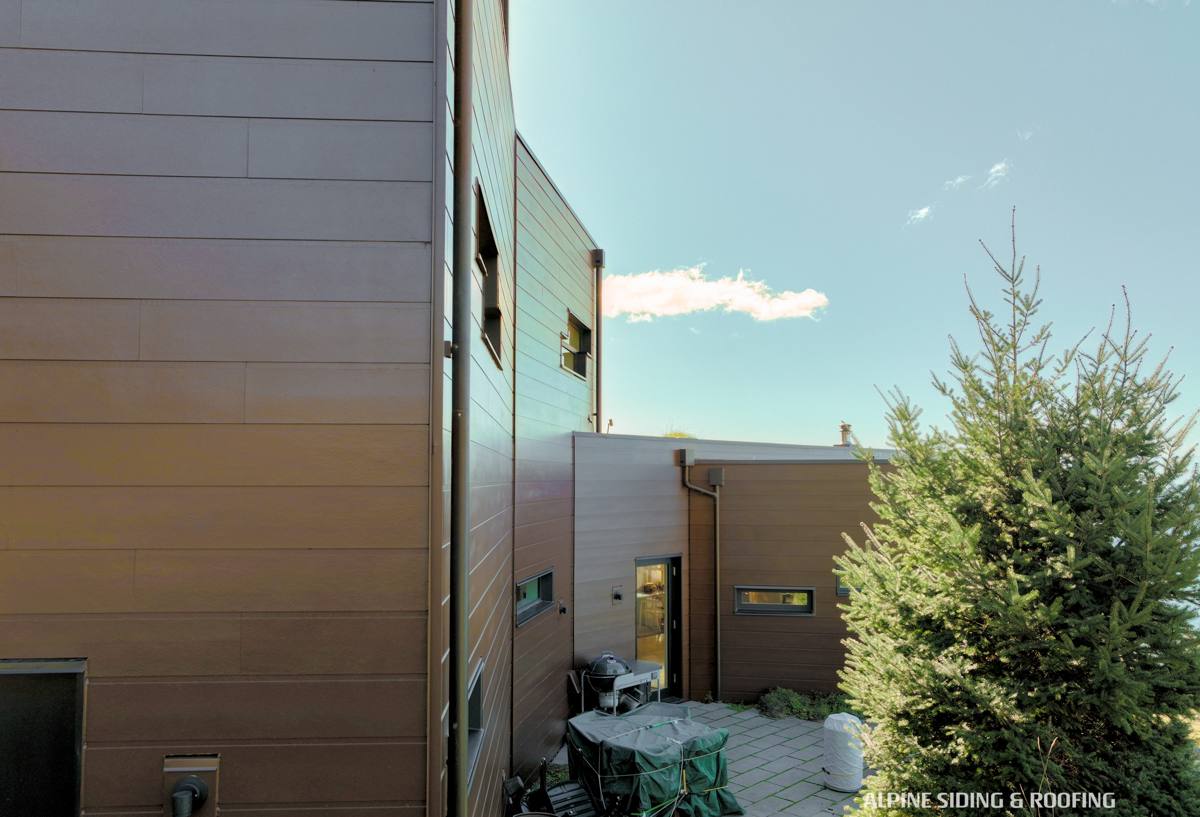
The Climate Your Siding Has to Survive
Aldergrove and Lynden both sit in a marine-influenced lowland, close enough to the Salish Sea and the Fraser Valley's low-lying terrain that homes here deal with a specific combination of stresses most siding products were never engineered around.
Salt Air
You don't have to live oceanfront to feel salt air's effect. Prevailing marine air moves inland through this region and settles into low-lying valleys, carrying fine salt content that accelerates corrosion on fasteners, flashing, and any siding product with a finish that isn't built to resist it. Over years, that exposure shows up as chalking, fading, and fastener staining on lower-grade materials.
Driving Rain
This isn't gentle drizzle. Storms moving through the Fraser Valley and Whatcom lowlands routinely bring wind-driven rain that hits siding at an angle, not straight down — which means water gets forced up under laps, around trim, and into any gap a rushed installer left behind. A siding system here has to shed water actively, not just sit there and hope gravity handles it.
Moss Season
Between the rainfall totals and the shade from mature trees common on rural and semi-rural lots in this area, moss and algae have a long growing window — often most of the year. Moss holds moisture directly against a wall surface far longer than open air would, which is exactly the condition that rots wood-based siding and delaminates poorly bonded composite products.
None of these three factors is dramatic on its own. Together, year after year, they're what separates a siding job that looks good for five years from one that performs correctly for twenty-five.
Why We Only Install James Hardie Fiber Cement
We don't install vinyl, LP SmartSide, Cemplank, Allura, primed spruce, or cedar. That's a deliberate standard, not a sales pitch, and it's worth explaining honestly rather than just stating it.
Vinyl is affordable and low-maintenance in mild climates, but it's a petroleum-based product that expands and contracts with temperature swings and can become brittle over time — and it doesn't offer the rigidity or fire resistance homeowners in this region increasingly want. Wood-based composite products like LP SmartSide use engineered wood strand technology that performs well when installation and maintenance are perfect, but any breach in the factory coating exposes wood fiber that's vulnerable to exactly the moisture and moss conditions described above. Cedar and primed spruce are real wood, and real wood needs real upkeep — repainting, re-caulking, and vigilant moisture management — in a climate that gives wood very little time to dry out between rain events.
James Hardie fiber cement is cement, sand, and cellulose fiber. It doesn't rot, it doesn't support insect activity, and it's non-combustible, which matters more each year as wildfire smoke and ember exposure become a regional concern even west of the Cascades. Hardie's ColorPlus factory finish is baked on under controlled conditions rather than field-applied, which gives it far better adhesion and fade resistance than a job-site paint job managing wet, cool application windows. And Hardie engineers specific product lines — its HZ5 and HZ10 systems — for different climate zones, so the plank you get is formulated for the humidity and temperature range it's actually going on, not a one-size-fits-all product.
We're not saying every other product is a bad product in every application. We're saying that for the specific combination of salt air, driving rain, and moss exposure this area deals with, Hardie is the system we're willing to put our name behind and warranty.
What a Correct Siding Installation Actually Involves
The siding itself is only part of the system. Most premature siding failures we get called out to inspect trace back to what's underneath the boards, not the boards themselves.
The Water-Resistive Barrier
Every wall needs a continuous water-resistive barrier (WRB) behind the siding, lapped correctly from the bottom of the wall up, so any water that gets past the siding has a planned path down and out rather than into the sheathing. In a driving-rain climate, gaps or reversed laps in this layer are where hidden rot starts.
Flashing at Every Penetration
Windows, doors, hose bibs, light fixtures, deck ledgers — every point where something interrupts the wall plane needs proper flashing integrated with the WRB, not just caulk smeared over the seam. Caulk is a maintenance item; flashing is the actual water management.
Rainscreen Gap
A small drainage gap between the WRB and the back of the siding lets bulk water drain and lets the wall assembly dry through airflow instead of staying damp against the sheathing. In a region with our rainfall totals and humidity, this gap is what keeps a wall system drying out between storms instead of staying perpetually damp — which is also what discourages moss and mildew from taking hold at the wall itself.
Fastening and Clearances
Hardie siding has specific fastener spacing, penetration depth, and clearance requirements — including gaps at the bottom of the siding above grade, decks, and roof lines so water and debris don't sit against the plank edge. Manufacturer installation instructions exist because they're what the warranty is actually based on; skipping them can void coverage even on a correctly manufactured product.
Our Installation Process, Step by Step
- On-site assessment: we inspect your current siding, sheathing condition, and trim details in person before quoting anything.
- Tear-off and sheathing inspection: old siding comes off and we check the sheathing underneath for hidden rot or moisture damage before covering anything back up.
- WRB and flashing installation: a continuous water-resistive barrier goes on first, integrated with new flashing at every window, door, and penetration.
- Rainscreen furring (where applicable): a drainage gap is built in so the wall assembly can dry between rain events.
- Hardie plank installation: siding is installed to manufacturer fastening and clearance specs, in the HZ product line appropriate for our climate zone.
- Trim, caulking, and touch-up: factory-finished trim and matched caulk close out seams and transitions.
- Final walkthrough: we go over the finished job with you before calling it done.
Signs Your Current Siding Is Already Failing
A lot of Aldergrove-area homeowners call us after noticing a problem, not before. Here's what tends to show up first in this climate:
- Persistent green or black staining that returns quickly after cleaning, especially on shaded or north-facing walls
- Soft or spongy spots when you press on the siding, particularly near the bottom courses or around window trim
- Visible cupping, warping, or separated seams on wood-based or composite panels
- Paint or finish that's chalking, peeling, or fading unevenly
- Rising utility bills that suggest the wall assembly isn't holding conditioned air the way it used to
- Visible gaps at trim, corners, or penetrations where caulk has failed
Any one of these on its own might just need a repair. Several at once, especially combined with soft sheathing, usually means it's time to talk about full replacement rather than patching around the problem.
What Drives the Cost of a Siding Installation
Every home is different, so we won't quote a number here — but these are the factors that actually move a project's price up or down, and it's worth understanding them before you start comparing bids.
| Factor | Why It Matters in This Climate |
|---|---|
| Tear-off vs. new sheathing | Homes with hidden moisture damage need sheathing repair before new siding goes on — common where old siding has failed quietly for years |
| Rainscreen / drainage gap | Adds labor and material but is one of the highest-value upgrades for a driving-rain, high-moss climate |
| Hardie product line and profile | Lap, shingle, and panel profiles all price differently; HZ10 vs. HZ5 formulation is chosen by climate zone, not preference |
| Trim and detail complexity | Homes with more windows, dormers, and roof intersections need more flashing and trim labor per square foot |
| Color and finish | Factory ColorPlus finishes cost more up front than field-painted trim but eliminate a repaint cycle |
| Access and site conditions | Rural and semi-rural lots common around Aldergrove sometimes add setup time for equipment and material staging |
Why a Border-Area Crew Matters
Aldergrove is close enough to Lynden that the two towns really do share one climate and one set of building challenges, but a siding crew that only knows one side of that line can still get the details wrong. We work this stretch of Whatcom County and the adjoining Fraser Valley communities regularly, which means we already understand the exposure patterns specific to this corridor — which walls take the worst of the driving rain, which lots hold onto moss longest, and how the salt-tinged marine air behaves as it moves inland.
Cross-border projects also come with practical logistics: coordinating quotes, scheduling, and material delivery across the line takes a contractor who's done it before and isn't figuring it out on your project. We handle that coordination as a normal part of doing business in this area, not as a special accommodation, because for us it is normal — Aldergrove is part of the same working area as Lynden, not an exception to it.
Maintaining Hardie Siding in This Climate
Fiber cement is low-maintenance, not no-maintenance. A few habits go a long way in a salt-air, high-moisture area:
- Rinse siding annually, focusing on shaded or north-facing walls where moss and algae take hold first
- Keep gutters clear so overflow doesn't run down the wall face and stay wet longer than the siding can shed
- Trim back vegetation and tree cover that keeps a wall section shaded and damp
- Re-caulk trim joints and penetrations if you notice separation, rather than waiting for water intrusion to show up inside
- Have flashing and caulk lines inspected every few years, especially around windows and roof-to-wall transitions
Done consistently, this keeps a correctly installed Hardie system performing for decades rather than just looking good for a season.
Get a Straightforward Estimate
If your Aldergrove-area home needs new siding or you're seeing early signs of trouble on what you've got now, we're glad to take a look. There's no pressure and no sales script — just an honest assessment of what your home needs and what it would take to do the job right. Fill out the form below to schedule a free estimate.