 Lynden Exterior
 Why Abbotsford Windows Work Harder Than Most
Homes in Abbotsford, BC sit in a climate that is genuinely tough on windows. You're close enough to the Strait of Georgia and the Fraser Valley's marine air to deal with salt-laden moisture on a regular basis, you get long stretches of driving rain off the Pacific systems that push through the valley, and the wet, shaded stretches of the year add up to a moss season that lasts far longer than most homeowners realize. None of that is dramatic on its own. What it does is slow, cumulative, and easy to miss until a window is already failing.
Energy-efficient windows aren't just about a lower heating bill, though that's real. In this climate, the glass package, frame material, and installation detailing also determine whether moisture, wind-driven rain, and organic growth stay outside where they belong or start working their way into the wall assembly. We treat efficiency and durability as the same job, because here, they are.
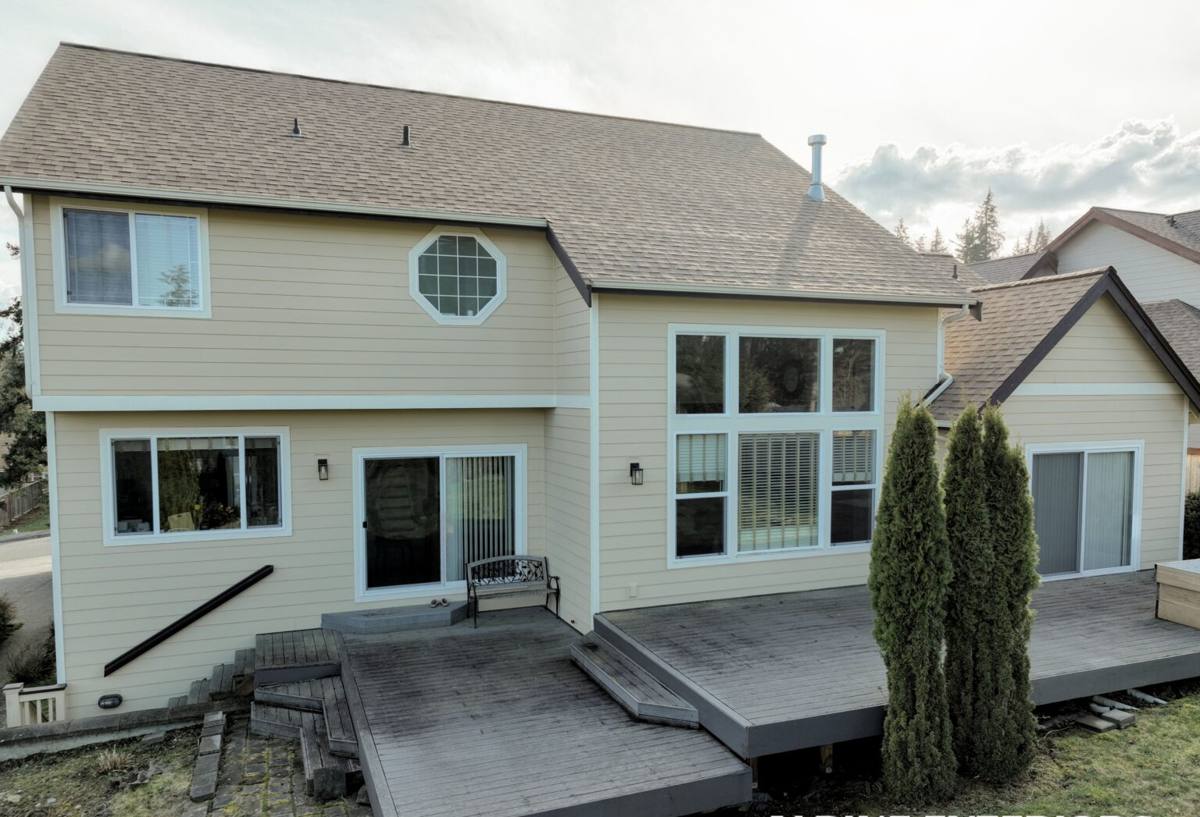
What the Local Climate Actually Does to Windows Over Time
Salt Air and Hardware Fatigue
Salt-bearing air doesn't just affect homes right on the water. Prevailing winds carry fine salt particulate well inland through the Fraser Valley, and it settles on window hardware, weep holes, and any exposed metal fasteners. Over years, that accelerates corrosion on hinges, locks, and lesser-grade cladding fasteners. It's rarely the glass that fails first around here — it's the small metal parts that hold everything together and keep water managed.
Driving Rain and Water Intrusion
Wind-driven rain doesn't behave like a gentle shower. It gets pushed sideways and upward against a wall, which means it finds gaps that vertical rain never would — at the head flashing, at the sill pan, at the corners of the frame. A window that's watertight in a light drizzle can still leak in a proper valley storm if the flashing details and sealants weren't done correctly the first time.
Moss, Shade, and Sill Rot
Long, mild, wet seasons are ideal for moss and algae growth on anything that stays damp and shaded — sills, trim, and the lower corners of frames especially. Once organic growth takes hold, it holds moisture against the material even longer, which is exactly the wrong thing for wood trim and exposed OSB or fiberboard sheathing behind the window. This is a slow-motion problem: it rarely shows up as a leak in year one, but by year eight or ten it can mean soft trim and staining that traces back to a window detail nobody thought twice about at installation.
What "Energy-Efficient" Actually Means for This Climate
Glass Packages
Double-pane with a Low-E coating and argon gas fill is the practical baseline for this region — it cuts heat loss and reduces condensation risk on the interior glass surface, which matters during our damp winters. Triple-pane windows push efficiency further and add a meaningful sound and comfort improvement, but they're heavier, cost more, and aren't always worth it on every elevation of every house. We'll tell you honestly where triple-pane earns its keep and where double-pane with a good coating is the smarter spend.
Frame Materials
Frame choice affects both efficiency and how the window handles moisture over the long run. We'll walk through the trade-offs by material below, but the short version is that in a wet, salt-exposed climate, how a frame handles water contact and how forgiving it is of minor installation variance matters as much as its raw insulation value.
The Installation Itself
A high-performance window installed poorly will underperform a mid-grade window installed correctly. Flashing sequence, sill pan drainage, sealant selection, and proper shimming all determine whether the rated efficiency and the water-tightness actually show up in the finished wall. This is the part of the job that's invisible once the trim goes back on — and the part that determines whether you have a problem in year two or year twenty.
Signs Your Current Windows Are Costing You Money
- Visible condensation or fogging between the panes — the seal has failed and the gas fill is gone
- Drafts you can feel near the frame on a windy day, even with the window fully latched
- Soft, discolored, or moss-covered trim and sill material
- Difficulty locking or latching, especially on the lower sash or hinge side
- Noticeably higher heating bills compared to similarly sized rooms elsewhere in the house
- Paint or finish that keeps failing on the interior sill no matter how often it's redone
Frame Material Comparison for This Climate
There's no single "best" frame material — the right call depends on the house, the elevation's rain and sun exposure, and your budget. Here's how the common options hold up specifically against salt air, driving rain, and moss-season moisture:
| Material | Moisture Handling | Maintenance | Notes for This Climate |
|---|---|---|---|
| Vinyl | Very good — won't rot or corrode | Low | Solid default choice for most homes; consistent performance in wet, salt-exposed conditions |
| Fiberglass | Excellent — very stable, low expansion/contraction | Low | Strong option for exposed elevations that take the brunt of driving rain |
| Wood / Wood-Clad | Requires diligent upkeep to stay ahead of moisture | High | We're selective about where we recommend this given the region's rot and moss pressure; best reserved for well-protected elevations with an owner committed to upkeep |
| Aluminum | Prone to corrosion in salt air over time | Moderate | Generally not our first recommendation here unless it's a thermally broken frame for a specific design need |
Our Installation Process
We keep this consistent from job to job because the details are what determine whether a window performs for twenty-plus years or starts leaking in five.
- On-site assessment — we check existing framing, sill condition, and any signs of past water intrusion before quoting anything
- Product selection — we walk through glass package and frame material options based on that specific elevation's rain and sun exposure
- Removal — old windows come out carefully so we can inspect the rough opening and sheathing underneath
- Repair as needed — any soft framing, rot, or prior flashing mistakes get addressed before the new window goes in, not covered over
- Sill pan and flashing — proper drainage path and flashing sequence, sealed and lapped to shed wind-driven rain
- Install and shim — window set plumb, level, and square, shimmed correctly so it operates smoothly and seals evenly
- Insulate and seal — gaps filled correctly around the frame, interior and exterior sealant applied where it belongs
- Trim and finish — interior and exterior trim reinstalled or replaced to match the home
- Final walkthrough — we test operation and go over care with you before we consider the job done
What Affects the Cost
We don't publish fixed prices because every house and every opening is different, but these are the main factors that move the number up or down:
| Factor | Why It Matters |
|---|---|
| Frame material | Vinyl is typically the most budget-friendly; fiberglass and wood-clad cost more up front |
| Glass package | Triple-pane and specialty coatings add cost but also add performance |
| Number and size of openings | More straightforward per-window pricing with volume, but large or custom-shaped windows cost more individually |
| Condition of the existing opening | Rot repair or reframing adds labor and material that a straightforward swap doesn't need |
| Full-frame vs. insert replacement | Full-frame replacement costs more but is often the right call when trim, sills, or flashing need attention anyway |
| Access and elevation | Upper-story or hard-to-access windows take more time and equipment |
Keeping Energy-Efficient Windows Performing Long-Term
Good installation gets you most of the way there, but a little seasonal attention keeps things performing as they should, especially given how long the wet season runs here.
- Rinse salt residue and grime off frames and hardware a couple of times a year, especially after windy coastal weather
- Check and clear weep holes along the bottom of the frame so water can drain instead of pooling
- Keep an eye on sills and trim for early moss or algae growth and clean it off before it takes hold
- Test locks and operating hardware seasonally — stiff or sticking hardware is often the first sign of a bigger issue
- Re-caulk exterior joints if you notice cracking or gaps, rather than waiting for a leak to show up inside
- Watch for condensation between panes, which means a seal has failed and the window needs attention
Why a Crew That Already Works in Abbotsford, BC Matters
Working across the border between Whatcom County and the Fraser Valley isn't complicated once you've done it regularly, but it does mean knowing local expectations, working with Abbotsford's permitting process where it applies, and understanding how this specific stretch of climate — the salt air, the driving rain, the long moss season — actually behaves on real houses, not just in a spec sheet. That's the kind of knowledge that comes from doing the work here repeatedly, not from a one-off job. We treat every Abbotsford installation with the same standard we hold ourselves to on our home turf: correct flashing, honest product recommendations, and no shortcuts on the details that don't show once the trim is back on.
If your windows are drafty, fogged, or just past their prime, we're happy to take a look and give you a straightforward, no-pressure estimate — use the form below to get started.