 Lynden Exterior
 Why Siding Takes a Beating in Nooksack
Nooksack sits in a part of Whatcom County where the weather doesn't do a home any favors. Salt-laden air moves in off the Sound and mixes with the moisture rolling through the valley, driving rain comes in sideways during fall and winter storms, and the shaded, damp conditions that stick around for much of the year create a moss season that can run far longer than most homeowners expect. Add in the everyday reality of rural and semi-rural properties near Lynden — mature trees, irrigation overspray, low morning sun angles that keep north-facing walls wet for hours — and you have an exterior wall system that's under constant low-grade attack.
None of that is dramatic on its own. It's the accumulation that causes problems: siding that stays damp longer than it should, seams that trap moisture instead of shedding it, and paint films that break down years before they're supposed to. Homes in this area don't need siding that merely looks good on install day. They need a system engineered to hold up to repeated wet-dry cycles, resist organic growth, and keep its finish intact through a couple of decades of Whatcom County winters.
What "Correct" Installation Actually Means Here
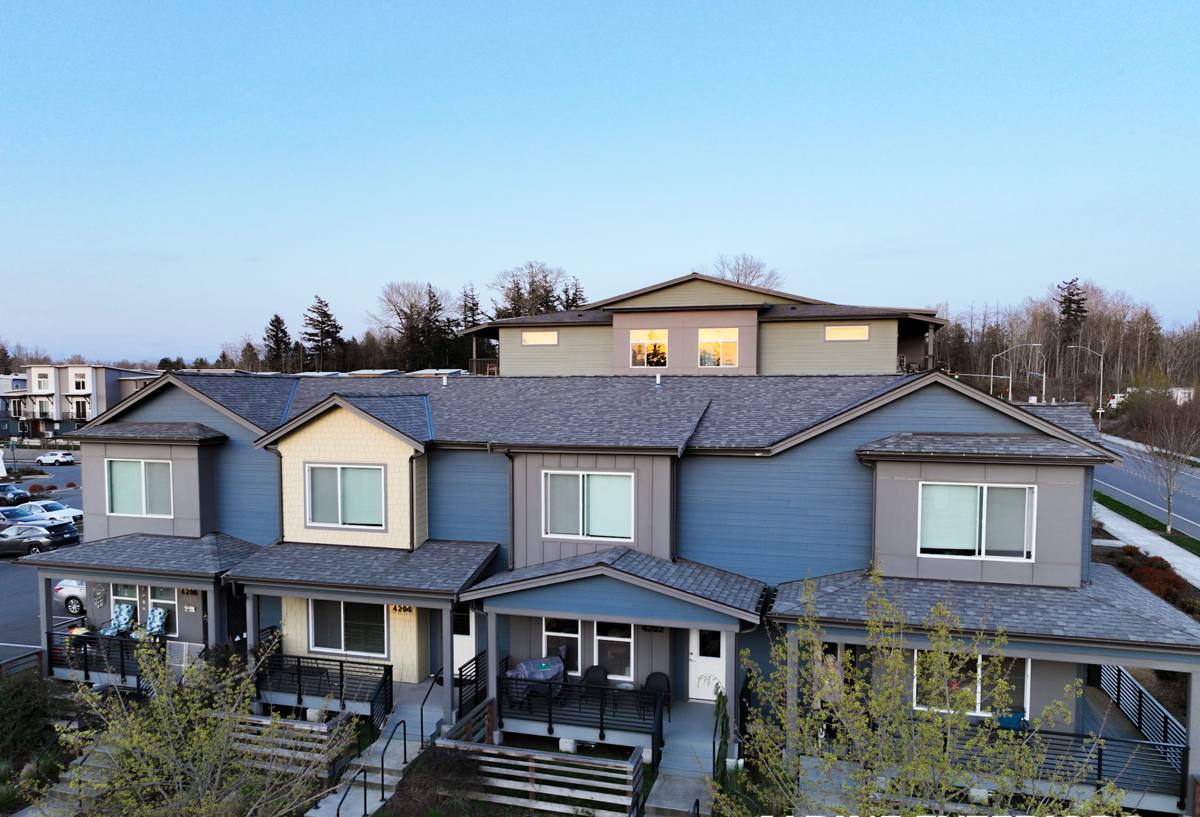
Fiber cement siding is only as good as the installation behind it, and that's especially true in a climate like this one. A technically correct Hardie install in Nooksack isn't just nailing boards to the wall — it's a moisture-management system from the sheathing out.
The details that matter in a wet climate
- A drainage plane (weather-resistive barrier) properly lapped and sealed at every penetration, not just stapled up quickly
- A rainscreen gap behind the siding so any moisture that does get behind the boards can drain and dry instead of sitting against the wall sheathing
- Correct fastener placement and spacing per Hardie's installation instructions — not "close enough," since improper fastening is one of the most common causes of early siding failure
- Proper clearance at grade, decks, patios, and roof lines so siding never sits in standing water or constant splash-back
- Factory-cut and factory-primed edges kept intact, with field cuts sealed exactly as the manufacturer specifies
- Flashing integrated at every window, door, and butt joint — the single biggest source of hidden water intrusion on any siding job
Skip any one of these and you can still end up with a wall that looks fine for a year or two before moisture problems show up from the inside out. This is the part of the job that separates a crew that installs Hardie occasionally from one that installs it as its entire business.
Why James Hardie's HZ5 Line Fits This Region
James Hardie engineers its siding by climate zone, and the Pacific Northwest — including Whatcom County — falls into the HZ5 category, built specifically for regions with sustained moisture, freeze-thaw cycling, and higher humidity. HZ5 products are formulated and tested for exactly the conditions Nooksack sees: extended damp periods, driving rain, and the kind of temperature swings that stress a wall assembly over time.
That climate engineering shows up in a few concrete ways: the fiber cement formulation is tuned to resist moisture absorption and the swelling/cracking that can follow, and the product is tested for freeze-thaw performance so repeated winter cycles don't degrade the board over the years. It's not a marketing distinction — it's the difference between siding designed for this specific weather pattern and siding designed for a drier, milder climate that happens to be sold nationwide.
Product lines we install
| Product | Common use | Why it fits Nooksack |
|---|---|---|
| HardiePlank lap siding | Primary wall cladding | Traditional or modern lap profiles that shed driving rain efficiently |
| HardiePanel vertical siding | Accent walls, gables, modern facades | Fewer horizontal laps means fewer potential water-entry points |
| HardieTrim boards | Corners, window and door surrounds, fascia | Resists the rot that eventually takes over wood trim in this climate |
| HardieSoffit panels | Eaves and overhangs | Non-combustible, moisture-stable ventilated soffit option |
ColorPlus Finish: Less Maintenance, Less Moss
One of the most practical advantages of James Hardie siding in a climate like this is the ColorPlus factory finish. It's baked on in a controlled environment rather than rolled or sprayed on site, which gives it better adhesion and more consistent coverage than field paint — and that matters directly for moss and mildew resistance. A tighter, more uniform finish gives algae and moss spores less texture and fewer micro-gaps to grab onto, which means less green streaking on north-facing and shaded walls and a longer stretch between repaints.
It also means the color is baked through the coating layer rather than sitting on top as a thin field coat, so the typical fade and chalking you see on repainted siding after a handful of Whatcom County winters is much less of an issue. Homeowners still need to rinse the siding occasionally to keep moss from taking hold — no exterior finish is completely maintenance-free in this region — but the interval between real maintenance work stretches out considerably compared to field-painted materials.
How We Approach a Nooksack Siding Job
Every property is different, but the process we follow stays consistent because it's built around the same moisture-management principles every time.
Step by step
- Walk-through and assessment. We look at existing siding condition, trim, flashing, moisture staining, and anywhere water has clearly been finding its way in.
- Tear-off and sheathing inspection. Old siding comes off so we can actually see the wall — rot, soft sheathing, or damaged framing gets addressed before anything new goes up, not covered over.
- Weather-resistive barrier and rainscreen installation. This is the step that determines how the wall performs for the next 30-plus years, and it's the one that's easiest to shortcut if a crew is in a hurry.
- Flashing at every penetration. Windows, doors, hose bibs, light fixtures, vents — anything that breaks the plane of the wall gets flashed correctly.
- Hardie siding installation to manufacturer spec. Correct fastener type, spacing, and clearances throughout.
- Trim, caulking, and final detailing. The parts that get noticed if they're wrong and never noticed if they're right.
- Final walk-through. We go over the finished job with the homeowner before calling it done.
James Hardie vs. Other Siding Options for This Climate
We only install James Hardie, but homeowners deserve to understand why we made that call rather than just take our word for it. Here's how the common alternatives stack up on the factors that actually matter in a wet, moss-prone climate like this one.
| Factor | James Hardie fiber cement | Vinyl siding | Wood / engineered wood (LP SmartSide, cedar) |
|---|---|---|---|
| Moisture absorption | Very low; engineered for wet climates | Doesn't absorb, but seams and gaps can trap moisture behind it | Wood fiber is moisture-sensitive; relies heavily on the finish staying intact |
| Moss/algae resistance | Factory ColorPlus finish resists organic growth well | Textured surfaces can hold moss and mildew | Porous surfaces are prone to moss and mildew without regular treatment |
| Fire resistance | Non-combustible | Melts/deforms under heat | Combustible |
| Repainting interval | Long, thanks to factory-cured finish | Rarely painted, but fades and can look dated | Frequent, especially on south- and west-facing walls |
| Installation sensitivity | Moderate — must follow manufacturer spec closely | Low, but that ease of install is part of why performance varies | High — any gap in the finish becomes an entry point for moisture |
A Maintenance Checklist for Nooksack Homeowners
Even the best siding system benefits from a little attention. This is the same list we'd hand any homeowner in this area, whether we installed their siding or not.
- Rinse siding annually, focusing on shaded, north-facing, and tree-covered walls where moss gets a head start
- Keep gutters clear so overflow doesn't run down the wall face during heavy rain events
- Trim back vegetation and tree limbs that keep sections of the wall shaded and damp longer than the rest of the house
- Check caulking at trim joints, window returns, and butt joints once a year and touch up anywhere it's cracked or pulled away
- Look for staining or soft spots near grade, decks, and downspout discharge points — early signs of a moisture problem
- Confirm sprinklers and irrigation aren't spraying directly onto siding on a regular cycle
Why It Matters to Hire a Crew That Already Works This Area
Siding installation isn't one-size-fits-all, even within a single manufacturer's product line. A crew that works Nooksack and the broader Lynden area regularly already knows how local moisture patterns behave against a wall, which details tend to get overlooked on older homes in this region, and how to sequence a job around the wetter stretches of the year so materials aren't installed under bad conditions. That's a different level of judgment than a crew that installs Hardie once in a while alongside a handful of other siding products.
There's also a practical, local accountability piece: a contractor who's planning to keep working in this community has every reason to get the flashing, the rainscreen gap, and the fastening right the first time, because callbacks and reputation in a small area travel fast. That's part of why we standardized on installing James Hardie exclusively — it lets our crews build deep, repeatable expertise on one system engineered for this exact climate, rather than spreading that expertise thin across several products with different installation rules.
Ready to Talk About Your Home
If your Nooksack home has siding that's showing moss, staining, cracked caulking, or just isn't holding up the way it should, we're happy to take a look and give you an honest read on what's going on and what it would take to fix it right. Reach out for a free, no-pressure estimate — there's no obligation, and you'll walk away with a clear picture of your options either way.