 Lynden Exterior
 Storm Damage Roof Repair for Maple Falls Homes
Maple Falls sits close enough to the Cascade foothills that weather behaves differently than it does down in Bellingham or out on the flats around Lynden. Homes here take on more standing moisture through the fall and winter, see heavier tree cover that drops limbs and needles onto roofs, and often sit at elevations where wind gusts funnel harder through the valley during winter storm systems. When a storm rolls through, the damage isn't always obvious from the ground, and putting off an inspection usually turns a small repair into a much bigger one.
We work storm damage calls throughout Whatcom County, and Maple Falls is part of our regular service area — not a place we drive out to once and never see again. That matters for storm repair specifically, because the roofs out here deal with a combination of driving rain, salt-influenced air moving up the valley from the Sound, and a moss season that runs longer than in drier parts of the state.
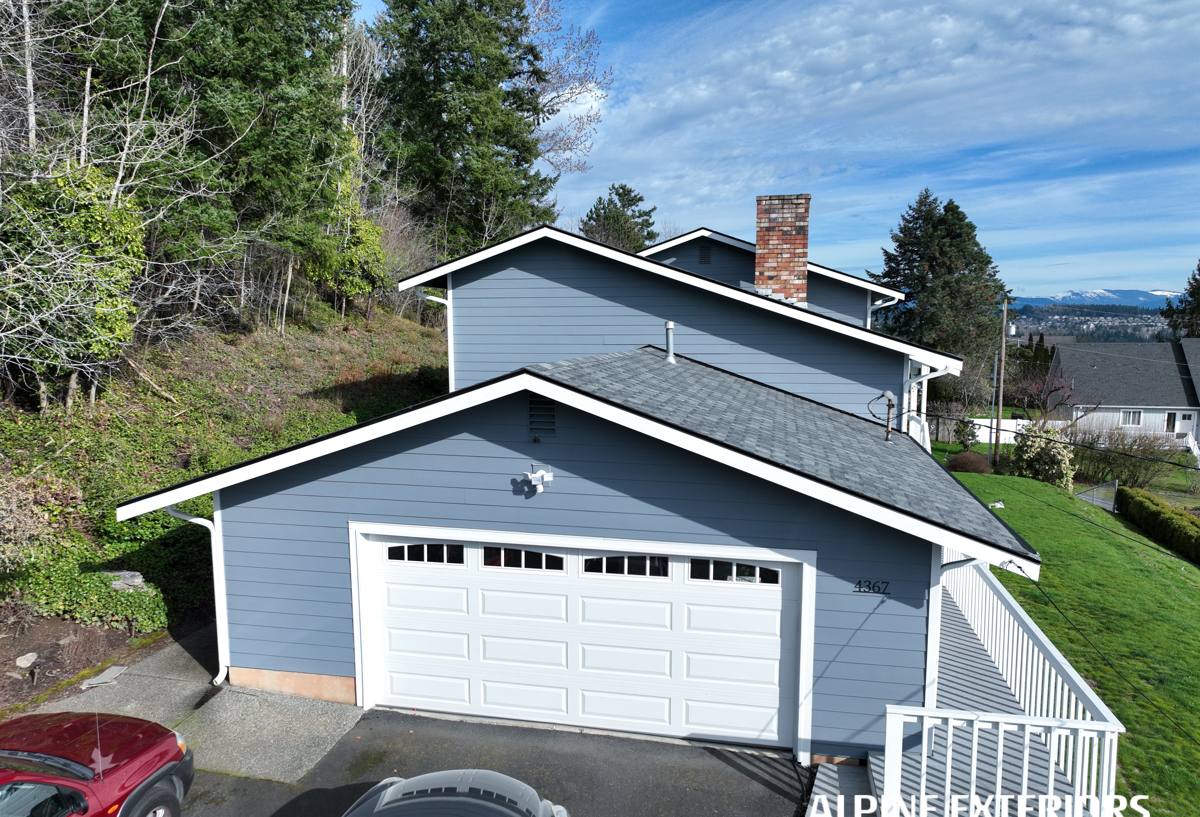
What Storms Actually Do to a Maple Falls Roof
Wind and Wind-Driven Rain
Wind is rarely the whole story — it's wind combined with rain that causes the worst damage. Gusts lift shingle tabs or shift panels just enough to break the seal, and then wind-driven rain gets pushed sideways and upward under the roofing material instead of running off the surface the way it's designed to. Once water is under the shingles or behind the flashing, it doesn't need a big opening to cause a big problem. A gap the width of a pencil is enough to soak sheathing over the course of a multi-day storm.
Falling Debris
Maple Falls has more mature tree cover close to rooflines than you'll find in newer, more open subdivisions. Storms knock down branches, and even small limbs falling from height can crack shingles, dent metal roofing, or puncture underlayment in ways that aren't visible unless someone gets up there and looks closely.
Moss and Trapped Moisture
This region's moss season is long, and moss does more than look bad. It holds moisture against the roofing material well after a storm has passed, which slows drying time and gives any storm-created gap more opportunity to let water through. A roof that would shed a normal rain fine can still leak after a storm if moss has built up around a stressed seam or a piece of lifted flashing.
Ice and Freeze-Thaw Cycling
Maple Falls sits at a higher elevation than much of Whatcom County, and it's not unusual for the area to see cold snaps and light icing that Lynden proper doesn't get. Freeze-thaw cycling can widen small cracks in flashing sealant or shingle adhesive that a fall storm already weakened, which is why we often find storm damage that didn't show up as a leak until weeks later during a cold spell.
Signs You Need a Storm Damage Inspection
- Missing, cracked, or curled shingles you can see from the ground
- Granules collecting in gutters or at the base of downspouts after a storm
- Water stains or discoloration on interior ceilings, especially near exterior walls or chimneys
- Visible dents or creases in metal roofing or flashing
- Debris — branches, needles, moss clumps — built up in valleys or around vents
- Sagging or soft spots when walking the attic, if it's safe to check
- Daylight visible through the roof deck from inside the attic
- A sudden increase in moss growth in one concentrated area, which can point to a spot holding extra moisture
Any one of these on its own doesn't mean you need a full roof replacement, but it does mean the roof needs a professional look before the next storm system comes through.
What a Correct Storm Repair Actually Involves
A lot of storm repair work in this region gets done wrong not because the crew is careless, but because they're rushing to patch a visible symptom instead of finding the actual entry point. Water travels. A stain on a ceiling in one room can trace back to a flashing gap several feet away, and a quick patch over the stain does nothing for the source.
Our process starts with a full roof inspection, not just a look at the spot the homeowner points out. We check the obvious storm damage — lifted or missing shingles, damaged flashing, debris impact — and we also check the areas storms tend to stress but don't always announce loudly: valleys, chimney and vent flashing, ridge caps, and any place where moss has been holding moisture against the surface. In the attic, we look for water staining, wet insulation, and daylight gaps that point to a compromised deck.
Once we know what's actually damaged, we give a straight assessment of what's a repair versus what's pointing toward a bigger issue. Most storm damage on a roof that was in decent shape beforehand is a legitimate repair — replacing damaged shingles or panels, resealing and re-flashing the affected area, clearing debris and moss buildup that's contributing to the problem, and checking the decking underneath for rot before closing everything back up. If the underlying decking is compromised or the roof was already near the end of its service life, we'll say so plainly rather than repair over a problem that's going to resurface.
Repair vs. Replacement: How We Make the Call
| Factor | Points Toward Repair | Points Toward Replacement |
|---|---|---|
| Roof age | Under roughly 15 years, or recently maintained | Nearing or past typical material lifespan |
| Extent of damage | Isolated to one section or a few spots | Widespread across multiple roof planes |
| Decking condition | Solid, dry sheathing under the damaged area | Soft, rotted, or repeatedly wet decking |
| Moss and moisture history | Minor, manageable buildup | Long-term trapped moisture with visible material breakdown |
| Prior storm history | First significant damage event | Pattern of repeated storm damage in the same areas |
These are guideposts, not hard rules — every roof is different, and we'll walk you through the specific reasoning for your home rather than defaulting to the more expensive option.
Why Local Storm Experience Matters in Maple Falls
A crew that mostly works flatter, more sheltered neighborhoods closer to town isn't necessarily prepared for what storm damage looks like out here. Elevation, tree cover, and exposure to wind funneling through the valley all change how a storm hits a roof, and they change where damage tends to concentrate. Knowing to check for moss-trapped moisture around a flashing seam, or to expect wind-driven rain intrusion on the windward side of a roof rather than assuming damage is evenly distributed, comes from working this specific area repeatedly, not from a generic storm-repair checklist.
We also know that access can be a factor for some Maple Falls properties — driveways, tree clearance, and terrain that differ from a standard in-town lot. Planning for that ahead of time means less time on site figuring out logistics and more time actually on the roof.
Materials and Repair Standards We Hold To
For storm repairs, we match materials to what's already on the roof whenever possible, since mismatched shingle profiles or metal panel types can create their own water-shedding problems down the line. Where flashing needs to be replaced, we use materials rated for the moisture exposure this region sees rather than the minimum builder-grade option, because flashing is one of the most common failure points in wind-driven rain events and it's not a place to cut corners. Sealants and underlayment are chosen for how they perform in prolonged damp conditions, not just how they test in a dry climate — a distinction that matters a lot more here than in drier parts of the country.
Insurance and Documentation
Most storm damage repairs in this area involve a homeowner's insurance claim. We document damage with photos before any repair work begins, note the likely cause (wind, impact, moisture intrusion), and provide a written assessment that homeowners can use when filing. We're not an insurance company and we don't guarantee claim outcomes, but a clear, honest damage assessment from a contractor who actually inspected the roof carries more weight with an adjuster than a vague description, and it protects you from having repair work questioned later.
After the Repair: Keeping Storms From Doing It Again
- Have gutters and downspouts cleared before the fall storm season, especially with tree cover nearby
- Keep an eye on moss growth and address it before it spreads across a full roof plane
- Trim back branches that hang over or near the roofline where practical
- Schedule a post-storm inspection after any significant wind event, even if there's no visible leak yet
- Keep a record of prior repairs and inspections so any recurring problem areas are easy to track over time
None of this prevents every storm from causing some damage — Whatcom County weather is what it is — but it reduces how often small issues turn into major repairs.
If a recent storm has you wondering about the condition of your roof, we're happy to take a look. We offer free, no-pressure estimates for Maple Falls homeowners, and there's a form below to get one scheduled.