 Lynden Exterior
 Composite Decking Built for Bellingham's Marine Climate
We're based in Lynden, and Bellingham is one of the Whatcom County communities we're out working in on a regular basis. It's a different deck-building environment than a lot of contractors are used to. Bellingham Bay puts homes closer to the water under a steady load of salt-tinged marine air, the region's rain tends to come in sideways on a west wind rather than falling straight down, and the combination of mild temperatures, tree cover, and near-constant dampness gives moss and algae a growing season that runs most of the year on shaded surfaces. A deck built to a generic national spec doesn't always hold up well against that specific mix.
This page is about one thing: composite decking for Bellingham homes specifically, not decking in general. Composite is a strong fit for this climate when it's built correctly, but "composite" isn't a single product and a correct build here involves more than just picking a board color. We'll walk through what the climate actually does to a deck, what a correct composite build looks like, how our process works, and what to expect once it's installed.
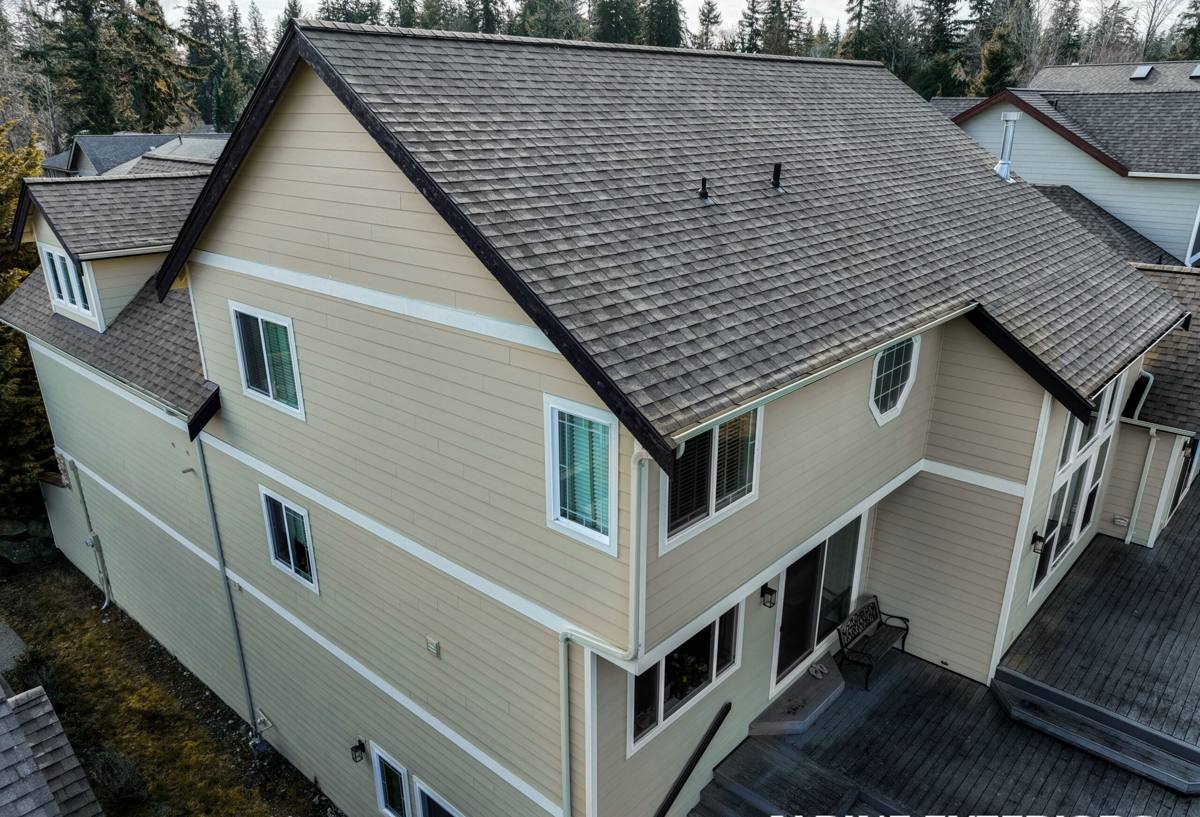
What Salt Air, Driving Rain, and a Long Moss Season Do to a Deck
Before getting into materials, it's worth being specific about the three things doing the damage, because they don't all attack a deck the same way.
Salt Air and Fastener Corrosion
Homes closer to Bellingham Bay sit in a steady flow of moisture-laden, salt-tinged air, not just during storms. That kind of sustained exposure is hard on any exposed metal — screws, joist hangers, post bases, railing brackets — and it's a slow, quiet process. A fastener that looks fine for the first few years can be corroding underneath a deck board where nobody's looking, and by the time it shows, the damage is already done. The farther a lot sits from the water, the less pronounced this effect is, but it's a factor across most of the Bellingham area, not just waterfront properties.
Wind-Driven Rain and Hidden Moisture
Rain that's pushed sideways by wind behaves differently than rain that falls straight down. It gets driven under ledger boards, into end-grain cuts, behind fascia, and into any gap in flashing that a calmer, drier climate's building details wouldn't need to account for. On a deck, that means the framing and ledger connection — the part attached to the house — takes on moisture exposure that a purely vertical rainfall assumption misses. This is where a lot of deck failures actually start, underneath the finished surface where nobody sees it until there's a soft spot or a leak inside the house.
A Long Moss Season on Shaded and Low-Sun Decking
Mild year-round temperatures, tree cover common to Whatcom County lots, and consistent dampness add up to a moss and algae season that can run for most of the calendar year on north-facing or heavily shaded decking. It shows up first in spots that don't get direct sun or airflow — under railings, in the shadow of the house, along board edges where water sits. Beyond looking bad, moss and algae on a deck surface get slick fast, which turns a maintenance issue into a safety issue on stairs and walking surfaces.
Why Composite Outperforms Wood Decking in This Climate
Wood decking, even good-quality pressure-treated or cedar, is a natural material that absorbs moisture, and in a climate this consistently wet, that absorption cycle — swelling when it rains, drying out between storms, swelling again — is what drives most of the cracking, splintering, and fastener pull-through we see on older decks in this area. Composite decking is manufactured from a blend of wood fiber and plastic (capped composites add a protective outer shell), and it doesn't go through that same absorb-and-dry cycle the way solid wood does. Here's how the two compare specifically for this climate:
| Factor | Wood Decking | Composite Decking |
|---|---|---|
| Moisture absorption | Absorbs and releases moisture with weather changes, driving swelling and checking | Minimal absorption, especially with a capped product |
| Moss and algae growth | Porous surface gives growth something to grip; needs regular cleaning and treatment | Denser, less porous surface resists growth, though it still needs periodic cleaning |
| Maintenance schedule | Annual or biannual sealing/staining, plus regular cleaning | Occasional washing; no sealing or staining required |
| Fastener corrosion exposure | Same exposure as any deck; loose boards more likely to work fasteners over time | Hidden fastener systems reduce exposed hardware and surface wear |
| Realistic lifespan in this climate | Shorter without consistent upkeep; moisture cycling accelerates wear | Longer service life with correct installation and substructure protection |
| Refinishing needs | Recurring cost and labor over the deck's life | None for the board surface itself |
Composite isn't magic, though, and it's worth saying plainly: a composite deck installed poorly over an unprotected wood frame, with the wrong fasteners and no real drainage path, will still fail in this climate. The board material solves the surface problem. The framing, flashing, and installation details underneath solve the structural problem, and that part matters just as much.
What a Correct Composite Deck Build Involves Here
A composite deck is only as good as what's underneath it. This is the part of the job that doesn't show in the finished photos but determines whether the deck is still solid in fifteen years or soft and spongy in five.
Framing, Ledger Attachment, and Flashing
The ledger board — where the deck attaches to the house — is the single most common failure point on decks in wet climates, because it's the connection point where wind-driven rain has the most opportunity to get behind the siding and into the house framing. A correct build uses proper ledger flashing that sheds water away from the house rather than trapping it against the rim joist, along with corrosion-resistant fasteners rated for the exposure.
Joist Protection and a Real Drainage Path
Even under a composite surface, the joists and beams are typically still dimensional lumber, and they need protection from the moisture that inevitably works its way between deck boards over time. That means joist tape or an equivalent moisture barrier on the top of each joist, and a framing layout that actually lets water drain away from the structure instead of pooling against posts or ledger connections. Skipping this step is one of the most common corners cut on composite decks, because it's invisible once the boards go down.
Hidden Fasteners and Board Spacing for a Wet Climate
Most composite systems use a hidden fastener clip rather than face-screwing through the board, which keeps the surface free of exposed metal and gives water fewer entry points into the fastener hole. Board spacing has to account for this region's humidity and temperature swings, tight enough to look clean, loose enough to let water and debris drain through rather than collect between boards, which is exactly where moss tends to start.
Railing, Fascia, and Trim Details
Railing posts and fascia boards see the same wind-driven rain exposure as the ledger, and corners here compound the corrosion and moisture issues already discussed. Post bases need proper standoff and drainage so water doesn't pool at the base connection, and fascia should be installed with a gap or drainage detail rather than tight against the framing where trapped moisture can sit unseen.
Choosing the Right Composite Board for a Bellingham Deck
Not all composite decking is built the same way, and the choice matters more here than it would in a drier climate.
Capped vs. Uncapped Composite
Capped composite has a shell — typically a plastic polymer layer — wrapped around the wood-fiber core, which blocks moisture from reaching the core and gives the board better resistance to staining, fading, and moss growth. Uncapped composite is generally less expensive but leaves the wood-fiber core more exposed at cut edges and over time, which matters in a climate where the board is rarely fully dry. For most Bellingham projects, we lean toward capped products specifically because of the marine air and moisture load this area sees.
Color and Grain Considerations
Darker composite boards absorb more heat, which isn't a major concern under this region's cloud cover the way it might be in a hot, sunny climate, but it does affect how quickly a surface dries after rain — a faster-drying surface gives moss and algae less time to establish. Lighter and mid-tone colors with a textured, wood-grain finish tend to show less visible staining from tannins, pollen, and organic debris than solid dark colors do, which is a practical consideration on a heavily treed lot.
| Decking Type | Moisture Resistance | Moss/Algae Resistance | Typical Cost Tier |
|---|---|---|---|
| Uncapped composite | Moderate — core can absorb moisture at cut edges over time | Moderate | Lower |
| Capped composite | High — polymer shell blocks moisture from the core | High | Mid to upper |
| Cellular PVC | Very high — no wood fiber content to absorb moisture | Very high | Upper |
We walk homeowners through these trade-offs during the estimate rather than defaulting to one product for every job. A shaded, tree-heavy lot near the bay has different priorities than an open, sun-exposed backyard further from the water, even within the same city.
Our Process for a Bellingham Composite Decking Project
The process is the same whether it's a full replacement or new construction, and it's built around not skipping the parts that don't show once the boards are down.
- On-site assessment. We look at the lot's actual exposure — proximity to the bay, tree cover, sun and shade pattern, existing drainage — rather than assuming every Bellingham property has identical conditions.
- Structural evaluation. For a replacement, we check the condition of the existing ledger connection, framing, and posts before assuming they can be reused. Reusing sound framing saves money; reusing compromised framing just buries a problem under new boards.
- Material walkthrough. We go over board options, colors, and railing systems based on what we saw during the assessment, with honest trade-offs, not just a catalog handoff.
- Permitting and engineering. Deck permits and, where required, engineering sign-off are handled before work starts, not treated as an afterthought.
- Build with attention to the hidden details. Ledger flashing, joist protection, drainage path, and fastener selection get the same attention as the visible surface work.
- Final walkthrough. We go over the finished deck and what realistic maintenance looks like so there are no surprises the first wet season.
Maintenance Bellingham Homeowners Should Actually Expect
Composite decking cuts the maintenance load dramatically compared to wood, but "low-maintenance" isn't "no-maintenance," especially in a climate this wet. A realistic yearly routine looks like:
- Rinse or wash the deck surface a few times a year, more often on shaded or heavily treed sections where organic debris and moisture collect
- Sweep leaves, needles, and other debris out from between boards and away from railing posts before they trap moisture
- Check that gaps between boards and around the perimeter haven't gotten packed with debris that blocks drainage
- Address any moss or algae film promptly with a mild cleaner rather than letting it establish, especially on stairs and other walking surfaces
- Inspect railing post bases and fascia trim periodically for any sign of trapped moisture or loose hardware
- Keep gutters and downspouts above or near the deck clear so runoff isn't being directed onto the deck surface
Why Hiring a Crew That Already Works Bellingham Matters
Deck-building fundamentals don't change from city to city, but the details that determine whether a deck holds up do. A crew that already works Bellingham regularly knows which lots sit close enough to the bay to warrant extra attention to fastener corrosion, which neighborhoods have enough tree cover that moss resistance should weigh heavily in material choice, and how local permitting works for deck projects in this jurisdiction. That's the difference between a deck built to a generic spec and one built for the specific conditions it's going to sit in for the next couple decades.
Before hiring anyone for a composite deck project, a few questions are worth asking:
- Is your Washington contractor license and insurance current, and can you provide proof?
- What's your process for protecting joists and framing under the composite surface, not just the board brand you install?
- How do you handle ledger flashing and attachment to the house specifically?
- What happens if you find damaged framing during a tear-off — is that communicated and priced before work continues?
- Can you explain why you'd recommend one composite product over another for my specific lot?
A contractor who can answer those in plain terms, without dodging into a sales pitch, is generally the safer bet regardless of price.
If you're weighing a composite deck for a Bellingham property, we're glad to come take a look, walk the site with you, and talk through what your specific lot actually needs. The estimate is free, there's no pressure attached to it, and you can use the form below to get started.