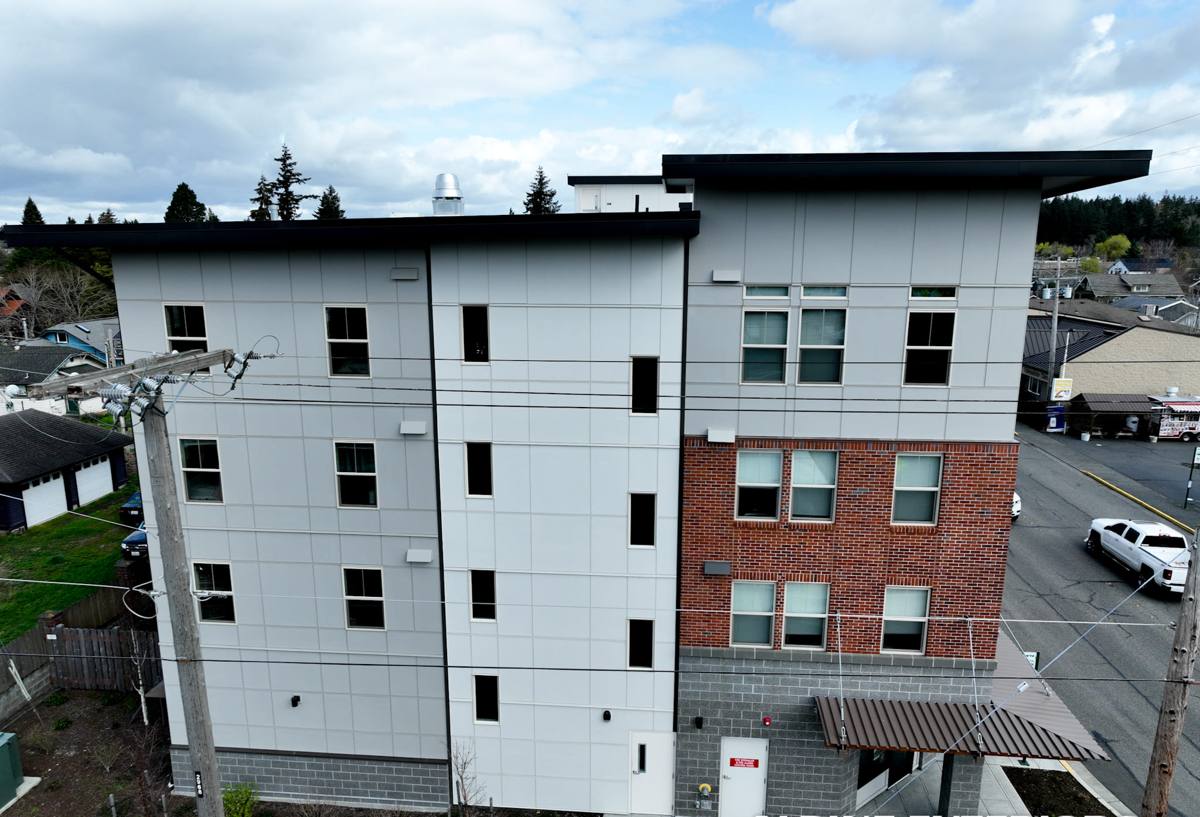
 Lynden Exterior
 Siding Repair for Aldergrove Homes: Why the Details Matter
Aldergrove sits just across the border from Lynden, close enough that the Aldergrove-Lynden crossing is the most direct way between the two — and close enough that homes on both sides deal with the same weather. Salt-tinged marine air moves through this part of the Fraser Valley and northern Whatcom County alike, driving rain comes in sideways more often than straight down through fall and winter, and a moss season that can run most of the year settles into shaded siding and north-facing walls. That combination is hard on any exterior cladding, and it's exactly the kind of climate where a poorly done siding repair fails again within a couple of wet seasons instead of actually solving the problem.
We work in Aldergrove regularly, not as an occasional add-on to our Whatcom County service area but as a normal part of the territory we cover from Lynden. On siding, we install and repair James Hardie fiber cement exclusively — that's a professional standard, not a sales position, and it shapes how we approach a repair call as much as it shapes a full replacement. This page is about siding repair specifically: what local homes actually need from it, what a correct repair job involves, and why it matters to hire a crew that already knows this area instead of someone driving in once and moving on.
What This Climate Puts Siding Through
Salt Air
Even away from the immediate coastline, marine air carries salt inland across this stretch of the Fraser Valley and northern Whatcom County. Over years, that accelerates corrosion in fasteners, flashing, and lower-grade trim hardware. On a repair job, that shows up as rust-streaked panels, corroded nail heads that have let go of the siding, or flashing that's thinned out enough to stop shedding water the way it should.
Driving Rain
Wind pushes rain sideways into wall assemblies more often than it falls straight down, especially through the wetter months. That sideways load finds its way into any gap, open joint, or failed caulk line, and it's usually the real reason a repair call comes in — not because the siding material itself failed, but because water got behind it at a seam, a butt joint, or a trim intersection.
A Long Moss Season
Mild temperatures and near-constant moisture add up to a moss and mildew season that can stretch across most of the year on shaded or tree-sheltered walls. Moss holds moisture against a wall long after the surrounding siding has dried out, and on porous or damaged material that constant dampness is what turns a cosmetic problem into a structural one underneath.
The Repair Issues We See Most Often
Most repair calls trace back to one of a handful of recurring problems, and figuring out which one you're dealing with is the first real step in any repair — not the color match or the patch itself.
Cracked or Open Caulk Joints
Caulk is the first line of defense at butt joints, trim intersections, and penetrations, and it's also the first thing to fail as it ages, shrinks, and separates from the surfaces it was sealing. Once it opens up, wind-driven rain has a direct path behind the siding.
Water Intrusion at Joints and Trim
Butt joints, window and door trim, and roof-to-wall transitions are the highest-risk spots on any siding system. When water gets behind the cladding at one of these points, it can travel and cause damage well away from where it actually entered — which is why a repair that only addresses the visible stain often misses the real source.
Impact Damage and Cracked Panels
Storm debris, fallen branches, and everyday accidents crack or chip fiber cement panels. Fiber cement doesn't dent like some materials, but it can crack under a sharp impact, and a cracked panel that's left alone gives moisture a direct entry point it wouldn't otherwise have.
Nail Pops and Fastener Failure
Fasteners that were driven at the wrong depth, spaced incorrectly, or that have corroded over time can work loose or pop through the face of a panel. Beyond the cosmetic issue, a loose fastener leaves an unsealed hole in the siding right where water pressure is highest during a storm.
What a Correct Siding Repair Actually Involves
A repair that's done right starts with figuring out why the damage happened, not just covering it up. Replacing a stained or cracked board without checking what's behind it is a common shortcut, and it's the reason so many "repaired" sections fail again within a year or two.
- Diagnosing the actual water path, not just the visible damage — a stain three feet from the real leak is common
- Removing enough surrounding material to check the house wrap, flashing, and sheathing underneath for hidden rot or trapped moisture
- Addressing the root cause — failed flashing, an open joint, a missing kick-out — before any new siding goes back on
- Matching the replacement material's profile, exposure, and color as closely as the existing siding allows
- Re-caulking and re-flashing to the same standard as new installation, not a quick bead over the old joint
- Confirming the repair meets manufacturer fastening and clearance specs so any product warranty stays intact
Skipping any of those steps might make a repair look finished, but it doesn't make it actually finished — and on a home dealing with this much sustained moisture, the difference shows up again fast.
Repair or Replace? How We Help You Decide
Not every damaged area needs a full re-side, and not every repair candidate is actually worth repairing. The honest answer depends on how widespread the damage is and what's happening underneath the surface.
| Factor | Repair usually makes sense | Replacement usually makes more sense |
|---|---|---|
| Extent of damage | Isolated to a few panels, one wall, or a specific detail like a trim joint | Spread across multiple walls or showing up in several unrelated spots |
| Sheathing condition | Sheathing underneath is sound once opened up | Sheathing is soft, rotted, or damaged over a wide area |
| Siding age and material | Newer James Hardie siding with a matchable product line still available | Older or discontinued material that can't be color- or profile-matched |
| Underlying cause | A specific, fixable issue — one bad joint, one failed flashing detail | A systemic problem, like a house wrap that's failed broadly behind the siding |
We'll tell you honestly which category your home falls into. Recommending a full replacement when a repair would genuinely hold up doesn't do you any favors, and neither does patching over a problem that's going to keep resurfacing.
Our Siding Repair Process
Inspection
We start by looking at the damage itself and at the areas around it — adjacent joints, trim, flashing, and any signs of moisture that haven't shown up as visible damage yet. A repair estimate that's based on a five-minute look at the obvious problem tends to miss what's actually going on.
Opening It Up
Once we know roughly what we're dealing with, we remove enough of the damaged and surrounding siding to check the substrate directly. This is the step that determines whether we're looking at a straightforward repair or something more involved.
Fixing the Cause
Whatever let water in — a gap in the house wrap, a missing or corroded flashing piece, an open joint — gets corrected before anything new goes back on. Replacing the visible siding without fixing this step just delays the same repair call by a season or two.
Matching and Installing
We install new James Hardie material to match the existing siding's profile and, as closely as possible, its color and exposure, fastened and sealed to the same standard as a new installation.
Final Check
We walk the repaired area with the homeowner, explain what we found and what we did about it, and flag anything else on the wall worth keeping an eye on.
Why We Repair Exclusively With James Hardie Fiber Cement
We install and repair one siding system — James Hardie fiber cement — rather than spreading our crew's expertise across several products. We don't work with LP SmartSide, vinyl siding, Cemplank, Allura, primed spruce, or cedar. Each has its place in the market, but for a climate that puts this much sustained moisture, salt air, and moss pressure on a wall, we'd rather stand fully behind one system than offer a cheaper repair on a material we don't trust to hold up here.
- Non-combustible core: a real factor for both safety and insurance underwriting, on new installation and repair work alike
- Factory-applied ColorPlus finish: holds color and adhesion far better under sustained moisture and UV exposure than a field-applied paint job on a patched section
- Climate-engineered HZ product lines: formulated for regions with heavy moisture exposure and freeze-thaw cycling, which describes this area well
- Dimensional stability: doesn't swell, cup, or warp the way engineered wood siding can after repeated wetting cycles, which matters when you're trying to match a repair to existing boards
- A strong transferable warranty: provided the repair is done to Hardie's published installation spec, which we treat as the baseline rather than an upsell
Signs Your Aldergrove Home Needs a Siding Repair Now
- Cracked, chipped, or missing sections of siding after a storm
- Caulk that's visibly cracked, shrunk, or pulled away from a joint or trim piece
- Moss or dark staining that returns quickly after cleaning, especially on shaded walls
- Soft or spongy siding, particularly near the ground or around window and door trim
- Rust streaking running down from fasteners or trim hardware
- Nail heads visibly popped through the face of a panel
- Musty odors or staining on an interior wall that backs up to exterior siding
Any one of these is worth a look before the next wet season turns a small, cheap repair into a much bigger one.
Why It Matters to Hire a Crew That Already Works Aldergrove, BC
Siding repair is diagnostic work as much as it's installation work, and that diagnosis gets better with repeated, local experience. Working this area regularly means we've seen how houses on both sides of the Lynden-Aldergrove crossing actually age — which wall orientations hold moisture longest, which older siding products in this area are prone to which failures, and which repair shortcuts tend to come back as a second call a year or two later. A crew that's only seen your house once, from a quote sheet, doesn't have that context. And when a repair does need a follow-up down the road, it helps to be dealing with a crew that's still working this same area, not one that's moved on to a different region entirely.
If you've got a section of siding on your Aldergrove home that's cracked, staining, or letting water in somewhere it shouldn't, we're glad to come take an honest look and give you a straightforward, no-pressure estimate. Reach out using the form below to get started.