 Lynden Exterior
 Abbotsford Roofs Work Harder Than Most
A roof in Abbotsford isn't just shedding rain a few months a year — it's dealing with a long, wet coastal season, air carrying salt and moisture off the Strait of Georgia and Puget Sound region, and enough shade and dampness in the Fraser Valley to keep moss actively growing for much of the year. None of that is unusual for this part of the Pacific Northwest, but it does mean a roof installed with generic, one-size-fits-all methods tends to show problems years before it should: soft spots at the eaves, moss ridges along the north slope, granule loss from shingles that stayed wet too long, and flashing that corrodes faster than the shingles around it.
New roof installation done right for this climate isn't about upgrading to a fancier product — it's about choosing materials and installation details that actually account for how much water this roof will see, how long it stays wet, and how much organic growth it will fight off every year.
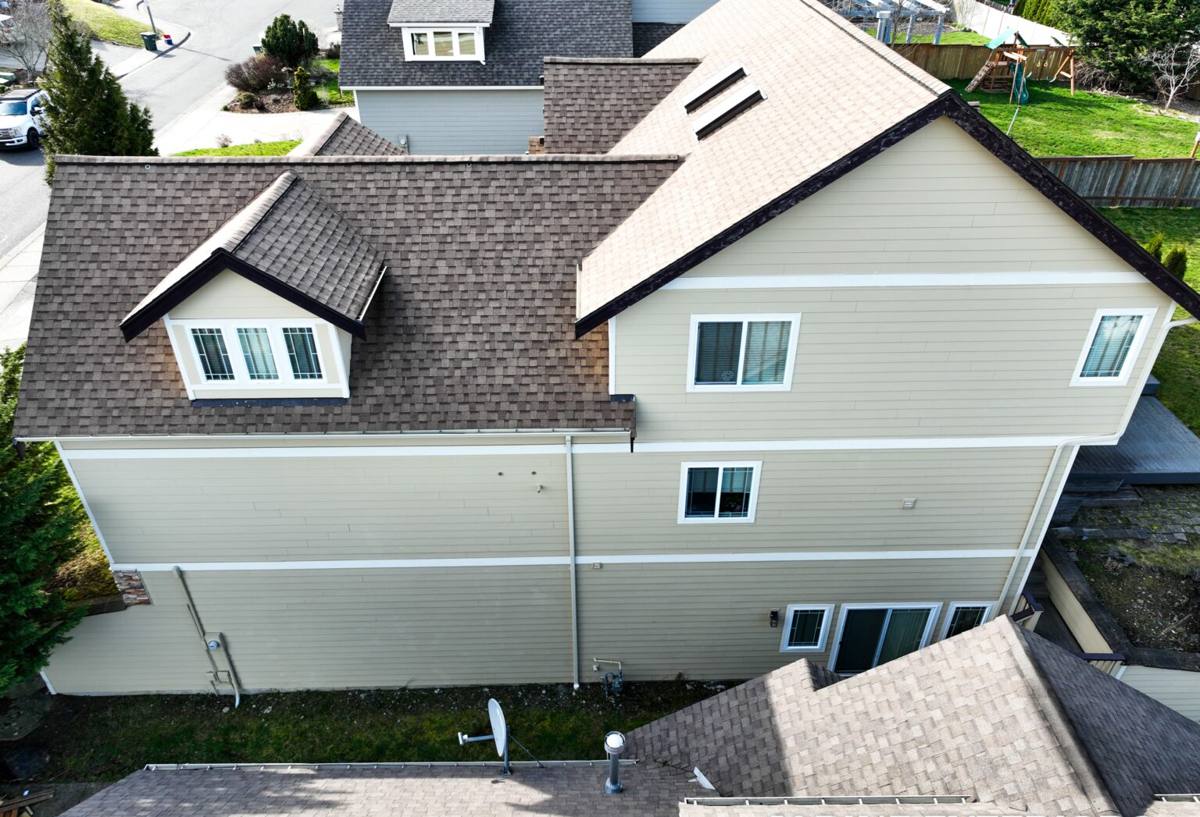
What Driving Rain and Long Moss Seasons Actually Do to a Roof
Driving Rain
Wind-driven rain doesn't just fall straight down — it pushes sideways and up under laps, flashing edges, and fastener heads. On a roof with weak underlayment coverage or shortcuts at valleys and penetrations, that's exactly where leaks start. It's rarely the field of the roof that fails first; it's the transitions.
Moss and Sustained Moisture
Moss doesn't just look bad. It holds water against the roofing material long after a storm has passed, works its way under shingle tabs and edges, and can lift shingles enough for wind to get underneath. On shaded, north-facing, or heavily treed lots — common throughout Abbotsford — moss can establish itself within a couple of seasons on a roof that isn't detailed to resist it.
Salt Air
Proximity to coastal air accelerates corrosion on exposed metal — fasteners, flashing, vents, and drip edge — faster than it would inland. Cheaper or mismatched metal components corrode first, and once flashing starts failing, water finds its way in even if the shingles above look fine.
What a Correct New Roof Installation Involves
A proper tear-off and re-roof is a sequence, and skipping or shortcutting any step is where most premature failures come from. For this climate, we treat the following as non-negotiable:
- Full tear-off to the deck, with the deck inspected and any soft or delaminated sheathing replaced — not covered over
- Ice-and-water shield at eaves, valleys, and around every penetration, not just where code minimums require it
- Synthetic underlayment across the full field for a consistent water barrier under wind-driven rain
- Corrosion-resistant flashing at all walls, chimneys, skylights, and roof-to-wall transitions — matched to the roofing material, not generic stock
- Balanced intake and exhaust ventilation so the attic can actually dry out between wet spells
- Proper fastening pattern and nail placement, checked against manufacturer specs rather than crew habit
Any one of these done poorly can undercut an otherwise good roofing product. This is where most of the difference between a roof that lasts and one that doesn't actually comes from.
Choosing a Roofing Material for This Climate
There's no single "best" roofing material — the right choice depends on the home, the budget, and how much moss and moisture resistance matters to the homeowner. Here's how the common options compare for a wet, moss-prone, salt-air-adjacent climate like Abbotsford's:
| Material | Moisture & Moss Resistance | Typical Lifespan | Maintenance |
|---|---|---|---|
| Architectural asphalt shingle | Good, with proper ventilation and algae-resistant granules | 25–30 years | Periodic moss/debris clearing recommended |
| Standing seam metal | Excellent — sheds water fast, nothing for moss to grip | 40–50+ years | Low; occasional fastener/sealant check |
| Cedar shake | Fair — attractive but absorbs moisture and needs active upkeep in wet climates | 20–30 years with maintenance | High; regular treatment and moss removal |
| Synthetic/composite shake or slate | Very good — moisture-stable material with a natural look | 40–50 years | Low |
We'll walk through these trade-offs honestly during your estimate rather than pushing whatever has the best margin. For a lot of Abbotsford homes, the deciding factor isn't the shingle itself but how much shade the roof sits under and how exposed it is to wind-driven rain off open ground.
Our New Roof Installation Process
- On-site inspection. We look at the current roof, the deck condition where accessible, attic ventilation, and any moss or water staining patterns that point to recurring problem areas.
- Honest scope and estimate. You get a clear breakdown of material options, what the tear-off will likely reveal, and a real number — not a lowball that grows once the crew is on the roof.
- Tear-off and deck inspection. Old material comes off completely so the deck can be checked and repaired where needed before anything new goes down.
- Underlayment and flashing installation. This is where most of the long-term water resistance actually comes from, and where we spend the extra time.
- Roofing material installation. Installed to manufacturer spec, with attention to fastening, exposure, and alignment — not just speed.
- Ventilation check and cleanup. We confirm intake and exhaust are balanced, then do a full site cleanup, including a magnetic sweep for stray fasteners.
- Final walkthrough. We go over the finished roof with you before calling the job done.
Ventilation: The Step That's Easy to Skip
In a climate where the attic space stays humid for long stretches, ventilation isn't optional. Without balanced intake at the soffits and exhaust at the ridge, moisture gets trapped under the deck, which shortens the life of the roofing material from underneath — the opposite direction most homeowners are watching. Poor ventilation also raises the risk of condensation-driven rot and can quietly void manufacturer warranties, since most roofing warranties assume proper attic airflow. We check and correct ventilation on every install, not just when a homeowner asks about it.
Signs Your Roof Needs Replacement, Not Another Patch
Repairs make sense for isolated damage. A full new roof installation makes more sense when the underlying material and flashing system are simply worn out. Signs worth taking seriously:
- Granule loss heavy enough that shingles look patchy or bald in spots
- Moss established along ridges, valleys, or the north-facing slope
- Curling, cupping, or cracked shingles across multiple areas, not just one spot
- Recurring leaks in different locations after repairs
- Visible sagging in the roofline or soft spots underfoot on the deck
- Flashing that's rusted, lifting, or separating from walls and chimneys
- The roof is at or past the material's expected lifespan and the last close inspection was years ago
If you're only seeing one or two of these, a repair may still be the right call — we'll tell you that plainly rather than pushing a full replacement you don't need yet.
Why It Matters That We Already Work in Abbotsford, BC
Roofing crews that only occasionally cross the border into the Fraser Valley tend to treat every job as a one-off — figuring out material suppliers, permitting expectations, and site logistics on the fly. Working Abbotsford regularly means we already know what this specific area's roofs are up against: which neighborhoods sit under heavier tree cover and see faster moss growth, which lots catch more wind-driven rain off open exposure, and which flashing and fastener grades hold up against the salt-tinged coastal air rather than corroding out in a few seasons. Based just south of the border in Lynden, Washington, we're close enough to be responsive and familiar enough with the area to skip the learning curve other crews charge you for.
What Affects the Cost of a New Roof
| Factor | Why It Matters |
|---|---|
| Roof size and pitch | More surface area and steeper slopes increase material and labor time |
| Material choice | Asphalt, metal, and synthetic products vary significantly in material cost and install time |
| Deck condition | Rot or soft sheathing found at tear-off adds repair work before install can proceed |
| Number of penetrations | Chimneys, skylights, and vents each require additional flashing detail |
| Ventilation upgrades | Adding or correcting intake/exhaust venting adds modest cost but protects the investment |
| Access and site conditions | Steep lots, limited driveway access, or tall trees can affect setup and disposal logistics |
We don't quote a number without seeing the roof first — anyone who does is guessing, and that guess usually changes once the crew starts tearing off material.
Get a Straight Answer on Your Roof
If your roof is showing moss, granule loss, or recurring leaks, it's worth getting an honest, no-pressure look before deciding between another round of repairs and a full replacement. Fill out the form below for a free estimate on new roof installation in Abbotsford, BC — we'll tell you what we actually see, not just what sells a job.